
Europe once organized its economic balance around a seemingly stable scenario in which Germany would manufacture and export, sustaining the continent’s industrial core, while the other economies orbited around that center with varying degrees of dependence. That model, which worked in the past to a certain extent, is now sliding into a crisis.
Although Germany has faced years of sluggish growth, the core issue isn’t in Berlin. The most pressing worry is that Europe’s manufacturing powerhouse is losing ground to China. Teresa Ribera, Vice-President of the European Commission, recently highlighted this trend in Agenda Pública, describing China as “an industrial power growing at breakneck speed.” If Germany fails to adjust to this new global industrial reality, the consequences will extend far beyond its borders, reaching other nations such as Spain, which could end up in a new arrangement of technological and industrial dependence on Beijing.
“The German export model is no longer competing against an emerging economy in need of European technology, but against an industrial superpower capable of displacing Europe”
In a report released this month by the Centre for European Reform (CER), titled China Shock 2.0: The Cost of Germany’s Complacency, Sander Tordoir and Brad Setser sound strong warnings about the magnitude of the Chinese challenge for Europe. The central thesis presented by the authors is that the German export model is no longer competing with an emerging economy dependent on European technology, but against an industrial superpower capable of distancing Europe from China, from third markets, and gradually from the European market itself.
Germany no longer understands its own crisis
Despite a multitude of warnings, Germany’s first problem has been misreading its own situation. Neither Olaf Scholz’s previous government nor the current Chancellor, Friedrich Merz, has shown the ability to correctly identify the country’s economic and industrial challenges.
The debate in Germany remains fixated on energy prices, European bureaucracy, and climate regulation. The new CER report dismantles much of that narrative and demonstrates that other European nations subjected to exactly the same regulatory framework (including the Netherlands, Poland, and Denmark) have grown much faster since 2019.
“About 40% of Germany’s economic deterioration derives directly from the loss of foreign markets”
The core difference lies elsewhere: exports. According to CER’s calculations, roughly 40% of Germany’s economic decline stems directly from the loss of foreign markets. Another 40% is tied to the energy shock following the break with Russia. Consequently, only about 20% of the downturn can be attributed to internal factors such as bureaucracy or weak domestic demand.
Among the wide range of consequences, the labor market stands out as particularly alarming. The European heavyweight could lose more than 400,000 jobs tied to its export relationship with China. Why? Because the industrial complementarities between the two countries have disappeared.
During the first Chinese shock, after Beijing joined the WTO in 2001, Germany benefited enormously by selling machinery, vehicles, and related goods to an economy in China that still depended on imports of advanced technology. Today, China Shock 2.0 works in the opposite direction: China no longer requires much European engineering but competes with it directly.
China’s export machinery
The current dynamic is rapidly tilting toward a dangerous imbalance. While China’s exports grow much faster than global trade, its manufacturing imports have remained essentially stagnant for a decade.
China absorbs global demand without opening its domestic market to an equivalent extent, and its expansion has been driven by three major factors:
- Massive industrial subsidies.
- Artificially depressed domestic demand.
- A persistently undervalued exchange rate.
The IMF estimates that Chinese state subsidies amount to about 4.4% of its GDP, around $800 billion per year. At the same time, excess domestic savings and weak domestic consumption push industrial overcapacity to be exported abroad. The result is mounting pressure on strategic European sectors, from automotive and machinery to renewables and clean technologies.
In that regard, the electric vehicle has become the most visible symbol of change. Europe assumed for years that it would have time to adapt to electrification, but China reached enormous export capacity ahead of schedule. Projections of 10 million vehicles exported by the end of the decade were already outdated by 2025.
Meanwhile, the United States has sharply tightened its trade policy. The Trump administration has imposed higher tariff barriers and reduced incentives for European vehicles, closing off one of the few markets where Germany could still partially offset its losses in Asia. As a result, Europe and China have entered direct competition for the remainder of the global market.
Spain enters the Chinese equation
In this newly configured landscape, Spain stands to gain considerably but also faces real risks. The Spanish economy has been seeking to enhance its industrial weight within Europe, and today it has an opportunity for reindustrialization, anchored in two central axes: the energy transition and the electric vehicle.
Faced with that situation, the prospect of Chinese investments in Europe’s green technology and energy sectors invites reconsideration of where Spain’s efforts should be directed.
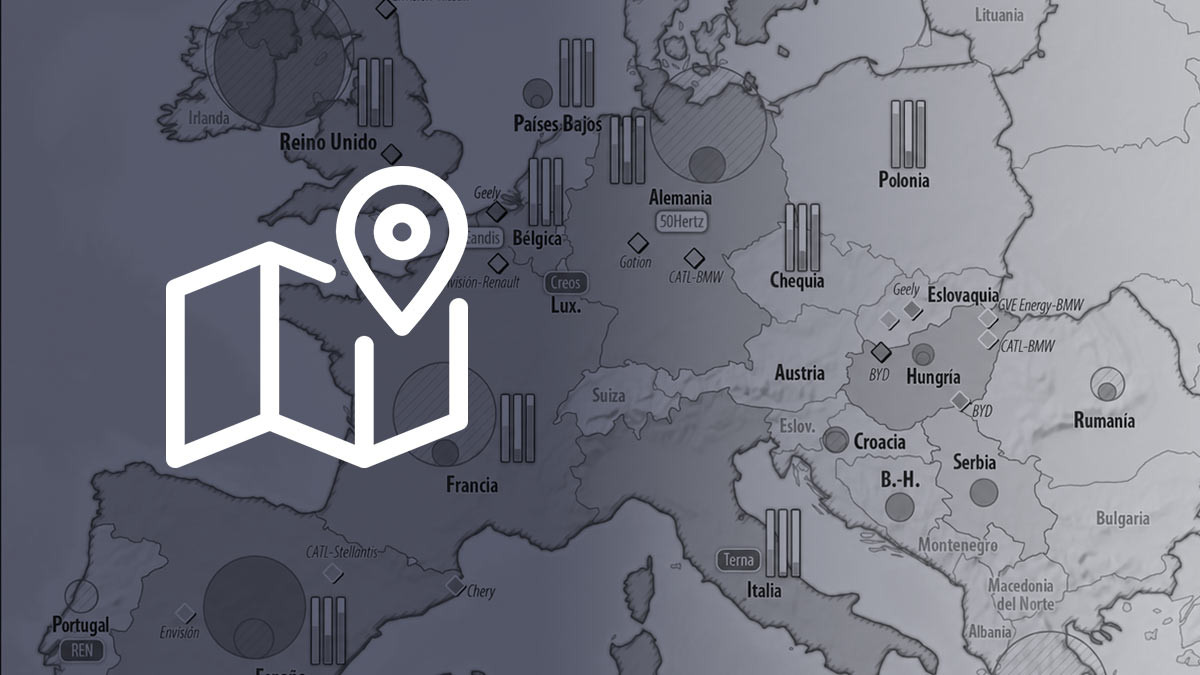
Hover over the map to zoom. European distribution of Chinese investments in green technology and energy sectors. Spain is among the main destinations for projects linked to batteries, electric cars, and industrial transition. | Map: Cassini
As the Cassini map shows, Spain is rapidly becoming one of Europe’s top destinations for Chinese industrial projects tied to batteries, electric cars, and low-carbon technologies.
Chinese firms such as CATL, Chery, and Envision are aiming to use Spanish territory as a production platform for the European market. Spain’s appeal rests on three pillars: 1) comparatively competitive labor costs; 2) full access to the single market; and 3) European subsidies and an urgent political imperative to attract industrial investment.
In the short term, that strategy can generate both jobs and manufacturing activity. But drawing on Europe’s accumulated experience, an urgent question arises: Who will actually control the added value of technology?
The myth of Chinese technology transfer
The idea that Chinese foreign direct investment through technology transfers can serve as Europe’s industrial rescue is now being challenged by empirical evidence. According to the CER report, those expectations are overly optimistic in two respects: first, regarding the strategic intentions of Chinese companies; and second, regarding Europe’s own industrial capacity.
While many European capitals hope that a surge of Chinese manufacturers will assist the revival of weakened sectors, the data hint at a far less symmetrical dynamic. Chinese investment in Europe remains relatively modest—about €10 billion in 2024—and highly selective, concentrated mainly in knowledge-intensive and high value-added industries.
Thus the objective has not been to create new and complete European industrial chains; instead, the dominant pattern has been to acquire existing technological capabilities. The report cites research covering more than 160,000 companies in 159 countries and identifies a particularly striking fact: around 41% of Chinese foreign investments between 2012 and 2021 were directed to Europe and were concentrated precisely in knowledge-intensive sectors.
“Acquired European companies have experienced a drop of roughly 25% in return on assets, plus stagnation in their patenting activity”
Given that figure, we can focus on some post-acquisition effects. Acquired European companies have posted a decline of roughly 25% in return on assets, with their patenting activity stagnating. Meanwhile, Chinese parent firms have increased their patenting activity, with patents granted tripling overall and quadrupling in the case of state-owned enterprises. The report’s authors argue that this isn’t simply due to market choices. Rather, it suggests that many Chinese companies willingly accept lower financial returns because their true strategic aim is to accelerate the absorption of technology, engineering capabilities, and industrial know-how back to their home country. In other words, the prevailing logic isn’t technology diffusion from China to Europe, but precisely the opposite.
The report also warns that this experience should temper European expectations about future Chinese greenfield investments in batteries or electric cars. Historical evidence again indicates that Chinese companies will tend to safeguard their key technologies, even when manufacturing within Europe.
Nor have the 27 EU Member States been using all their available tools. China built its automobile industry using tools that Europe barely employs today: high tariffs, mandatory joint ventures, restrictions on foreign ownership, and stringent demands around industrial location. Beijing leveraged market access to compel Western multinationals to transfer technology and productive capacity. Europe, by contrast, continues to offer one of the world’s most open markets, but without equivalent instruments for industrial negotiation.
European ingenuity
Therefore, Europe’s problem is that it confronts China with too few instruments. Brussels has stepped up trade investigations and sectoral tariffs, especially against Chinese electric vehicles—that much is true. But these measures are slow-moving, fragmented, and limited in the face of the systemic distortions generated by the entire Chinese economy.
“The country can attract investment and factories, but if it fails to develop its own technological capacity, it could be reduced to peripheral functionality”
Moreover, Germany continues to curb a more aggressive European industrial policy, fearing retaliation and hoping to keep access to the Chinese market. Paradoxically, France and certain sectors of the European Commission have begun to argue more clearly for Buy European policies, local-content requirements, and strategic protection mechanisms.
The risk for Spain becomes particularly clear. The country can attract investment and factories, but without cultivating its own technological capacity and a coordinated European industrial policy, it risks being relegated to a peripheral role within value chains managed from Asia.
Deindustrialization and irrelevance
The grand European illusion was the belief that it could simultaneously maintain absolute openness to trade, depend on external energy sources, and preserve strategic autonomy. That balancing act is over. Germany’s crisis demonstrates that even Europe’s leading industrial power can quickly fall behind a competitor backed by continental scale, massive subsidies, and long-term planning.
Spain still has room to leverage parts of the ongoing industrial reconfiguration. But there’s a fundamental distinction between reindustrialization and becoming an assembly hub dependent on foreign technology.
Germany’s complacency in the face of China Shock 2.0 is no longer just a German issue. It is redefining Europe’s entire industrial equilibrium, and in this scenario, Spain is not on the fringe. The country is moving straight into the heart of Europe’s geo-economic chessboard, with all the risks and opportunities that such a move entails.
