

Disinformation has become one of the central themes of our democracies. There is much debate about it, about how to fight it and curb its effects, but citizens are rarely asked how they perceive it and what stance they take towards it. The latest CIS barometer, from May 2026, delves into that terrain and what it finds is highly relevant.
From it emerges that 91.7% of Spaniards believe there are political parties that use disinformation as a weapon. When asked spontaneously which ones, without being shown any options, the most repeated name is a single one: Vox. It is named by 34.2% of the sample. Ahead of the PSOE (23.7%) and more than four times the figure for the PP (7.7%). The CIS barometer thus sketches a map that the Spanish political system has been unwilling to confront for years: there exists a disinformation project with an identifiable producer, an identifiable amplifier, and an identifiable beneficiary.
The 86% Mirage
The surface reading of the study invites optimism about regulation. 86% demand stricter rules on the diffusion of hoaxes; 85.1% consider disinformation a threat to democracy; 88% demand mandatory codes for digital platforms; and 84.3% see verifiers as necessary. With figures like these, any legislative initiative would seem to have a clear field.
But it is far from being the case. The key lies in a datum that the very survey shows: 20.3% of those who acknowledge that there are parties that disinform respond “all of them,” and another 11.6% do not know or do not answer.
“Almost a third of the citizenry has given up discriminating between sources and identifying the responsible party”
In total, nearly one third of the citizenry has renounced distinguishing between sources and pinpointing the accountable. That renunciation, which is not neutral, acts as a blocking attitude toward any regulatory intervention, in the sense that every law would inevitably appear partisan to someone who starts from the premise that everyone lies equally.
The Identified Producer
The responses of the public in the CIS barometer point to a reality: the disproportionate volume of false or manipulated content that comes from the Vox–far-right ecosystem. This pattern is not limited to the party’s official accounts; it is woven through a broader network that includes media satellites, digital coordination dynamics, intensive diffusion on platforms like X or Telegram, and the activity of autonomous figures linked to that political space and ideology.
The bloc-based distribution reinforces this diagnosis. Voters for Sumar point to Vox in 74.6% of cases; those for ERC, in 75.4%; those for EH Bildu, in 75.1%; those for the BNG, in 61.9%; and those for the PSOE, in 58.9%. It is not just polarization, but a broad sociological majority, spanning across different political families, that converges on identifying the same actor. The traditional-right, which attributes responsibility to the PSOE in 51.5%, does not deny this pattern; it shifts it strategically, constructing an equivalence that avoids compromising its potential ally on the right flank. That equivalence, in itself, is the rhetorical operation that sustains the opacity of disinformation.
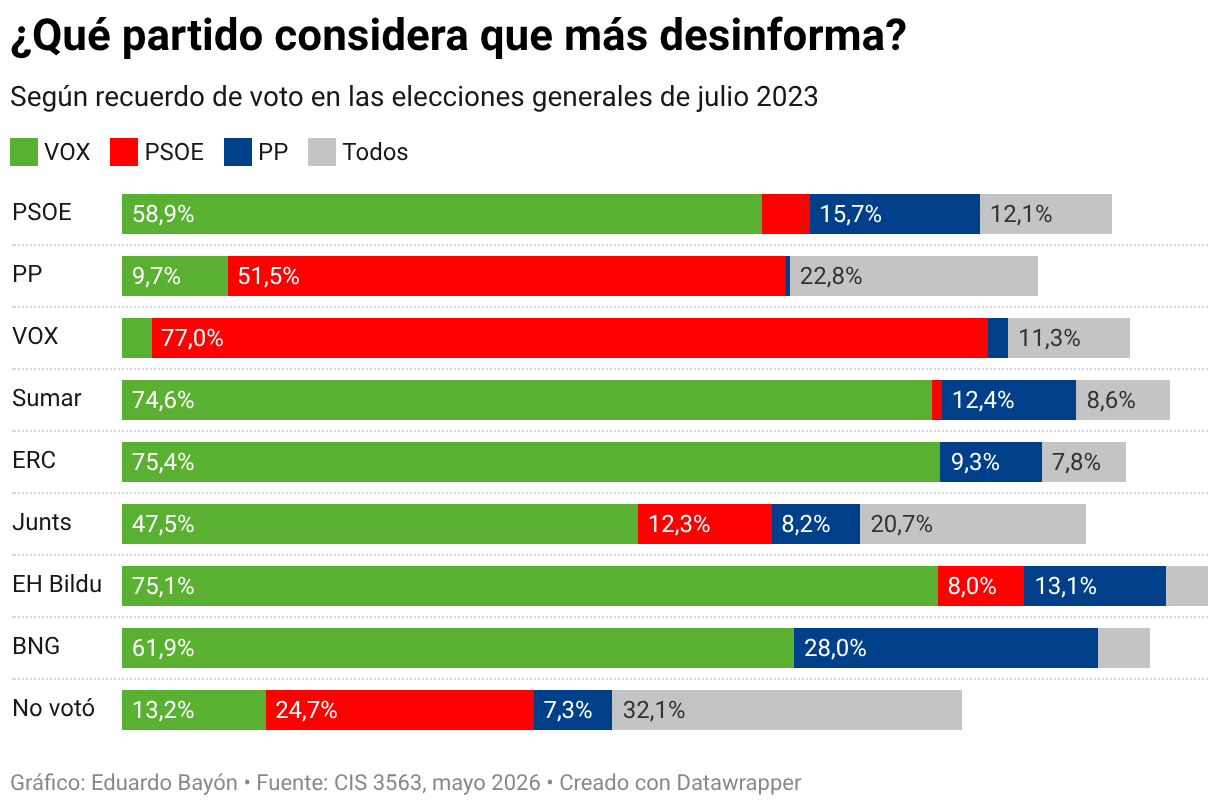
Three additional elements reinforce the identification of the producer. The first is regulatory exceptionalism: among Vox voters, 27.8% reject stricter regulation, 29.7% oppose verifiers, and 28.5% oppose imposing obligations on platforms. It is the only electoral bloc that systematically sits outside the consensus. The PP voter, by contrast, remains largely in favor of regulation (75.7%). The split is not left-right; it is Vox versus the rest of the democratic spectrum.
The second is the perceived impact on hate: 22.6% of Vox’s electorate believes disinformation “has no influence” on anti-immigrant hate, compared with 1.5% for the PSOE and 1.4% for Sumar. The gap is structural and hardly reducible to a mere ideological disagreement: where the rest of the political system identifies a documented effect, that segment denies it.
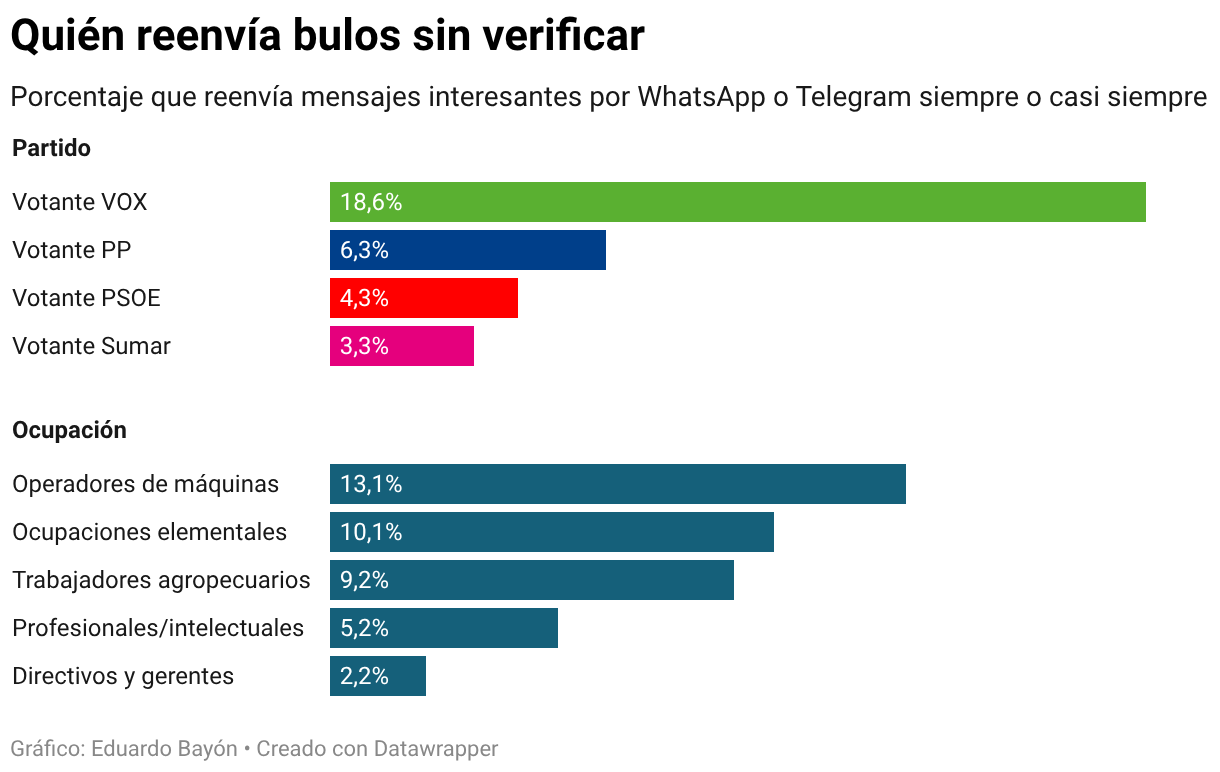
The third is active forwarding: 18.6% of Vox voters admit to always or almost always forwarding messages via WhatsApp or Telegram without checking, compared with 4.3% in the PSOE. It is not just exposure to the hoax; it also involves participation in its circulation. This obliges us to nuance the usual diagnosis about the production and diffusion chain of disinformation.
The Amplifier: The Social Inequality of the Hoax
The hoax originates in a concentrated political pole, but circulates with unequal effectiveness depending on the sociolaboral structure. Here appears a second asymmetry of the Spanish system, less visible in the public debate, but key to understanding the dynamics of disinformation.
“The pattern is consistent: the lower cultural capital and greater dependence on unmediated digital channels, the higher the likelihood of amplifying unverified content”
The frequency of forwarding unverified messages, broken down by professional category, draws a sharp slope. Among executives and managers, 2.2% report always or almost always forwarding; among professionals and intellectuals, 5.2%. The figure rises to 9.2% among agricultural workers, to 10.1% in elementary occupations, and reaches 13.1% among plant and machinery operators. The pattern is consistent: lower cultural capital and greater reliance on unmediated digital channels leads to a higher probability of amplifying unverified content.
The consumption of political humor on social networks reinforces this map. While 38% of all respondents say they consume it regularly, the share rises to 73.2% among students, to 51.9% among service workers, and to 50.3% in elementary occupations. Among executives it is 32.4%, and among retirees it drops to 15.5%, a group that remains more dependent on television, still subject to editorial codes. Social networks are the space where the information battle is currently fought. And they are the popular and youth territory.
The conclusion, therefore, is that the professional elites produce the diagnosis —“Vox disinforms”— and distance themselves from the problem, while the hoax circulates in digital ecosystems. Professionals and intellectuals point to Vox at 47.3% and PSOE at 18.3%, a ratio of 2.6 to 1. In elementary occupations the situation reverses: 28.7% point to PSOE and only 10.9% to Vox. The diagnosis of who disinforms does not respond solely to the ideological axis, but also to social and cultural position and the type of information ecosystem in which one is embedded.
“Disinformation not only spreads; it adapts to the spaces where it encounters less friction”
This does not imply a lower critical capacity among the popular classes, but rather differential exposure: greater presence in closed messaging channels such as WhatsApp or Telegram, less access to paid media and less interaction with verifiers. Disinformation not only spreads; it adapts to the spaces where it encounters less friction.
In this sense, the Vox disinformation project is not merely an ideological operation: it is an operation that colonizes sociolaboral spaces to which, today, verified journalism and institutional parties do not reach. When the union does not reach the warehouse worker, when public media does not compete on TikTok, when the parliamentary left speaks with institutional or academic language, the WhatsApp hoax occupies that vacuum effectively, and it does so because it is free, emotional, communal, and seemingly spontaneous.
The consequence is political. Combating disinformation cannot be framed solely in regulatory terms, because the problem is not only one of supply, but also of circulation and trust. Without intervention in the channels and communities where content is distributed, any strategy will be incomplete. It is not just about limiting the production of the hoax, but about contesting the environments in which it is amplified.
Humor as Narrative Contraband
There is an additional cross-cut that completes the picture. 55.7% of Spaniards reject that humor serves to introduce falsehoods into political debate. Yet, 45.9% of Vox’s electorate consider it acceptable —the highest share on the political spectrum, followed by Sumar with 41.1%—, suggesting that the use of a humorous register as an argumentative vehicle is transversal, though with different functions depending on the ideological space. Where the divergence becomes more pronounced is in the perception of restriction: 51.3% of Vox voters believe humor is “much more limited” than a decade ago, compared with 37.8% of the PP, 12.2% of the PSOE and 9.2% of Sumar.
The narrative of “you can’t say anything” or “you can’t express opinions as before” operates as a framework of legitimation. It allows reframing hate-speech regulation as a form of cultural censorship, shifting the axis of the debate from content to the supposed restriction of freedom of expression. In this context, certain formats — memes, audiovisual montages, or satirical pieces — function as vehicles for disseminating false or misleading content that are partly protected by their humorous encoding.
“Content moderation becomes censorship, verification becomes bias, and the debate about disinformation becomes a conflict over freedom of expression”
In this manner, content moderation becomes censorship, verification becomes bias, and the debate about disinformation becomes a conflict over freedom of expression. While part of the progressive space debates the limits of humor in normative terms, other actors use that same register as an effective channel for circulating narratives that are difficult to introduce through conventional information channels. In other words, they advance in the cultural battle in which we are immersed.
The Way Out
Spain does not face a diffuse problem of disinformation, but rather a more bounded phenomenon: the existence of an disinformation-producing political project with identifiable headquarters, infrastructure, and beneficiaries. The CIS barometer reflects this with unusual clarity. The broad consensus —that 86% who call for greater regulation— does not solve the problem; partly, it masks it by allowing each bloc to project responsibility onto the adversary.
The way out is not only regulatory: it is, essentially, political. It involves naming the producer, deactivating the rhetorical symmetry that protects it, and materially contesting the spaces where the hoax circulates. Without that second part, no regulatory reform will reach its objective.
