
In the eighties, when Spain was learning to decentralize, Manuel Clavero said that if one autonomous community received a competence, the others would claim it too, even if they did not quite know what to do with it. The “coffee for everyone” was not a political proposal; it was a complaint about the need to juggle political interests to balance competing claims. However, at that free bar of coffee, nobody debated the quality of the coffee, nor its temperature, nor the time at which everyone took it, nor what happened if someone ended up spilling it on others. Today we realize how much those nuances matter when we observe the external action of the autonomous communities.
“With all the communities projecting outward, the question that remains is whether that momentum is strengthening Spain’s international position”
The communities have been gaining presence and capacity to project beyond their borders for years. What once might have seemed a mere supplement (a few offices in Brussels, a handful of trade missions, a cultural week in Mexico) today constitutes a plan of action linked to attracting investment, promoting the economy, university cooperation, cultural diplomacy, and technological outreach. With all the communities projecting outward, the question that remains is whether this momentum is strengthening Spain’s international position or, on the contrary, is generating dispersion and coordination costs that prevent fully leveraging its potential.
Recent data from the Real Instituto Elcano’s Global Presence Index show that the autonomous exterior capacity is highly concentrated: Madrid accounts for 28.7% of the autonomous contribution to Spain’s global presence, Catalonia for 21.8%, and the top five communities together around 70% of the total. That concentration reflects the kind of productive and institutional fabric each territory possesses. The Basque Country projects a model of advanced industry (automotive, aerospace, energy, machine tools) with notable clusters at fairs like Hannover Messe and a General Secretariat for Exterior Action that coordinates delegations in 96 countries. Galicia bets on the diaspora, shared culture with Latin America, and agrifood, with Inditex as a gravitational hub. The Valencian Community pivots on port logistics and agricultural export. Andalusia has just approved in November 2025 its first Exterior Action Strategy 2025-2030, acknowledging that until now its projection had been more reactive than planned. The map is not uniform, and that is not in itself a problem; territorial specialization has real value. The problem worsens when that diversity finds no mechanism to articulate it or a common vision to give it meaning.
The Law 2/2014, on the State’s Action and External Service, exists precisely for that purpose. The communities cannot conclude international treaties, assume representation of the State, nor harm its foreign policy. Their outward-looking trips and actions must be communicated to the Ministry of Foreign Affairs, which can issue recommendations on their alignment with the Government’s objectives. That mechanism only works if it is activated, and its activation depends on a political will that is not always present.
“In both cases, the objectives of external action and those of the State’s foreign policy pointed in different directions”
The visit of Isabel Díaz Ayuso to Mexico in May 2026 is the most recent example of what happens when that mechanism fails. The President of the Community of Madrid arrived defending Hernán Cortés and equating the government of Claudia Sheinbaum with authoritarian regimes. In parallel, Spanish diplomacy was working to repair a bilateral relationship with Mexico that had deteriorated for years. The result was that Isabel Díaz Ayuso had to leave the country early; the Spanish government accused her of having gone to Mexico to “try to break diplomatic relations” between the two countries, and the visit produced no weighty agreement, no reinforced trade network, nor any tangible external benefit for either Madrid or Spain. Something similar had happened in February 2026, when Ayuso participated via videoconference in a gala at Mar-a-Lago alongside Javier Milei and María Corina Machado, while the Trump Administration pressed Spain with threats of trade retaliation. Projecting alignment with that scenario while the Spanish Government tried to manage that tension was not territorial diplomacy or Madrid’s economic promotion; it was domestic politics projected abroad. In both cases, the objectives of external action and those of the State’s foreign policy pointed in different directions. That divergence is what the current legal framework seeks to prevent.
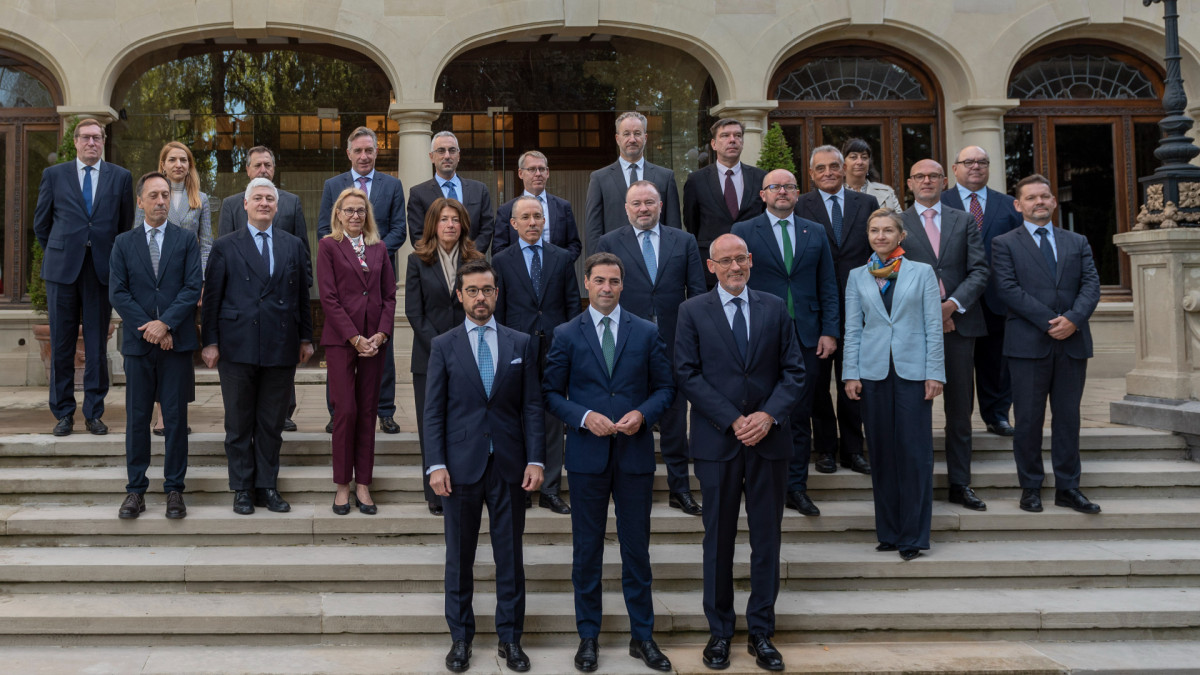
A few hundred kilometers away, another community was exemplifying coordination in foreign affairs. By the end of September 2025, Lehendakari Imanol Pradales received at Ajuria Enea a delegation of twenty-one European Union ambassadors accredited in Spain to present Euskadi’s project as a laboratory of advanced industry with a planned February 2026 European meeting of industrialized regions. In July 2025, Pedro Sánchez and Pradales had jointly chaired the Bilateral State-Basque Country Commission, the first time in history that a Lehendakari and a Spanish prime minister presided jointly over that body. The PNV and the PSOE do not agree on everything, and yet they produced a coordination dynamic that yielded concrete results for both sides. The Basque Country does not renounce having its own ambitious exterior action (it has more foreign offices per capita than any other community), but it coordinates it within a framework where state diplomatic coverage amplifies Basque efforts in third countries and Euskadi’s industrial specialization reinforces Spain’s technological image in European forums where the State does not always have such specific presence. That logic of complementarity, when it works, turns territorial plurality into a real advantage.
“The foreign buyer walking down that corridor gets four different versions of something that could have been articulated as a single, stronger offer”
Outside that kind of coordination, the system tends to fragment. At sectoral fairs such as Fruit Logistica in Berlin or Anuga in Cologne, it’s not unusual to find adjacent stands of the Government of Andalusia, the Generalitat Valenciana, the Region of Murcia, and ICEX, each with its own brand image and its own sales team, exporting many times the same products to the same markets. The foreign buyer walking down that corridor receives four different versions of something that could have been articulated as a single, stronger offer, with greater bargaining power and lower administrative costs. The fragmentation also extends to institutions: in 2025, the Parliament of Catalonia approved the creation of its own Exterior Action Corps, with duties of relations with foreign governments that the Association of Spanish Diplomats considered a violation of the state’s exclusive competence in international relations. The law exists, but the dispute over its application also exists.
That loss of scale is also reflected in the discontinuity of exterior action due to the regional political cycle. The Valencian Community opened, closed, and reopened its Brussels delegation in less than a decade. The Community of Madrid closed its trade office in Shanghai in 2012 and took years to regain that presence. The external partner who has lived through that cycle three times learns not to take that relationship too seriously. The same happens with spending. Regional expenditure on development cooperation has stagnated or declined, averaging around 0.12% in regional budgets, far from the 0.7% reference. National foreign action maintains a nearly centennial policy coherence (with nuances); while regional foreign action begins to crawl, throwing wobbles, depending more on political color than on a shared strategy.
The new Spain’s Exterior Action Strategy 2025-2028 acknowledges that challenge and places emphasis on coherence and joint deployment across levels of government. It is a significant signal, and the document is clearer than its predecessors about the need to integrate autonomous communities, businesses, universities, and civil society into a common projection. The interesting part is that the document itself points to concrete elements such as sectoral conferences with autonomous participation in forming positions before international bodies, the integration of territorial offices into the State’s external network, and shared evaluation frameworks that allow measuring the real return of each initiative. We could say that the strategy tentatively moves toward turning those guidelines into concrete obligations, with calendars, responsible parties, and consequences when they are not met.
“Until the country decides that it wants a coffee maker and not merely a scatter of individual cups, the question of what kind of international presence Spain builds will depend not on one, but on twenty political agendas”
Decades after that coffee for all, autonomous external action has grown without a clear design of who serves whom, at what temperature, when, and with whom. The result is that some tables serve an excellent coffee while others spill it onto other tables. Until the country decides that it wants a coffee maker and not merely a scatter of individual cups, the question of what kind of international presence Spain builds will continue to depend not on one, but on twenty political agendas.
