
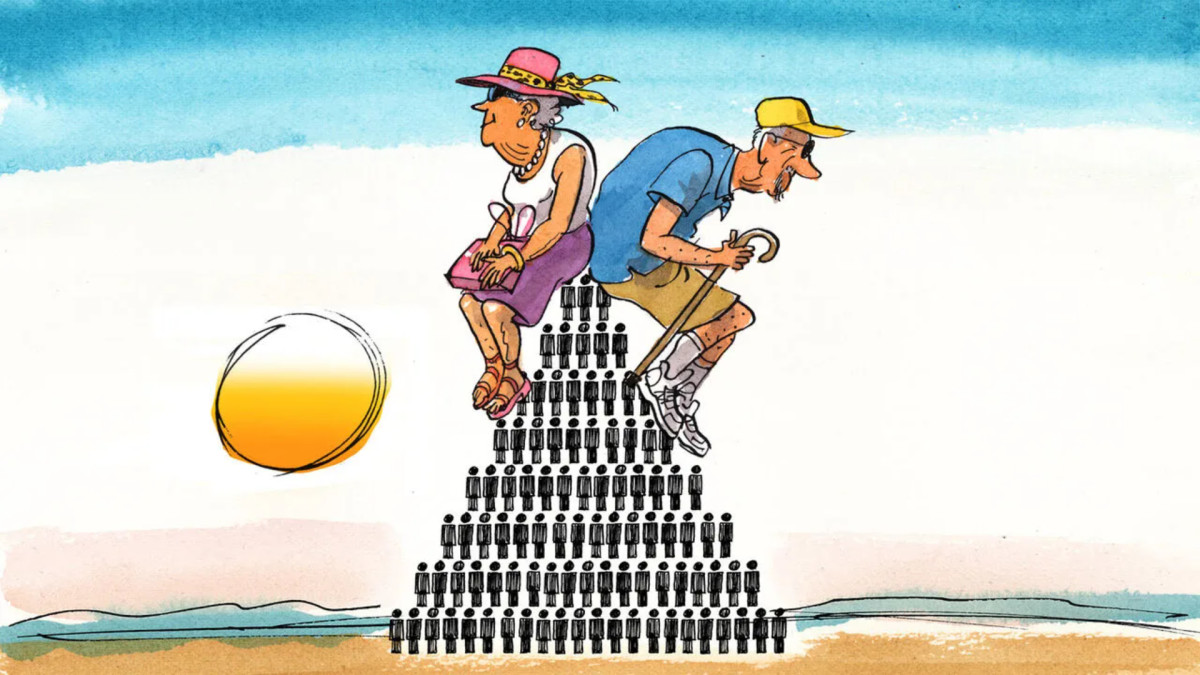
There was a time when inequality in Europe was largely horizontal. The richer western half rode in BMWs and vacationed abroad, while the East, poorer, fixed its own appliances and queued to buy bread. But three decades of convergence growth in the former communist countries have ended the jokes about Romanian cars whose top speed was “downhill.” Today, inequality in Europe has a vertical dimension: one that climbs and descends through family trees. Young people who cannot leave the room they share with their parents because of sky-high housing prices wonder whether they will ever enjoy, as adults, the lifestyle they knew as children. Employed thirty-somethings pay hefty taxes to fund pensions for older people who retired in their prime. The costs associated with aging swallow a quarter of the European Union’s GDP, a figure unlikely to fall as the Old Continent continues aging. Being young in Europe feels like involuntary participation in an intergenerational scam.
If the European welfare state seems like a pyramid scheme, its pharaohs are the baby boomers. The sizable generation born in the two decades after 1945, now aged roughly sixty to eighty (hello, mom! hello, dad!), would like to go down in history as the first in centuries not to initiate a war between parts of the continent. Sociologists will surely celebrate the 1960s, when the boomers attempted to replace chauvinism with rock and roll. Economists will be less forgiving. The boomers granted themselves generous pensions, leaning on demographic trends that later ran out. That cost left Europe languishing. The current generation of grandparents inherited a continent being rebuilt after the war; they will leave one that needs repairs for the damage they helped cause.
“Homeownership used to be the path to financial independence. Now inheritance seems a better bet, if it ever arrives”
The most obvious prize in this intergenerational heist is housing, which the boomers bought cheaply and which now costs millions. Yes, they did it by taking on debt at sky-high interest rates, but they later benefited from house prices continuing to rise after the mortgages were paid. Even adjusted for inflation, housing in Europe has become a quarter more expensive in just a decade, with rents that have also risen faster than incomes. The result, beyond making the boomers feel financially clever when, in truth, they were lucky, is to leave young people out of ownership. The share of Europeans living in their parents’ home well into middle age—not entirely by choice, one might assume, given how good mom’s kitchen is—has risen steadily. Among those born in the eighties, almost a quarter were still living at home at thirty, 50% more than those born two decades earlier. Homeownership used to be the path to financial independence. Now inheritance seems a better bet, if it ever arrives.
Europe is far from the only place where older people live in exorbitantly priced houses. But its cradle-to-grave welfare state has shouldered a larger share of the cost of aging onto the young. In most other rich countries, including the United States, Japan, and South Korea, those over 65 derive a substantial portion of their income from still working a bit and from private pensions funded during their working lives. Europeans retire early, live long, and expect the State—i.e., current taxpayers—to pay the bill for their retirement plans. In the United States, trillions of dollars accumulated in private pensions provided the money for venture capital and private equity funds, which in turn allowed American companies to become giants. In most European countries, today’s pensions are paid by today’s workers, with the expectation that tomorrow’s workers, not yet born, will take over and fund their parents as they age. Part of this is financed with public deficits, which the not-yet-born will also have to pay someday. That implies less capital for European firms, one of the reasons there are so few large players in fields like technology. Instead, a huge unfunded cost remains weighing on public finances.
“In 1960, more than five workers supported each pensioner in Western Europe. Now there are only 2.5 workers per pensioner”
None of this mattered when both the economy and the population were growing so rapidly, as remembered by those born after the postwar years in their youth. But the European population is hitting a ceiling, in large part because the boomers set in motion the trend toward smaller families. In 1960, more than five workers supported each pensioner in Western Europe. Now there are only 2.5 workers per pensioner. The result is that today’s young people know that, at least in part, they will have to arrange their own pension, as Americans do, in addition to paying toward their parents’ benefits when they age. The only other immediate option to improve the workers-to-pensioners ratio is to import a large number of migrants. Yet efforts in that direction have contributed to poisoning European politics, by pushing hard-right populist parties.
Not a continent for the young
No one will fault the boomers for living longer. (Again: a somewhat awkward nod to the columnist’s parents). But an older society is a society that attends to the present, not the future. The median age of voters in France’s most recent presidential elections was 52, partly because older people are more likely than the young to approach the ballot box. That remains within a decade of the effective retirement age. As expected, politicians have made the priorities of the elderly their own. When budgets tighten, there is always money to safeguard pensions and care homes; it becomes much easier to push through cuts in education and innovation. “The future of democracy is decided by more and more voters who have no future,” laments Maxime Sbaihi, economist at Club Landoy, a French demographic think tank.
Things might have shifted after COVID-19, when the young bore years of social restrictions largely to protect the elderly. Unfortunately, that favor has not yet been returned, though today there is a European Commissioner for “intergenerational equity.” Raymond Aron, the French thinker, warned that an aging society would be “haunted by the spirit of abdication.” That weary mood feels all too real for today’s Europeans, as they pass, heads bowed, another nursery converted into a retirement home.
