
The president tramples the rule of law in his rush to glorify himself.
President Donald Trump has long made a habit of naming ventures after himself, from Trump Tower to the Trump National Golf Club, the Trump Taj Mahal casino, Trump University, Trump Steaks, Trump Vodka, and Trump: The Game. Yet as recent weeks have shown, this kind of self-promotion can collide with legal constraints when it requires approval from Congress.
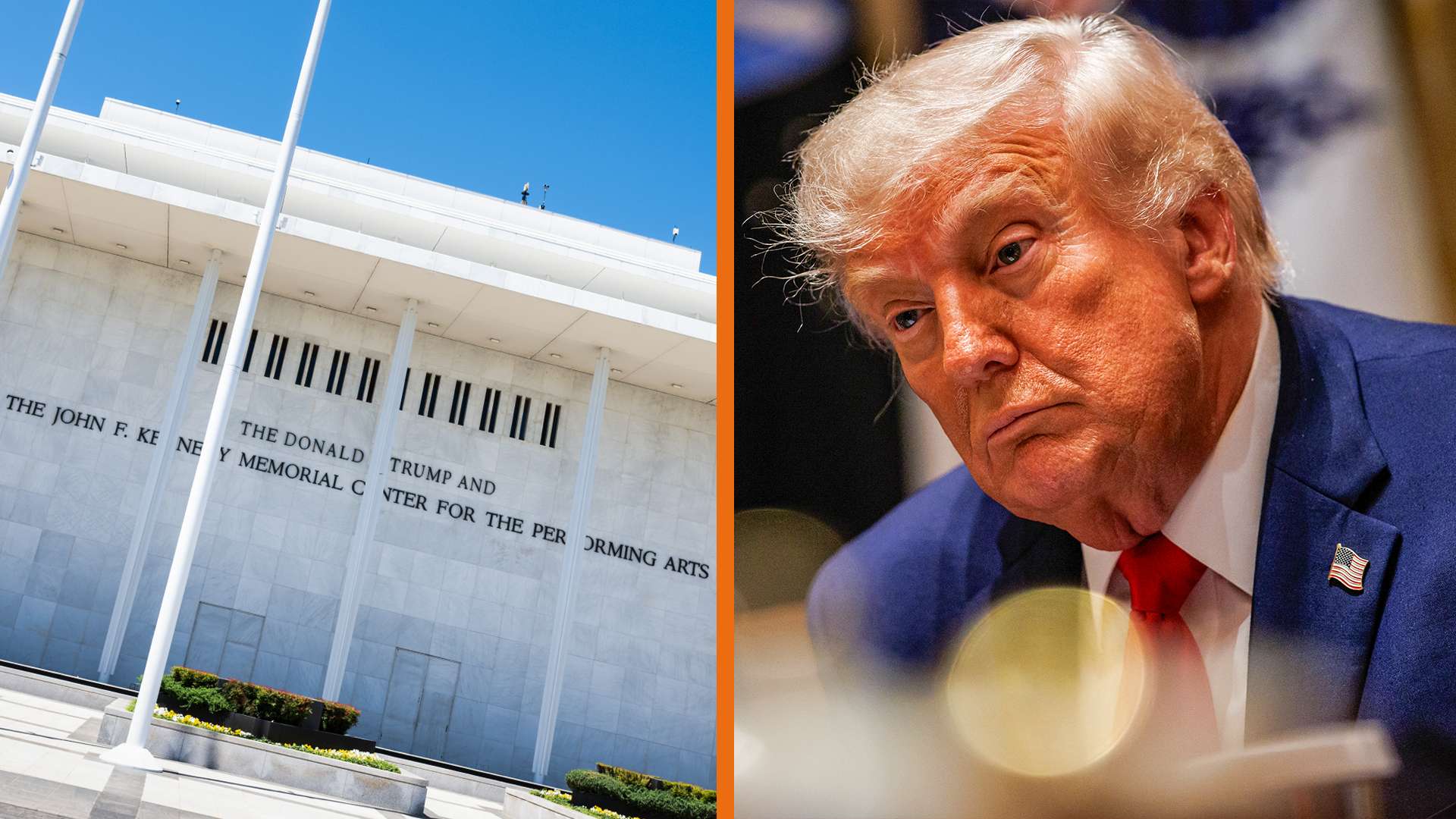
Last Friday, a federal judge determined that the president’s appointees overstepped their statutory authority by affixing his name to the John F. Kennedy Center for the Performing Arts. The ruling served as another reminder of the president’s pattern of flouting the rule of law in his eagerness to magnify his own image.
The Kennedy Center’s Board of Trustees, chaired by Trump and populated with loyal allies, voted to change the name on December 18, and the modification was instantly visible on the building’s exterior lettering. The updated designation also appeared on the center’s website, logo, and emails.
“Not so fast,” asserted U.S. District Judge Christopher Cooper: Congress had expressly set the Kennedy Center’s name, and it alone possessed the authority to alter it. Trump reacted as expected to what he perceived as an affront to his vanity, declaring, “Judge Cooper should be ashamed of himself!”
The insinuation that Trump knows what shame is seemed incongruous with the conduct at issue in the case. And this was far from the only instance in which Trump has courted controversy by leveraging his position to feed his appetite for public adulation.
A few weeks before Trump affixed his name to the Kennedy Center, the State Department announced that the U.S. Institute of Peace, a think tank established by Congress in 1984, would be renamed to honor “the greatest dealmaker in our nation’s history.” That change, which was likewise reflected on the building’s exterior, was similarly difficult to reconcile with federal law.
Trump has also lent his name to a new class of battleships. But unlike the Kennedy Center and the U.S. Institute of Peace, those ships have not yet been constructed and may never receive congressional funding.
The so-called “Trump Gold Card” appears even more problematic. This program, which Trump claimed to authorize in September, was designed to attract foreign investors by granting them permanent residency in exchange for a “contribution” of $1 million to the U.S. Treasury. But because Congress has not approved any such program, the legal justification would require rewriting the EB-1 and EB-2 visa criteria, which depend on qualifications beyond mere wealth.
Nevertheless, the Trump administration established a website offering a place in line for wealthy would-be immigrants who pay a $15,000 “processing fee.” Given the program’s questionable legality, that pledge seems as hollow as the oversized mockup of the Trump Gold Card that the president displayed in the Oval Office last fall, which featured the Statue of Liberty, a bald eagle, a headshot of Trump, and his signature.
Trump’s face and signature are also central to the “commemorative U.S. passports” that the State Department plans to issue soon, purportedly to mark the nation’s 250th birthday. Trump’s signature, but not his face, will appear on American currency as well, occupying the position usually held by the U.S. treasurer—a change Treasury Secretary Scott Bessent calls a “powerful way to recognize the historic achievements of our great country and President Donald J. Trump.”
Both tributes are unprecedented yet legal. The same cannot be said of the fanciful plan to mint a $250 bill bearing Trump’s image, which would violate federal law in two respects: honoring a living person and creating a new denomination.
Last year, Representative Joe Wilson (R–S.C.) introduced legislation that would have eliminated those obstacles and required the Treasury Department to “commemorate the semiquincentennial of the United States” by producing the Trump bills. But that bill went nowhere, underscoring a point that Trump already understood: doing things the legal way is difficult.
© Copyright 2026 by Creators Syndicate Inc.
