
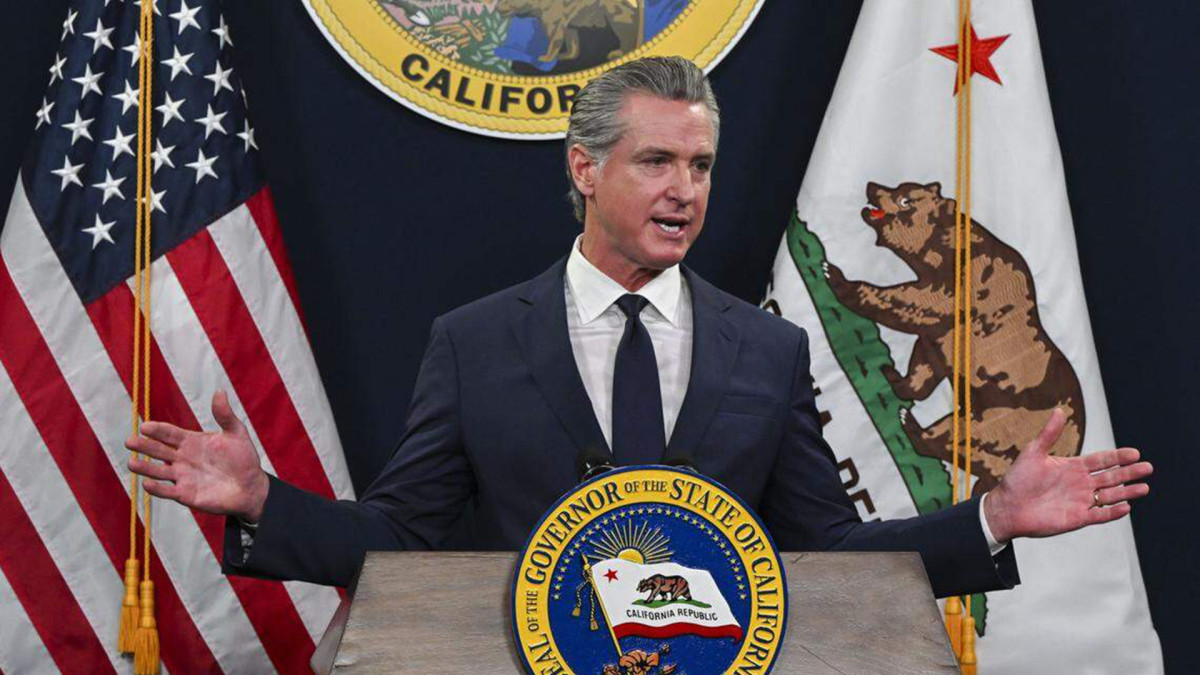
California: the tech mecca, the epicenter of artificial intelligence, the laboratory where the future is tested in the present. Here, the algorithms that decide what we see and what we consume are invented. California is the mecca: the place where technology is invented (and regulated), where artificial intelligence stops being a promise, a temptation, to become a tool of power. Silicon Valley is not just a territory: it is a laboratory that decides how we will live, how we will work, how we will relate. And now, in these primaries, that experiment intertwines with politics: the outcome can determine whether humanity will have a relationship of trust or fear with technology.
The Golden State (the golden state, as it is popularly known) votes and the world watches. It is not an exaggeration. As POLITICO recalls, the regulation of artificial intelligence begins in the state where the most advanced laboratories in the field are concentrated. The veto by Gavin Newsom —the still Democratic governor— of the SB 1047 bill, which sought to impose one of the strictest artificial intelligence regulations in the United States, became a model for other states and a reference for Europe (and the rest of the world). Newsom sent the proposal back unsigned in September 2024, arguing that it was poorly focused and could hamper innovation. Now, with Xavier Becerra (a Democrat and one of the favorites, former Health Secretary under Joe Biden), Tom Steyer (also a Democrat, climate activist) and Steve Hilton (a Republican, former Fox News commentator, backed by Donald Trump and also well positioned in the early results) contending for the governorship, the question is whether California will continue to be the permissive mecca of Silicon Valley or if it will dare to impose tougher limits.
“The tech boom that promises wealth translates into neighborhoods where only the wealthy can live”
But the election also speaks to another wound: housing. Prices in San Francisco, Los Angeles, or San Diego push out entire families, and the tech boom that promises wealth translates into neighborhoods where only the wealthy can live. Steyer bluntly states that he will not allow “workers to lose their jobs while their families are being pushed out of the state.” His plan for AI-specific taxes and a jobs guarantee aims to redistribute what innovation concentrates. Becerra, closer to Newsom’s continuity, bets on investment in training and digital literacy, but without taking on the tech giants head-on (that would be a politically perilous affront in California).
Against this backdrop, the California primaries have become a prologue to the November midterms. In that sense, California is, once again, a kind of political laboratory. As happened in the 1960s with student movements, or in the 1990s with the war on drugs, today it is the epicenter of the discussion about how to coexist with the technology that transforms us. The vote on June 2 will not directly decide the governor, but it can anticipate which options will reach November and whether artificial intelligence will be an unbridled engine or a vehicle with rules. It will also indicate whether housing will remain a privilege or become a right. And, of course, whether the November midterm elections will be fought over innovation or resistance. And in that fracture, as always, California looks at itself and the world looks at it. In short, as Calder McHugh puts it in a piece published in POLITICO, “the election at stake in California could shape the future of AI” — and with it, the future of all of us.
The keys to the California election
The first thing to note is a date: July 10. That will be the day results are certified. But why the long wait if the election was on June 2?
There are four variables to consider. The first is mail-in voting. The majority of electors vote via ballots sent by that method, which can take up to seven days after the election to arrive (if they are postmarked on time). The second is the counting of provisional ballots: they are verified manually, and that delays the tally. The third is the large number of voters: California is the most populous state in the U.S. (with more than 39 million residents) and has more than 22 million registered voters. And, finally, the fourth variable is more of a historical pattern: in past elections, the final results have taken between three and five weeks to complete.
It should also be noted that there is almost a month for counties to deliver final results to the secretary of state. That period serves to count pending votes, i.e., mail ballots, provisional ballots, or military ballots. Therefore, July 10 is the date the results are expected to receive official certification.
Moreover, to understand the complexity of this election, the aforementioned factor is key: the jungle primary or top-two primary system (the two most-voted), in which the two candidates who receive the most votes, regardless of party, advance directly to the general election. That opens up possibilities of face-offs like Democrat against Democrat, or even a Republican sneaking onto the final ballot.
“Hilton has pushed the narrative that ‘California is the world’s crypto and AI capital’. And that could indeed shape the Republican agenda at the national level”
Taking all this into account, we must not lose sight that this electoral contest is being fought between two Democratic visions: Xavier Becerra’s and Tom Steyer’s. The former favors pragmatic continuity and tech-friendly policy, while the latter leans toward a hard regulatory agenda and a green transition. What will the reading be after the result? Undoubtedly, it will be a thermometer of the ideological direction (and political action) of the blue party. Another key point is that Steve Hilton enjoys the backing of Donald Trump, which makes clear that the Republicans continue to seek a foothold in states where they face more challenges than opportunities. Although with slim chances of winning, Hilton has advanced the message of “California as the world capital of crypto and AI.” And that—indeed—could shape the Republican agenda at the national level.
California’s weight in any U.S. election is enormous. What happens after this voting moment will be interpreted as a preview of the midterms: if the Democrats show unity and strength, they would solidify the advantage; but if the Republicans gain more visibility, it would be a breath of air for the narrative of an Administration that, in less than two years, has generated as much international controversy as fissures within its own party.
What will happen in California? There remains a month of uncertainty, and in the preliminary results, the contest appears to be between Becerra and Hilton. What we do know is that, from what is concluded on July 10, the way of interacting with artificial intelligence could change, not only in the Golden State or in the United States, but in the rest of the world. Freedom versus regulation: another argument fueling the polarization that has so deeply redefined relations in today’s volatile geopolitical map.
