
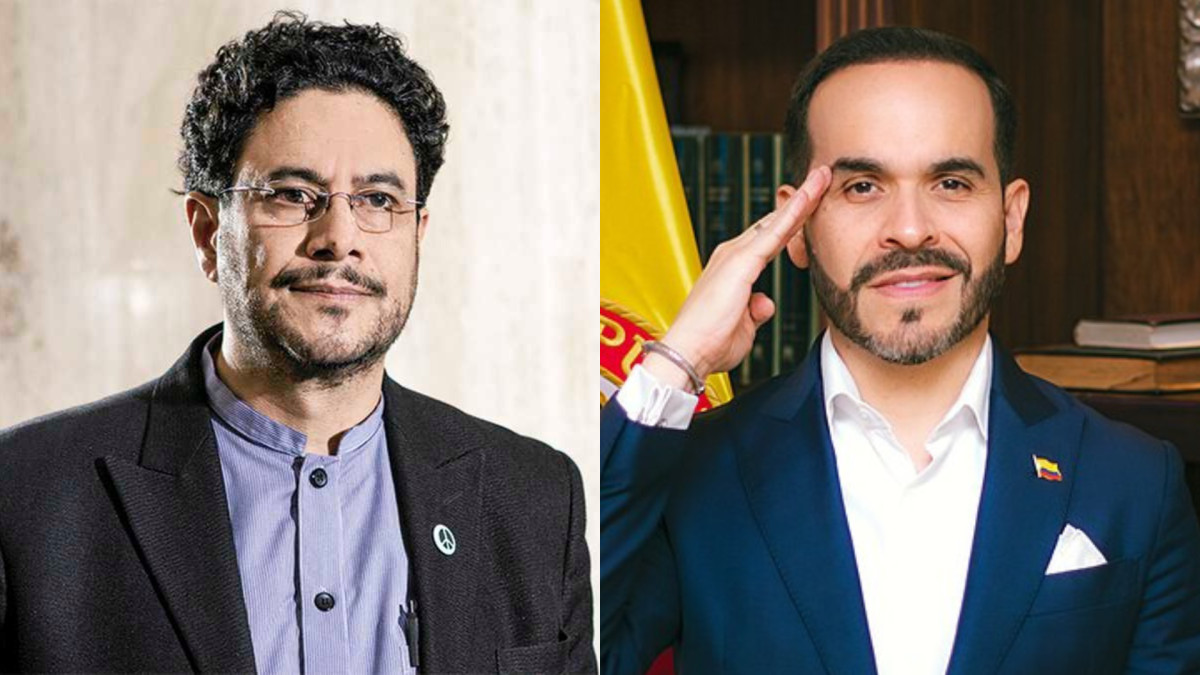
The bloody years of narco violence and guerrilla warfare remain indelible in the popular memory of Colombians: wounds that still shape how power and force are understood. In Colombia, the use of force takes on another meaning, for it is not reduced to the legitimate authority of the State, but is crossed by decades of armed conflict, repression and resistance. Now, after controversial general elections, the country is approaching a runoff that resembles a duel more than a vote. It recalls more a tale of confrontation and bravado than the narrative of a consolidated democracy. Last weekend, the ballots were filled with suspicions and alleged irregularities that tainted the tally. And in that fracture, two men embody two incompatible futures: one who speaks of reconciliation, the other who calls for force.
“Cepeda talks about a Colombia that is built with transparency between civil society and the government offices. He speaks of forgotten territories, of human rights, of a democracy expandable”
On one side, there is Iván Cepeda, heir to the Historic Pact (a coalition of left and center-left), who insists on peace as a horizon, the only path to sustain the institutions. He speaks of a Colombia built with transparency between civil society and the government offices. He talks about forgotten territories, about human rights, about a democracy expandable to those who never had it. His rhetoric is one of continuity, but also a promise: that the Colombia which bled at the end of the last century can, at last, scar. Facing him, Abelardo de la Espriella — with a tone that recalls Trump, Milei, Vox, Orbán, and Bukele — raises the voice of order imposed by iron, the discipline of the military. He says the Army must guarantee the people’s will “by reason or by force.” His tone, in brief, is rupture; his bet, the hard hand.
Saving the distance, this political contest resembles the atmosphere of the nineties, when drug trafficking, insecurity and unlimited corruption were a stain that darkened everything. Today, the shadow is different. It is the distrust in institutions, the suspicion of fraud and manipulated elections; it is the idea that democracy is defended, but that it is hardly sustained. Gustavo Petro, while still president, has said he does not recognize the results. Nevertheless, Espriella demands immediate respect. The point here is not only who reaches the Government, but whether the country can continue to believe in its own democratic forms and institutions.
“It will be decided whether the country bets (and acknowledges) the peace promised by Cepeda, or whether it leans toward its own version of Bukele’s authoritarian project”
It is never too early to sound alarms like the one this controversial election has generated, especially when it concerns the survival of a democracy in an American republic. June 21 will be the date on which this tangle of accusations, incendiary rhetoric, and divided positions is resolved. In brief, it will be with a runoff that decides something more than who will be Colombia’s president; it will decide whether the country bets (and acknowledges) the peace promised by Cepeda, or leans toward its own version of Bukele’s authoritarian project. That day, at the polls, it will be decided whether the ballots are enough to contain a fracture or if, as so many times in the country’s history, politics will become another battlefield.
Who are Cepeda and Espriella, and how do they reach the runoff?
Colombia, as we are seeing today, is not a territory immune to the suffocating polarization that afflicts so many countries. There, too, they confront, with very difficult possibilities of conciliation, on one side the pacifying and integrative discourse and, on the other, bravado and rupture imposed by force.
Iván Cepeda (1962, Bogotá) is the candidate of the Historic Pact. His proposal centers on what he has called “an ethical and social revolution” against corruption, in addition to prioritizing justice for victims of violence and proposing agrarian reform. Although he arrives with more than 9.6 million votes, he faces the challenge of overturning Abelardo de la Espriella’s initial lead.
He carries a biography that seems written for a raw non-fiction book. He is the son of Manuel Cepeda Vargas, a senator of the Patriotic Union who was murdered in 1994, and Yira Castro, a communist leader who died years earlier. He went into exile in Europe (between 1998 and 2004) after having denounced ties between politicians and paramilitaries. Later, he returned to his country and became a congressman and one of the most visible faces of the Colombian left. His government proposal, titled The Power of Truth, is articulated around four “democratic revolutions,” as he himself calls them. First, ethics, with a national system against rampant corruption, which aims to “not only punish the corrupt, but recover what was stolen and repair the victimized communities.” Second, the social, with agrarian reform and justice for the victims of the armed conflict. Third, the environmental, with policies for energy transition and ecological justice. And, fourth, the political, with the elimination of the National Electoral Council, which he accuses of being captured by partisan interests. “We have come to exercise our right to choose a future and a different destiny for Colombia, to deepen the changes we have had in these years of Government”, he said when voting in Bogotá.
But, facing the runoff on June 21, he has the enormous challenge of turning his 9.6 million loyal votes (the 40.9%) into a majority capable of defeating a political opponent who, in this first instance, surpassed him by nearly half a million votes. Cepeda needs to win over moderate voters, the center and, if possible, the moderate right. He must also persuade the undecided voters, resisting the bravado and the ultra-pragmatic rhetoric of his rival.
“From Espriella, he proposes the construction of ten megaprison complexes run by private companies. ‘First the rights of the people who behave well and then the criminals,’ is one of his sharp phrases”
In contrast, is Abelardo de la Espriella (born 1978, Bogotá), a lawyer and businessman who has reinvented himself as a presidential candidate, putting order and strength at the forefront of his speech. He is, in that sense, another echo of the radical lines of leaders like Trump, Milei or Bukele. He calls himself “the Colombian Tiger,” and among his most recurrent quotes and examples is the Salvadoran president. His proposal, following the lines of the aforementioned leader, is the construction of ten megaprison complexes run by private companies. “First the rights of the people who behave well and then the criminals,” is one of his pithy lines.
He also proposes reducing the size of the State (something very similar to Milei’s praxis), confronts international bodies (the same as Trump, Bukele or Milei) and has argued that democracy “is defended by reason or by force”. His political strategy is a hybrid of the discourses of the aforementioned leaders, emphasizing his more radical policies.
Now, in the first round, he obtained more than 10.3 million votes (43.7%). This lead puts him in a more comfortable position than Cepeda heading into the June 21 runoff. Nevertheless, anything can still happen. To win, he would need to consolidate the right’s support and attract center voters. His prospects, according to various Colombian analysts (such as Felipe Melo, a political scientist and legislative adviser), are high, because he became an unforeseen political phenomenon and because he embodies the narrative of order versus chaos. Nevertheless, his confrontational politics and anti-conciliation stance have sparked some suspicion and fear, especially because, as noted at the start of this piece, the ghosts of Colombia’s bloodiest years remain present in the collective imagination.
What will be the political fate of that country after the runoff? At this moment, it is difficult to make precise predictions. The only certainty is that either option will have a very hard time launching its national project, for there is almost another Colombia that will want the opposite.
