
Among other shortcomings, the plaintiff did not plead that the alleged fraudulent conduct caused him to buy goods.
An excerpt from the lengthy (and, in my view, largely accurate) ruling in Hoffman v. N.Y. Times Co., issued yesterday by Judge Evelyn Padin (D.N.J.):
Pro se plaintiff Harold Hoffman sues the New York Times Company. The complaint arises from a Times article published on July 25, 2025, with the headline “Young, Old, and Sick Starve to Death in Gaza: ‘There Is Nothing'” and the photograph that accompanies it:
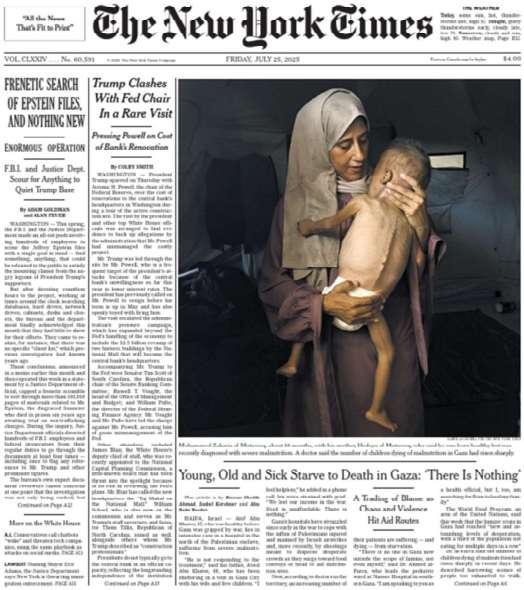
According to the plaintiff, the Times deliberately and misleadingly omitted that the infant shown in the photograph—an 18‑month‑old boy named Mohammed Zakaria al-Mutawaq (pictured with his mother, Hedaya al-Mutawaq)—was born with cerebral palsy, hypoxemia, and serious genetic conditions, in order to advance an untrue narrative about how the Hamas–Israel conflict has affected Gaza residents. The plaintiff further contends that publishing the Article violated the Times’s motto, “All the News That’s Fit to Print.” …
The plaintiff brings five NJCFA claims, along with a single common-law fraud count. The NJCFA prohibits:
The act, use or employment by any person of any unconscionable commercial practice, deception, fraud, false pretense, false promise, misrepresentation, or the knowing, concealment, suppression, or omission of any material fact with intent that others rely upon such concealment, suppression or omission, in connection with the sale or advertisement of any merchandise or real estate, or with the subsequent performance of such person as aforesaid, whether or not any person has in fact been misled, deceived or damaged thereby, is declared to be an unlawful practice….
Here, the plaintiff appears to ground his claims on two affirmative misrepresentations—(1) publishing the Article and Photo knowing they were false or misleading, and (2) the Times’s Motto—along with two knowing omissions related to the Article—(1) failing to include Mohammed’s full health history in the Article and (2) removing his alleged healthier older brother from the Photo….
[1.] Plaintiff’s NJCFA claims based on the Article and Photo
At the outset, the court emphasizes that, to plead a claim under the NJCFA, a plaintiff must show facts demonstrating that the alleged fraudulent conduct induced or lured the plaintiff into purchasing merchandise or real estate.
[T]he Article and the Photo were published long after the plaintiff subscribed to the Times. Indeed, the plaintiff concedes that the Article and Photo did not cause him to buy the subscription. Consequently, he cannot demonstrate that the Article or Photo were made in connection with the sale or advertisement of merchandise or that any omission from either caused his loss. It follows that the plaintiff cannot state a NJCFA claim based on any conduct tied to the publication of the Article or Photo.
[2.] Plaintiff’s NJCFA claim based on the Times’s Motto
While the Times advances several arguments why the NJCFA claim predicated on its Motto should fail, the court need only address one: the Motto is not an actionable affirmative misrepresentation under the NJCFA. The act distinguishes between facts that can be misrepresented and mere puffery. Advertising that amounts to puffery is not actionable because a reasonable consumer would not rely on it. Puffery is characterized by vague, highly subjective assertions rather than precise, verifiable statements. For example, the New Jersey Supreme Court in Rodio held that Allstate’s slogan, “You’re in good hands with Allstate,” amounted to nothing more than puffery and did not constitute a deception or other unlawful practice under the NJCFA.
The court agrees with the Times that the Motto is not a factual falsehood. It finds the Motto to be a broad, subjective statement that does not promise anything specific. As the Times persuasively argues, what counts as “fit” to print is inherently a subjective editorial judgment, and the plaintiff acknowledges the newspaper has editorial discretion to emphasize certain news. Thus, the Times retains broad discretion to decide what is deemed fit to publish. Disliking the news or suspecting political bias does not transform the Motto into a concrete claim that consumers relied upon to subscribe.
Moreover, the Motto does not even rise to typical puffery. It contains no explicit assertion of superiority, either general or measured, nor does it assure anything specific or quantifiable. See, e.g., In re Toshiba Am. (D.N.J. 2009) (holding that a slogan like “Today, Tomorrow and Beyond” constitutes non-actionable puffery); Argabright v. Rheem Mfg. Co. (D.N.J. 2016) (finding that claims that products were “top-quality” or “dependable” cannot sustain a misrepresentation claim); Peruto v. TimberTech Ltd. (D.N.J. 2015) (finding that statements that a decking product would provide years of low-maintenance use and outdoor enjoyment amounted to non-actionable puffery). The Times’s Motto is even more vague than those examples, and the court views it as something no reasonable person would treat as a material factor when deciding whether to subscribe to the Times.
[3.] Plaintiff’s NJCFA claim based on the New York Times’s Handbook of Practices for Ethical Journalism (the “Handbook”)
In his briefing, the plaintiff shifts course and argues for the first time that the inducement to subscribe came not from the Article, the Photo, or the Motto, but from the Times’s “written promise to deliver accurate news coverage in exchange for subscription funds.” The promise cited by plaintiff appears in Chapter Two of the Handbook: “accuracy is the foundation of our credibility.” He asserts that reliance on this promise, which he says is accessible online for all subscribers to view and rely upon, led him to purchase and maintain his subscription. …
As discussed above, to be actionable under the NJCFA, an affirmative misrepresentation must be made in connection with the sale or advertisement of any merchandise or real estate. Even putting aside questions about when he first saw the Handbook or when he subscribed, the plaintiff has not shown that this Handbook statement was made in connection with any sale of merchandise. All he offers is that the statement “is viewable online for all subscribers to see and rely upon,” which is markedly different from proving that it was made in connection with the sale of merchandise….
[The same deficiencies that doom the NJCFA claims also doom the common-law fraud claims….]
David L. Cook (Sills Cummis & Gross) represents the Times.
