
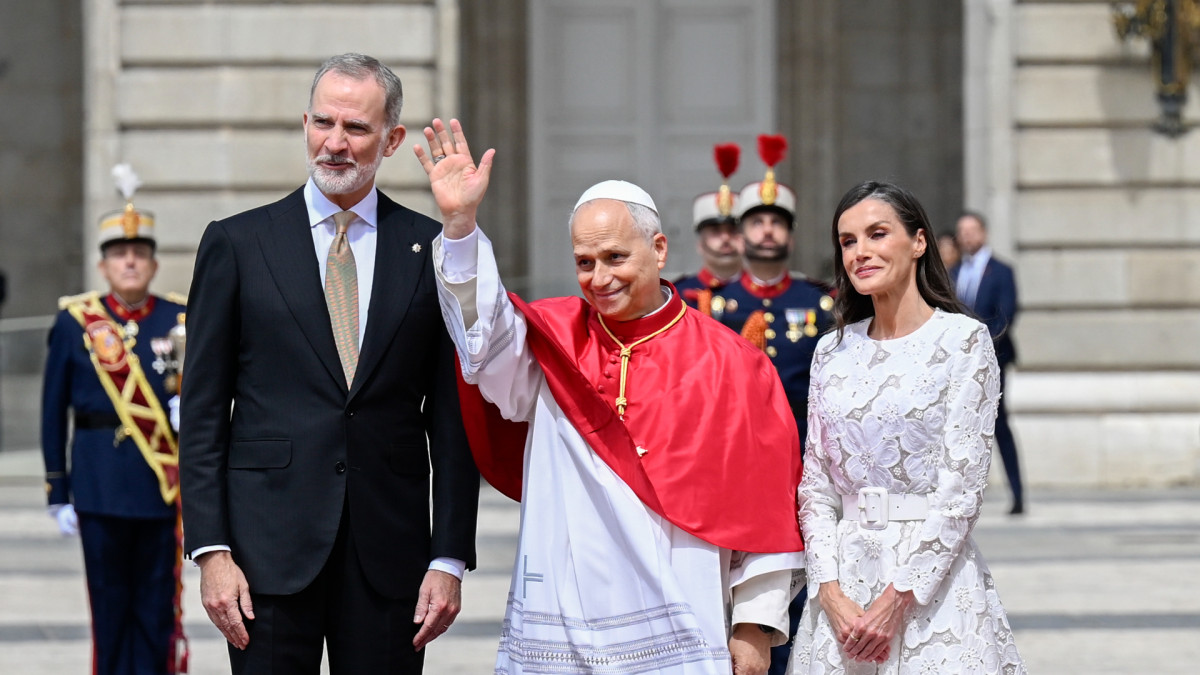
King Felipe VI and Pope Leo XIV stand among the world’s most influential leaders, though for different reasons. The former commands recognition through Spain’s rich history, its role within the European Union, and its influence across the Spanish-speaking world; the latter’s significance goes beyond his position at the Holy See, guiding more than a billion people across the globe. The visions they offer in today’s global climate share a clear stand against reactionary extremes, and in recent months both have risen as custodians of Europe’s founding ideals. The following passages recount some of the most notable moments from the Pope and the King’s joint appearance at Spain’s Royal Palace, offering a source of inspiration for people everywhere who uphold the values of liberty, fraternity, and justice.
Vindication of the European model
“I invite everyone, for the love of truth, to abandon the divisive and polarizing narratives of your social reality and its history, to move from barren simplifications to the fruitful appreciation of complexity. I see here a specific vocation for Europe, of which Spain remains an original and fundamental protagonist. It is a gift that the Old Continent can give to the world, if it wants to remain young, because to be young is to have a future and a mission that is actively pursued. To appreciate complexity and to study it; to learn not to deny it, and to live it as a blessing; to flee from approaches to identity that seem to clarify everything while populating the world with ghosts and enemies. This is the task of those who have a great history behind them,” said Leo XIV.
“I encourage you to cultivate dialogue and social friendship within yourself, to take into account the perspectives of the poor and the young”
In relation to Spain he said, “I express my gratitude for its fidelity to international law and multilateralism, which translates into an active commitment to peace and solidarity among peoples. At the same time, I encourage you to cultivate dialogue and social friendship within yourself, to take into account the perspectives of the poor and the young when imagining the future, to harmonize the demands for autonomy and unity, and to give impetus to the process of European Union, not in opposition to other powers but as a gift for the whole human family.”
The King focused on this same point by claiming the importance of building community: “Unity as an aspiration arises from the awareness of our fragility as individuals, of our contingency, of our limitations, but also of that inexhaustible capacity for good and beauty that reaches its peak when the human being loves his neighbor, when he opens himself and gives himself to others. Always remembering this, in word and in deed —and especially in these times of uncertainty— well deserves to serve as a guideline for universal conduct: unity as a vehicle and instrument for peace.”
“In this time,” the King continued, “we run the risk of forgetting what really matters, of sliding into the mistaken belief that —with many of our references subverted by the pulse of the present— anything goes, everything is admissible, negotiable, and justifiable. But that’s not how it is. The dignity of the person, human rights, democratic values, and international legality must remain our prime numbers… Because in those values, in their multiple combinations, lies the arithmetic of freedom, equality, and justice; the one that adds and multiplies, not the one that subtracts and divides.”
Against the paralysis of fear, and in favor of listening to the other
“Your words urge us to replace fear, which is sterile and paralyzing, with a thoughtful and shared knowledge of the potential and the risks of this new reality,” said Felipe VI. “And you add that this new technology” —referring to the Pope’s latest encyclical, warning of the risks of artificial intelligence— “cannot be a monopoly for a few but an instrument in the hands of all that benefits all societies. That will only be possible if we manage to preserve the person at the center of any discourse, never to be replaced, subjugated, or coerced by any algorithm.”
“When the attention is on the other —on whoever we have before us— we can identify with their pain, with their joy, with their weaknesses and strengths”
“Because in a world flooded with data and messages,” he continued, “empathy, understanding, and listening are essential. Your predecessor, His Holiness Pope Francis, often insisted on the importance of knowing how to listen. It is paradoxical that, in a time of interconnections, we are losing that capacity, or that patience. Because when the attention is on the other —on whoever we have before us— we can identify with their pain, with their joy, with their weaknesses and strengths. We can put ourselves in their place. Only if we learn to understand the reasoning of others, to seek common ground or agreement, will we be able to move forward together.”
Recalling the Spanish model of coexistence
Pope Leo XIV stressed that “it is necessary, especially on the part of those who have economic, political, and institutional responsibilities, to make a qualitative leap —a change of course in investments aimed at schools, universities, and research, at local communities and civil society as vibrant places of participation and cultural mediation. Security, which we too often hope derives from weapons and walls, in fact matures when we learn to move forward alongside the other and to grow together, side by side. Your own history testifies to this.”
“The presence of Islam on the Iberian Peninsula, for example,” he added, “constituted a long-lasting political, cultural, and religious reality. During that period there was not only confrontation; attempts were also made to create a space for contact, conversation, and dialogue on the meaning of truth between Christians, Muslims, and Jews. At the School of Translators of Alfonso X the Wise, experts belonging to the three religions collaborated in translating the richness of Arabic, Greek, and Hebrew heritage, contributing to the dissemination of texts such as, among others, those of the philosophers Averroes (1126-1198) and Maimonides (1138-1204). In particular, cities like Córdoba and Toledo became places of mediation between languages, religions, and knowledge. This is the truth that European cities tell: their historical stratification, the fabric of solidarity that over the centuries has shaped their differences, transforming inevitable conflicts into starting points.”
The King remarked to the Pope that he had “arrived in a country where some of your roots are. You are welcomed by a people you know well: vital and with character, supportive and tolerant, creative and cosmopolitan.”
An ‘Ignatian opportunity’ in the face of an uncertain world
Pope Leo warned that today, “the temptation to gain popularity by stoking the fire of polarization seems to grow, rather than diminish. Human dignity does not cease to be violated. That is why we need culture, interior reflection, free and quality education —we need transcendence. And yet, since those dark nights, men and women faithful to the truth have been impelled to advance from place to place to the point where, in conscience, justice and peace embrace each other. It is from their freedom that we learn to be free.” And it was in that context that Leo XIV vindicated the role of the Catholic Church, which “today is ready to put itself at the service of the future of those who seek reconciliation and peace.”
“Let us avoid words that humiliate or confront. Let us opt instead for clarity that illuminates, and frankness that opens paths”
“As another noble son of this land taught us,” said the Pope, in reference to Ignatius of Loyola, “it is possible to rethink everything, giving credence to the ‘desolations and consolations’ of the heart, in an exercise of discernment and imagination by which he preferred peace to arms and saints to those with power. He understood that the good to which he was attracted was not utopian; and so his crisis was transformed into grace. The same can happen with the ‘novelties’ that concern us today, about which our sensibilities are divided. Let us avoid words that humiliate or confront. Let us opt instead for clarity that illuminates, and frankness that opens paths. Let us not bless naïve enthusiasms or feed sterile fears. Rather, let us indicate the criteria of discernment —the dignity of the person, the universal destination of goods, attention to the poor, care for our common home, and peace— and translate them into practices: responsible planning, assessments of human and social impact, inclusion of the most fragile, digital literacy, research and industry oriented toward justice and peace,” he concluded.
