
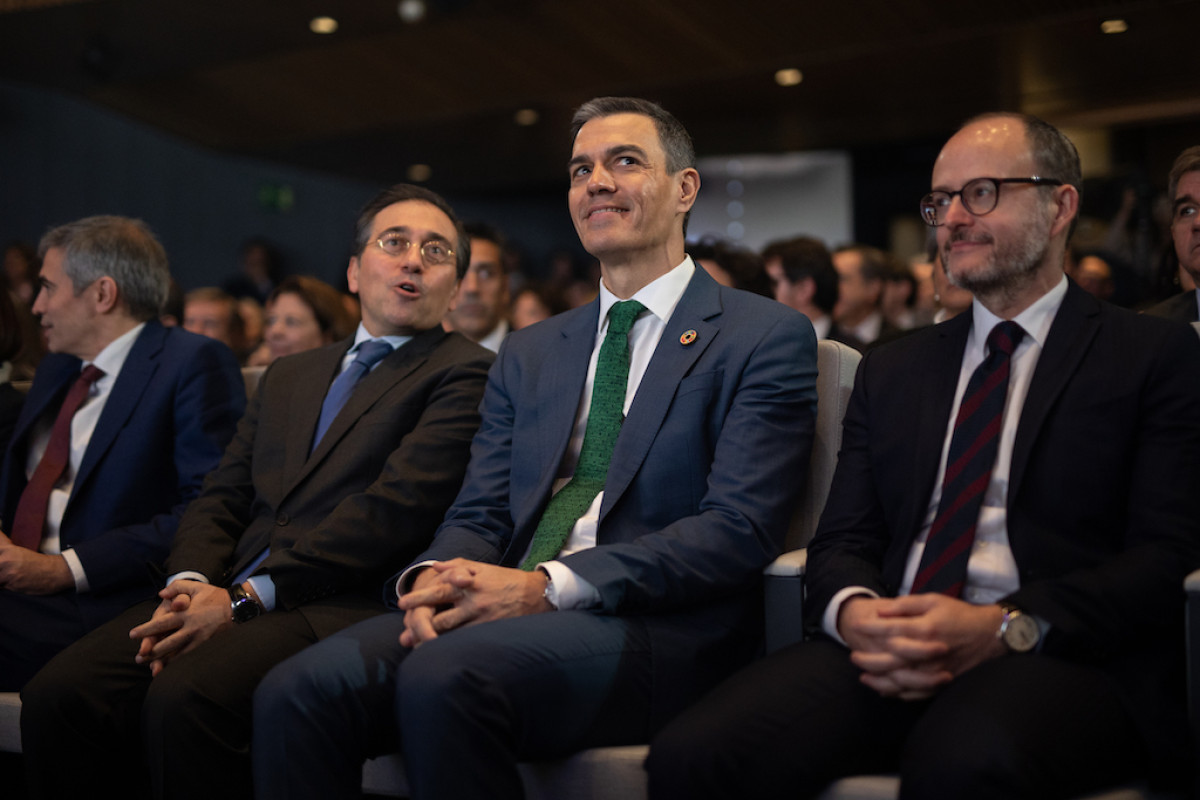
The legitimacy of his government was born in 2018 under a premise of ethical regeneration, and today that founding narrative faces a grey area. Culpa in vigilando attributed to Pedro Sánchez and the fact that the legitimacy of his government was born in 2018 under a premise of ethical regeneration remain behind that evolving debate.
Today, in my weekly column on European politics, I will try to add a bit more to what is already the second-longest-serving presidency after Felipe González. The reason is that, in my view, European and foreign policy is one of the arenas where Pedro Sánchez’s terms have made a difference.
Pedro Sánchez is not the first Spanish president to attempt to increase Spain’s international weight. Nor is he the first to use diplomatic successes to bolster his domestic political position. José María Aznar did so with his Atlantic alignment, while José Luis Rodríguez Zapatero built part of his international profile around the withdrawal from Iraq and opposition to the war.
The difference with Sánchez and his Foreign Minister, José Manuel Albares, is another matter. He is probably the first president of Spain’s democracy to push more defined positions in areas where there had previously been a broad passive consensus, turning foreign policy into one of the fields where national political differences are also expressed.
For much of Spain’s democracy, the country maintained a peculiar relationship with international affairs. It functioned thanks to that passive consensus I mentioned, and in many cases that also meant inaction. It wasn’t always codified or tied to major formal agreements, but rather it was more of a shared political culture. Europe formed a common horizon, while the relationship with the United States was managed with different nuances—yet within known parameters. In turn, Spain’s stance on the Middle East, Morocco, or China evolved gradually and without major ruptures.
Even when extraordinary episodes arose, such as the Iraq War, they were perceived precisely as exceptions. The intensity of the political conflict provoked by Aznar’s decision partly explained why it disrupted a relatively entrenched continuity.
“The novelty with Pedro Sánchez is the adoption of own, recognizable and different positions in some of the most relevant international debates of our time”
In this sense, the novelty is the willingness to adopt own, recognizable, and different positions in some of the most relevant international debates of our time, where Spain had traditionally preferred to move within broad margins of consensus and diplomatic flexibility.
One of the most evident cases, and perhaps among the first in the timeline, was Morocco and Western Sahara. During the Spanish democratic era, successive governments maintained a difficult balance between the country’s historic commitments, relations with Morocco, the stability of Ceuta and Melilla, migratory cooperation, and ties with Algeria.
Sánchez’s shift toward Rabat’s autonomy plan leaned toward a new approach to a matter marked by the search for diplomatic balance. That decision was interpreted by his critics as a substantial modification of a historic Spanish stance. In this sense, the matter ceased to be purely a diplomatic issue and moved into the domestic agenda. It generated tensions within the governing coalition, sparked parliamentary clashes, and opened a public debate that persists to this day.
Something similar happened with Gaza and Israel. On the conflict, Spain maintained positions relatively close to those of most of its European partners. The recognition of a Palestinian state projected Spain toward a more visible stance within the European and international debate. But it also produced an internal effect. Once again, a topic belonging to diplomacy escalated, in this case, into a political differentiating element. The position on Israel began to be part of party identities, parliamentary disputes, and Spain’s public conversation.
“Transatlantic relations have jumped from the security sphere to be treated as a discussion about political identity, European sovereignty and ideological positioning within Spain”
Chronologically, the relationship with the United States offers a third example. Until recently, issues related to NATO, American military bases, or strategic cooperation formed part of a relatively stable consensus. Even when ideological differences existed, governments tended to preserve broad spaces of continuity.
However, tensions with the Trump Administration or the implications of American policy toward Iran have introduced new fault lines. Transatlantic relations have jumped from the security plane to being treated as a discussion about political identity, European sovereignty and ideological positioning within Spain.
The same is true with China. Decisions about Beijing trigger increasingly heated internal political debate because they force answers to questions that go well beyond trade. Should Europe align with Washington? Should it preserve its own strategic autonomy? To what extent can Chinese investments in sensitive sectors be accepted?
The four examples point in the same direction. The politicization of Spanish foreign policy does not arise because international matters have inevitably invaded national politics. It arises because certain government decisions have replaced a logic based on consensus and balancing with a logic based on more defined and visible positions.
“Spain is more visible today than a decade ago. Its positions attract attention. Its ability to influence certain debates is greater”
Passive consensus kept international conflicts on the margins of political debate. In the absence of that agreement, parties compete, the media pay more attention, and citizens take sides. All this while foreign policy becomes part of the daily political struggle. I believe this transformation has positive effects. Spain is more visible today than a decade ago. Its positions attract attention. Its ability to influence certain European debates is greater. A country that takes clear positions has a better chance of being heard than one that simply follows others.
But visibility comes at a cost we must assume. When a country adopts more defined positions, it also faces greater resistance. Its decisions affect tangible interests and its moves receive more scrutiny. Moreover, its adversaries have more incentives to respond.
Think of the Pegasus case, in early 2022, when the mobile phones of the Prime Minister and several ministers, such as Margarita Robles, Fernando Grande-Marlaska, or Luis Planas, were illicitly infected and sensitive information extracted. The technology is Israeli. Read the article we publish today about the American perspective on the Zapatero case. Former CIA officer Bjorn Beam states that “HSI (Homeland Security Investigations) has steadily expanded its global reach and its priorities have become more political under the Trump Administration” and explains that “regardless of the case in question, that pattern makes any decision to hand over evidence to a foreign court worthy of additional scrutiny”.
International relevance and political conflict tend to grow together. And at the moment when political actors are forced to choose sides, foreign policy enters the national arena. In Spain, this playing field has arrived to stay, and if not, take a look at yesterday’s video of Alberto Núñez Feijóo supporting Keiko Fujimori. If the popular leader records this video, it is because he thinks it defines his political identity in Spain. Perhaps that is why he deleted it.
