
Two-speed Europe is an old idea. And somehow it feels so natural and so taken for granted that in practice it is older than in theory. Long before Wolfgang Schäuble, accompanied by Karl Lamers, theorized about the Kerneuropa, the Benelux nuclear Europe and the Franco-German axis that should advance rapidly toward federalization, the club was already functioning at several speeds. The Schengen area was a practical embodiment of the idea, and the euro was its confirmation. Whenever the Eurogroup ministers, a peculiar gathering with no formal basis in the Treaties, meet a day before the formal EU Council of Finance Ministers, the Member States are reaffirming the idea of a two-speed Europe.
It is a reality that, however, remains controversial. In 2017 it resurfaced clearly on the table after Brexit was voted in the referendum held in the United Kingdom. Jean-Claude Juncker, president of the European Commission between 2014 and 2019, included it in his White Paper as one of the forward-looking options. France actively pushed it. François Hollande, the French president, convened in Versailles the leaders of Germany, then Angela Merkel; Italy, at the time led by the Social Democrat Paolo Gentiloni; and Spain, then governed by Mariano Rajoy, precisely to advance that agenda, noting that “unity is not uniformity”.
“From 2020, in the midst of permanent crisis management, the EU has had only one idea in mind: preserve unity at any price.”
The idea did not survive the declaration marking six decades of the Rome Treaty, and the debate surrounding the proposal generated a great deal of tension. Juncker even warned that some saw in this push a new “iron curtain” that would divide Europe, a sign of how emotional and corrosive the discussion was. From 2020 onward, in the midst of permanent crisis management, the EU has had only one idea in mind: preserve unity at any price. And that implies slowing everyone down, but maintaining cohesion.
In the face of the sense of creeping euro-sclerosis that has seeped into European political debate for about the last two years, the taboo has been broken again. There is a need to advance reforms of the internal market, but trying to do so within the usual EU Council formations, any progress is extremely slow, tedious and, at times, doomed to stagnation. That is what led the six large economies of the European Union—Germany, France, Italy, Spain, the Netherlands, and Poland—to form a tighter coordination group, the so-called E6.
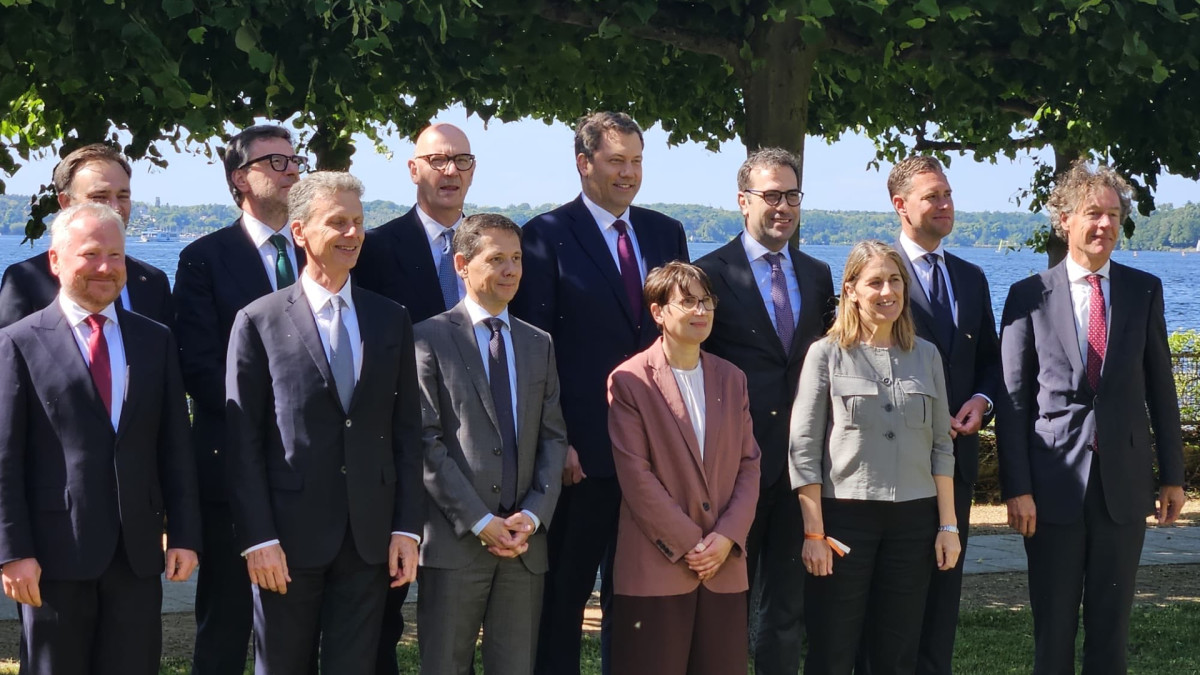
Recently, after a meeting in Berlin, the finance ministers of the group announced a major agreement for centralized supervision of European capital markets, a key step toward advancing the Union of Savings and Investments (SIU, for its English acronym). The other objectives of this cooperation group are the strengthening of the euro, defense, and critical raw materials.
Spain has always wanted to be part of the vanguard group, but in a largely discreet way. It was not about actively promoting the idea, but about ensuring it would be part of it. On this occasion it is standing out more, playing a more active role. Not only within the framework of the E6. This very week circulated a non-paper, which in EU jargon amounts to a kind of reflection document, together with France and Italy, with proposals to make the banking sector more competitive that include, among other measures, facilitating operations of large European banks across different member states.
What to do with this progress?
Ursula von der Leyen, president of the European Commission, has endorsed moving forward in this direction and has opened the door to reinforced cooperation among member states in certain economic areas if joint progress cannot be achieved. “We often advance at the pace of the slowest, and reinforced cooperation prevents that from happening,” she stated in February. The progress that can be made by the end of the year will be fundamental to determine whether this new impulse toward a two-speed Europe can give a boost to the whole group of Twenty-Seven, which remains Brussels’ preferred scenario, or whether it will require an actual “drift.”
“The EU decision-making processes give small countries more bargaining power than they would have in any other format”
The idea continues to generate a great deal of division within the EU. In a recent interview with the POLITICO portal, Makis Keravnos, Cyprus’ finance minister, warned of the risks that the six large economies of the European Union proceed separately from the rest of the club. Especially the smaller countries view these moves with great suspicion. Because the reality is that EU decision-making processes give small countries more bargaining power than they would have in any other format. At the same time, the view from some of the large member states is that some of the smaller countries slow progress to protect interests that, at times, are unjust to the rest of the EU, as in the area of financial market integration. It’s no accident, in fact, that Ireland has openly positioned itself against the E6 initiative.
The fundamental question is what happens to the tangible progress that the E6 is trying to put on the table. If it succeeds in bringing a large bloc of member states onto its reform agenda, how will the E6 maintain the level of ambition it is attempting to imprint? How can it avoid these measures being weighed down by the same dynamics and logic of the usual European process?
