
Hardly could there be a stranger political marriage than the one uniting Donald Trump’s MAGA movement with the new techno-right, the group of Silicon Valley billionaires and venture capitalists who financed Trump’s return to power and stoked his appetite for deregulation. The alliance blends a regressive populist movement with a Silicon Valley vanguard guided by the belief that artificial intelligence will leave vast swathes of people economically redundant.
Both sides are not only pursuing different aims; they also live in different worlds. MAGA rhetoric is anchored in a mythical past. It seeks to restore an industrial, national, and cultural order that has been lost, with a family-centered and locally rooted view of work, gender roles, and community life. The ethos that dominates Silicon Valley holds that disruption is a civilizational imperative and that current social arrangements are dispensable. One side longs for an idyllic past; the other wants to render the present obsolete.
Their ideas about ordinary people differ accordingly. The movement sees itself as a group of “forgotten” citizens, including manual workers, small business owners, and voters in interior states that have been deindustrialized, whom coastal elites have discarded. The tech billionaires, by contrast, do not hide that they foresee a semi-permanent underclass as a result of replacing millions of workers with advanced systems that will concentrate wealth and power in the hands of current capital owners and AI companies. According to what some call the “San Francisco consensus,” the average worker is not a protagonist of the future but a vestige of a past era, supposedly appeased with modest social benefits while innovation presses forward.
“The Trumpist coalition has welded two incompatible narratives: a populist story that extols voters and a meritocratic, elitist one for those who contribute the money”
Instead of resolving this contradiction, the coalition hides it behind a personality cult. While tech investors proclaim themselves geniuses, Trump adopts a doubly absurd stance, boasting both of his formidable intelligence quotient and of his peculiar devotion to the “uneducated.” This posture managed, for a time, to mask the fact that the same hierarchy of cognitive values that flatters donors also marks many of his followers as expendable. Thus the Trumpist coalition has brought together two incompatible narratives: a populist storytelling that extols voters and a meritocratic, elitist one for those who contribute the money.
But as Trump’s power wanes as a result of the Iran debacle, so too does his ability to keep two incompatible promises. The magic trick that held the coalition together no longer works, and the ill-starred marriage begins to fall apart. And of all arenas where tension is evident, the deepest fracture runs through the electric grid.
Trump promised to lower Americans’ electricity bills (even by half). But in many places that underpin the MAGA coalition, residential electricity prices have surged, and capacity charges have risen by more than a factor of ten in two years.
Nearly half of the recent price increase is due to the voracious electricity demand from data centers. It is estimated that by 2028 the monthly bill for a typical household in a data-center-hosting location will be about $70 higher.
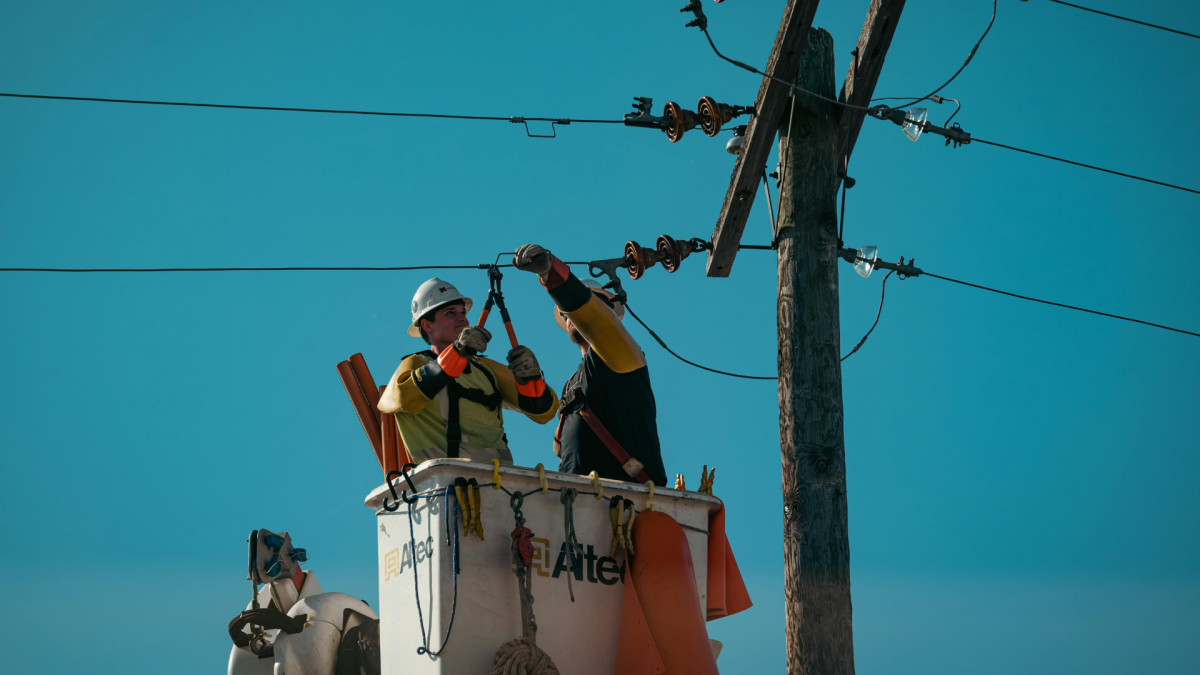
The rising cost of electricity makes the contradictions of the techno-MAGA alliance unmistakable. Rural communities and peri-urban areas in Virginia, Ohio, Georgia, and Arizona—with strong MAGA presence—are already mobilizing against substations and transmission corridors serving data-center clusters whose benefits accrue elsewhere; at the state level, populism is looking at ways to protect ratepayers and shield households from data-center costs.
So the great irony is that the biggest protests against AI infrastructure in 2026 may come from the Trumpist coalition. Heating a rural home through the winter in Pennsylvania is a problem that a personalist cult cannot solve.
The injustice is undeniable. One grid remains public, regulated, slow, and politically contested; the other is increasingly private, adjacent to data centers, vertically integrated, and free from the restraints imposed on the rest. Hyper-scale centers sign deals for nuclear and gigawatt-scale gas use, and begin reopening idle reactors and building private gas plants on their grounds.
They enjoy the support of federal regulators, who rewrote the rules so that data centers can have direct connections to power plants without passing through the transmission infrastructure relied on by the rest. The compute clusters obtain constant exclusive megawatts, while households connected to the same system face volatile tariffs. In one grid, the citizen gets what they pay for; the other grid is funded, but not accessible.
“This is not the usual gradient of benefits built into public services, but a parallel system, an electric ‘apartheid'”
The human redundancy of the techno-right is not an aspiration but a strategy. AI clusters expand to absorb paid work from a shrinking labor force, while the unpaid work households still perform gradually disappears from the model. The pattern is not entirely unfamiliar. Publicly financed infrastructure has always tended to serve some groups better than others, depending on where the lines pass, how access is priced, and how reliable the service is. Though not inherently discriminatory, infrastructure investment tends to trace the outlines of class, geography, and political influence.
However, what we see now in the United States is more than that. It is not the usual gradient of advantages built into public services, but a parallel system, an electric apartheid established through private contracts. Hyper-scale operators are creating a bifurcated regime where a constant, exclusive provision is designed for one class of users, while the public grid absorbs volatility and costs.
The demographic majority on the losing side of the system is not a racial “other” as in apartheid South Africa, as Elon Musk reminds us. They are middle- and working-class voters in the interior, deindustrialized; precisely the voters MAGA claims to defend. They backed Trump in droves and are now being asked to pay for a system designed to make them obsolete.
It is now clear that techno-populism contains the seeds of its own dissolution. A war over energy that grows ever more intense makes the divorce inevitable. The consumption meter does not ask whom the future was promised to; it records who actually receives it.
© Project Syndicate, 2026.
