
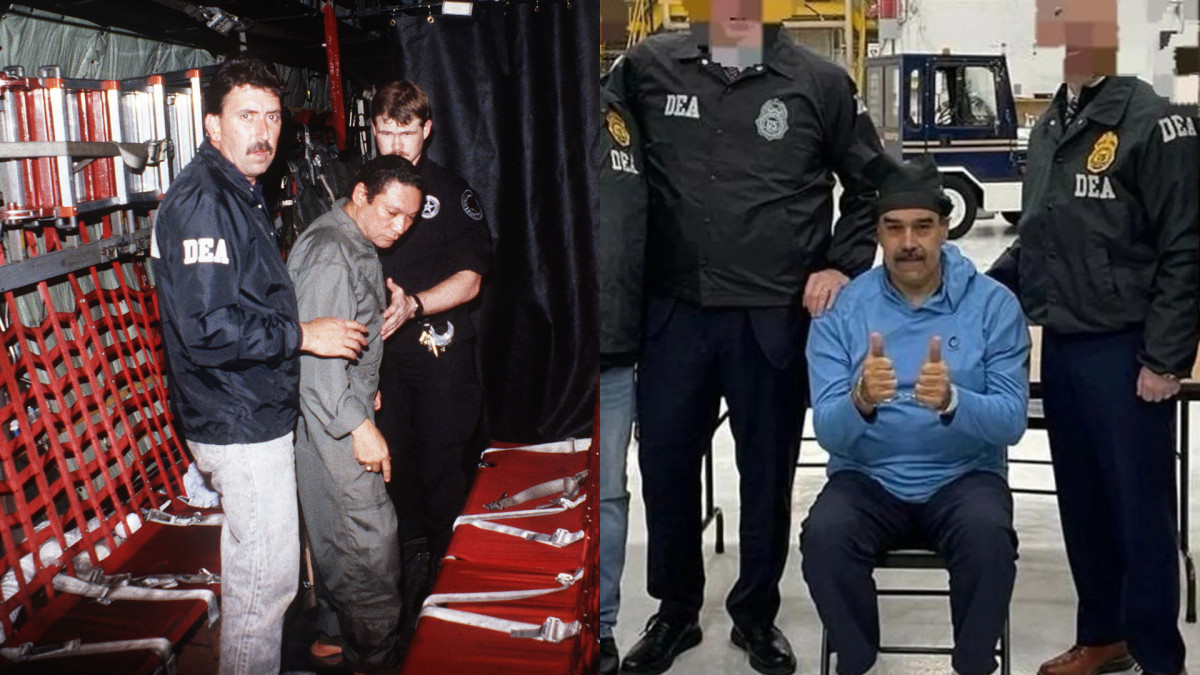
We are only a few days into 2026, but it feels a lot like 1990, when the United States captured Panamanian leader Manuel Noriega and transported him to the United States to stand trial on federal drug trafficking charges. Nicolás Maduro and his closest adviser — who is also his wife — Cilia Flores, are no longer leading Venezuela after a “wide-scale attack” by the United States, and will face trial on various federal charges, including drug trafficking, according to President Trump.
The breaking news this weekend about the capture of Maduro and Flores, part of Operation Absolute Resolve, had been in the works for some time, yet it surprised the world on Saturday morning. Soon after news of Maduro’s capture emerged, the United States Attorney General, Pam Bondi, posted on X (formerly Twitter): “Nicolás Maduro and his wife, Cilia Flores, have been charged in the Southern District of New York. Nicolás Maduro has been charged with conspiracy to narcoterrorism, conspiracy to import cocaine, possession of machine guns and destructive devices, and conspiracy to possess machine guns and destructive devices against the United States”. She added: “They will soon face the full force of American justice, on American soil and before American courts”.
“The U.S. Attorney General also shared the declassified indictment, making clear that the United States regards Maduro as a fugitive from justice and not a world leader”
Bondi also shared the declassified indictment, making clear that the United States regards Maduro as a fugitive from justice and not a world leader. It should be noted that Maduro was no longer recognized as Venezuela’s president during Trump’s first term, nor throughout the Biden Administration, and again he was not recognized during Trump’s second term. The Biden Administration raised the reward for information leading to Maduro’s capture to twenty-five million dollars, and the second Trump Administration later raised it to fifty million.
The Relationship Between Nicolás Maduro and the United States
Maduro was indicted in 2020 during Trump’s first term and charged with drug trafficking, narcoterrorism, and corruption, among other charges. At that time, the Department of Justice focused on Maduro’s alleged ties to the FARC, designated as a Foreign Terrorist Organization, as well as his alleged leadership of the Cartel de los Soles. Consequently, although many observers were surprised by the United States’ attacks on vessels — allegedly linked to the Tren de Aragua in recent months —, the link between Maduro and drug trafficking has been a focus of the Trump Administration since its first term.
As for the next steps, Trump declared that the United States will “lead the country” until a “proper transition” occurs. He also noted that the American oil industry is ready to make large investments in Venezuela to repair the country’s infrastructure, stating: “We are going to bring our enormous American oil companies, the largest in the world, to invest billions of dollars, repair the severely damaged oil infrastructure and begin to generate revenue for the country”.
“Let us hope that any governmental structure established will be equally successful. The days ahead and the steps to come will be difficult and risky”
Agenda Pública consulted about these events with former U.S. Congressman Francis Rooney (FL-19), who represented Florida’s 19th District from 2017 to 2021 and was vice chair of the House Foreign Affairs Committee, as well as a senior member of the Western Hemisphere Subcommittee. Rooney stated that “the United States’ police action to capture Nicolás Maduro and Cilia Flores, linked to extensive criminal activity, appears to have been successful”.
Rooney — who in 2022 was awarded the Commander of the Order of Isabella the Catholic — added: “Let us hope that any governmental structure established will be equally successful”. Finally, he warned that “the days ahead and the next steps will be difficult and risky”.
Max Meizlish, a researcher at the Foundation for Defense of Democracies, told Agenda Pública: “The United States should use its economic influence to support democratic actors in Venezuela while avoiding the networks of corruption and repression from reconstituting themselves in the post-Maduro era. This is especially important in the oil sector, where privatization of the state-owned company will require clear limits so that regime-linked officials and their allies do not become a new class of politically powerful oligarchs“.
“The U.S. should promote a rules-based, market-oriented recovery that gives people their own, transparent and democratic path”
Meizlish — who was previously part of the U.S. Treasury’s Office of Foreign Assets Control — added: “In essence, the United States must promote a rules-based, market-oriented recovery that gives people their own, transparent and democratic path”.
It is clear that President Trump seeks to avoid the situation the United States faced after the 2003 invasion of Iraq, when the Coalition Provisional Authority’s de-Ba’athification policy caused chaos and the U.S. presence lasted for years. This also explains why the operation was framed as a specific action in support of a legal matter — the charges against Maduro and Flores — and not as a war to topple a regime. Additionally, Trump mentioned that Venezuelan Vice President Delcy Rodríguez should cooperate with the United States, stating that “she really has no choice”.
Later, Rodríguez adopted a defiant tone in a televised address: “If there is anything the Venezuelan people know clearly, it is that we will never be slaves”. However, she added that she desires “respectful relations” with the United States, which evidences recognition of the complex current situation.
The Opposition to Maduro and the Future of Venezuela
Many analysts were surprised by Trump’s statements about María Corina Machado, stating that “she does not have the support” to lead Venezuela. It is worth recalling that when the Trump Administration recognized Juan Guaidó as president in 2019, this did not cause Maduro to effectively relinquish the presidency, even though his government ceased to be recognized. This time, the White House seems to be acting differently, communicating with Rodríguez to avoid a scenario similar to Iraq. The comments from both make clear that the situation remains tense and that this is not about abandoning the democratic opposition, but about ensuring a lasting transition.
Finally, the departure of Maduro from power is something many Venezuelans have waited for years. Although I am not Venezuelan, three generations of my family lived in Venezuela, including my Peruvian grandfather —though I am American, half of my family is Peruvian—. In short, I have known and been friends with people from Venezuela my entire life; it is a country whose politics I have followed closely and to which I wish the best.
“Venezuela has faced economic difficulties for many years under Maduro. In October 2025, annual inflation stood at around 270%”
Venezuela has faced economic difficulties for many years under Maduro. In October 2025, annual inflation stood at around 270%. Additionally, food insecurity has been a persistent problem, with 80% of the population living in poverty.
It seems clear that the majority of Venezuelans and Venezuelan-Americans are satisfied with Maduro and Flores’s capture. Although questions remain about the future of the country, for now there is cautious optimism about what lies ahead.
I recall that on May 13, 2019 I witnessed the joy of Venezuelans and Venezuelan-Americans when the demonstrators —inside the Venezuelan Embassy in Washington, D.C., invited by regime staff who were withdrawing— were expelled after Guaidó was recognized by the Trump Administration. Cheers of “They’re leaving, they’re leaving, they’re leaving” could be heard as the last demonstrators exited.
And now, it is Maduro and Flores who are “They’re leaving!”.
