
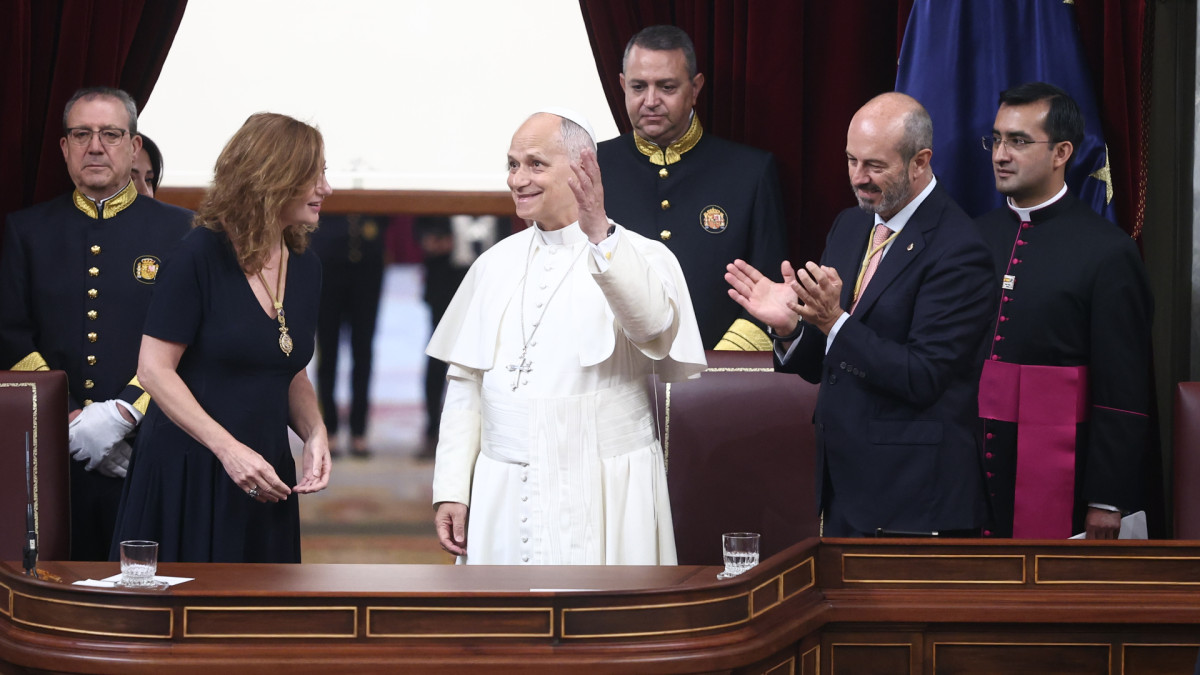
When Pope Leo XIV walked into the Congress of Deputies last Monday, many expected a ceremonial speech about the long-standing relationship between Spain and the Church. What they heard, however, was something quite different. For more than half an hour, the pontiff tackled some of the most pressing issues shaping contemporary European politics: immigration, human dignity, social cohesion, peace, democracy, religious freedom, and the construction of Europe. And he did so in a way that, while some might read it strictly through a Spanish lens, transcends national politics by far.
The papal visit to Madrid can be read as a gesture of closeness to Spain. Yet it can also be seen as a pointed intervention in one of the continent’s most crucial political debates: the struggle to define what it means to be conservative in twenty‑first‑century Europe.
Many right‑of‑center and center‑right parties have long been trying to forge a synthesis between two distinct traditions. On one hand, the Christian democratic heritage that helped shape postwar Europe on universalist principles, multilateral institutions, and a conception of human dignity applicable to all. On the other, the ascent of a new national‑conservative right that defends stricter borders, an identitarian view of the nation, and a more exclusionary understanding of the political community.
Pope Leo XIV has chosen to weigh in on that dispute. And he did so from Madrid.
More than Immigration
The immediate reaction to the speech focused on the Pope’s references to immigration. He advocated for opening “safe and legal” pathways for migrants and refugees, denounced the trafficking networks that exploit their despair, and urged policies that guarantee protection, hospitality, and real opportunities for integration.
“What Leo XIV laid on the table is the impossibility of separating the different elements of the Church’s social doctrine.”
In Spain, where the migration debate occupies an increasingly central place on the political agenda, those words were quickly read as a response to proposals supported by Vox and watched with growing interest by some sectors of the Partido Popular. But reducing the Pope’s message to an immigration issue would be to stay on the surface.
What Leo XIV put on the table is the impossibility of separating the various elements of the Church’s social doctrine according to political convenience. In recent years, a portion of Europe’s right has found some comfort in invoking Christian tradition as a cultural and identitarian element. Family, defense of life, and Europe’s Christian roots have become recurring references in the rhetoric of many conservative leaders.
Yet Catholic social tradition has never been a take‑it‑or‑leave‑it menu. The same doctrine that defends life “from conception to natural death” also calls for the protection of migrants, refugees, the poor, and the excluded. The same anthropological vision that emphasizes the importance of the family insists on the universal dignity of every person, regardless of origin, ethnicity, religion, language, or economic or social status.
The Pope’s message was precisely this: it is not possible to claim one part of the Christian legacy while ignoring the other.
The Problem of Identitarian Christianity
The intervention gains an even more significant dimension when viewed in the European context. Over the past decade, various conservative and nationalist leaders have resorted to Christianity as a tool for political mobilization. In Hungary, France, Italy, and the Netherlands, references to Europe’s “Christian roots” have become a common element in debates about immigration, integration, and national sovereignty.
The paradox is that many of these appeals have tended toward cultural rather than religious content. Christianity often appears less as a universal faith and more as a symbolic boundary designed to determine who belongs to the national community and who is left outside. It’s a border‑mark more than a universal creed.
“His Madrid speech reminded us that Christian tradition was not born to delimit closed communities, but to affirm the equal dignity of all human beings.”
That reinterpretation is precisely what Leo XIV seems prepared to challenge. His Madrid address reminded listeners that Christian tradition was not created to carve out closed communities but to uphold the universal dignity of every person. From that perspective, welcoming the foreigner is not a voluntary political concession but a logical consequence of the principles that the right itself asserts when speaking of Christian values.
It is not a purely theological debate. It carries very concrete political consequences.
Because it compels us to answer a difficult question: is it possible to defend simultaneously an identitarian vision of the nation and a universalist conception of human dignity?
The Return of Old Christian-Democratic Europe
The choice of Spain hardly appears accidental. The Partido Popular is part of the European People’s Party, a political family that has been engaged for years in a heated strategic discussion. The central question is simple to formulate and extraordinarily difficult to resolve: to what extent should the center‑right incorporate elements of the radical right’s discourse to avoid losing voters to its right flank?
The question appears in almost every European country.
In Germany, the CDU constantly debates how to respond to the growth of the extreme right. In France, the traditional boundary between the center‑right and Marine Le Pen’s political space has become increasingly blurred. In Italy, Giorgia Meloni’s ascent has clearly altered the balance of continental right‑wing forces.
In that context, Leo XIV’s words are also a claim to the political tradition that gave rise to European integration. The architects of the European Community—Adenauer, De Gasperi, and Schuman, among others—were deeply inspired by Christian social thought and conceived politics as an act of reconciliation. After World War II, their objective was to build institutions capable of tempering the nationalism that had devastated the continent.
“The idea of Europe arose precisely to curb the logic of identity confrontation between peoples and states.”
The idea of Europe emerged to curb precisely that logic of identity-based confrontation among peoples and states. When Leo XIV defends universal human dignity, solidarity, and cooperation, he is reclaiming fundamental elements of that tradition. This is a intervention in a contemporary debate about the future of the European right.
Populism as a Moral Challenge
Another significant aspect does not stem so much from the Congressional speech as from Leo XIV’s prior intervention before members of the European People’s Party, in which he linked genuinely “popular” politics to direct contact with the people and called it “the best antidote against populism.”
In recent years, the word has been used so often that it has lost part of its descriptive power. For some, it simply refers to any anti‑establishment political force. For others, it has become a label used to discredit opponents.
“The difference appears when the people stop being a plural community and become an exclusionary category.”
Leo XIV proposed a different definition. The fundamental difference between “popular” politics and populist politics does not lie in their ability to connect with citizens’ concerns. Both can do so. The difference arises when the people cease to be a plural community and become an exclusionary category. Populism, in this view, is not limited to representing particular social groups. It aims to monopolize legitimate representation of the people and to present those who disagree as illegitimate adversaries or internal enemies.
This logic currently runs through a large part of Western democracies. It appears in debates about immigration, but also in discussions about judicial institutions, the media, regulatory bodies, and European integration.
The Pope’s concern seems to be directed precisely at that tendency. Not because he rejects political conflict—inevitable in any democracy—but because he challenges turning politics into a perpetual battle between irreconcilable communities.
The Spanish Case
This is where the Spanish dimension of the discourse becomes evident. The growing rivalry between the Partido Popular and Vox mirrors tensions present in other European countries, but with its own characteristics.
The PP long managed to integrate liberal, conservative, and Christian‑democratic sensibilities under a single political umbrella. That internal coalition allowed it to build a force capable of aspiring to broad majorities. Vox’s emergence disrupted that balance. Since then, the party’s leadership has faced a permanent tension: it must prevent votes from drifting to the right without losing its central position within the Spanish and European political system.
Leo XIV’s words complicate that equation even further. They introduce a moral authority for a substantial portion of the conservative electorate and pose a critique that cannot easily be dismissed as a left‑wing critique.
A Warning for Europe
It would be a mistake to interpret Madrid’s speech as merely a Spanish episode. What happened in Congress is part of a broader conversation that runs through almost all Western democracies.
The combination of migration pressure, economic insecurity, housing crises, social fragmentation, and distrust of institutions is fueling the growth of political projects that promise to redefine the borders of the national community.
“Solutions cannot be built by sacrificing fundamental principles on which the European democratic order rests.”
Leo XIV’s response does not deny these problems. For Leo XIV, solutions cannot be built by sacrificing the fundamental principles on which the European democratic order rests. That is why the Pope’s intervention matters so much: it forces a reconsideration of a core question that European conservatives have spent years trying to avoid: can conservatism stay true to its Christian‑democratic roots while adopting political frameworks increasingly defined by identitarian exclusion?
For a few minutes, under the gaze of Spanish deputies and much of Europe, Leo XIV succeeded in placing the question at the very center of the debate.
