
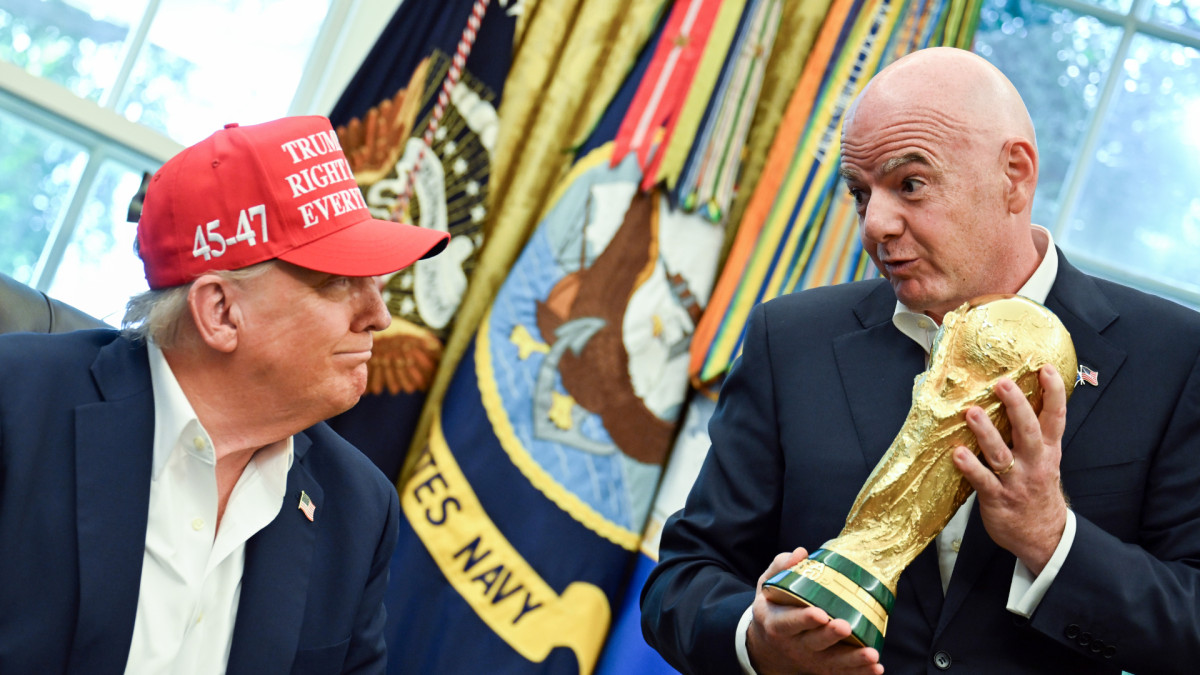
The ball begins to roll today in a unprecedented World Cup. For the first time in its entire history, the World Cup is played within the borders of three different states: the United States, Mexico and Canada, the footballing rendering of the USMCA agreement.
The event, moreover, inaugurates an expansion in the number of participating teams that definitively dilutes the historic European hegemony. Although this dilution is mainly quantitative, it does not necessarily entail an equivalent redistribution of economic or institutional power in global football.
This restructuring symbolically coincides with the sixtieth anniversary of the 1966 England World Cup; an edition marked by the unanimous boycott of African football, motivated precisely by the deep inequality in the distribution of international qualifying slots.
The African boycott of 1966
The discontent of the African continent with the distribution of qualifying slots culminated in a unanimous boycott of the 1966 World Cup. As a consequence of a pronounced eurocentrism, FIFA allocated ten of the sixteen World Cup slots to European nations, while Latin America received four and Central America and the Caribbean received one; the remaining ticket had to be contested by Africa, Asia and Oceania. In addition, the Confederation of African Football (CAF) had expelled the apartheid regime of South Africa from the organization, but FIFA allowed it to compete in the Oceania group. This did not please the African representatives either.
“Securing representation in one of the world’s greatest international showcases meant the culmination of the political goals of a region that had just begun its decolonization”
The CAF considered that this distribution was a flagrant injustice, so it asked FIFA that, in the name of equality and the fair play, it be granted a direct slot in the final tournament, reducing Europe’s final number to nine. The CAF had been formed in 1957 and, with almost a decade of activity, already counted sixteen national teams capable of taking part in the World Cup. Beyond the sporting aspect, securing representation in one of the world’s greatest showcases represented the culmination of the political goals of a region that had just begun its decolonization against the European empires. FIFA was not in favor of granting that direct slot to Africa, so the CAF decided not to participate.
The boycott had its effects. For the 1970 World Cup, the CAF obtained a direct slot for its teams, but European dominance persisted even after the expansion from sixteen to twenty-four teams implemented at the 1982 World Cup in Spain. Europe’s dominance did not dip below 50% of the total slots until the 1998 tournament.
This year, for the first time since the inaugural edition of 1930, European football records its lowest relative share of participating nations, thereby cementing a World Cup with a significantly more global character.
The 1966 final was played between Germany and England, giving the English their first and only World Cup title.
The 2026 World Cup
The current edition of the World Cup, under the leadership of Gianni Infantino, consolidates a new expansion in the tournament format by increasing the number of competitors from 32 to 48 national teams. Although this restructuring guarantees a clear rise in the volume of matches and in the economic benefits that follow, there is also a geopolitical backdrop that directly connects with the grievances that motivated Africa’s boycott in 1966.
“FIFA’s governance aligns with opening spaces for representation toward the Global South”
In an international order that is increasingly fragmented and multipolar, FIFA’s governance aligns with opening spaces for representation toward the Global South, which, far from being a homogeneous bloc, responds to different dynamics and interests. The most dramatic shift in this new distribution concentrates on the African continent, which doubles its presence from five to ten representatives. It is not surprising, since CAF has only one federation fewer than Europe.
The notable trend is the greater permeability of the tournament to historically peripheral nations, which broadens the international visibility of many States, though without guaranteeing a structural impact on their position within the global football system. In this World Cup we will see teams such as Algeria, Egypt, Cape Verde or the Democratic Republic of the Congo, which had not participated since 1974, when it competed under the name of Zaire.
This sporting prominence sits, once again, within a political context. Africa returns to being one of the central regions in current geopolitics. Although the decolonization process has ended, it remains a region with high foreign intervention due to its abundance of strategic resources, essential for international trade and economic development.
Moreover, in practice, FIFA operates under a logic of representative democracy where each national federation has a vote, regardless of its historical or economic weight. Yet formal equality coexists with a structural asymmetry, since European football continues to concentrate the main economic, media and influence resources.
“This model of exchanging votes for power shares finds its expression today with Infantino”
This institutional design bears a direct parallel with the political shift following the boycott. In 1974, African federations proved decisive in granting Brazilian João Havelange the presidency of the organization. This model of vote-for-power exchange, refined also during the Blatter era with the 2010 World Cup in South Africa, finds its expression today with Infantino. The current FIFA president has already confirmed his candidacy for re-election in 2027, a move that has the unanimous backing of the major south-global football confederations, including CAF and CONMEBOL of South America.
Beyond the playing fields, the ball rolls today on a hot geopolitical board. The paradox of this new sporting order is evident: while FIFA celebrates its multicultural opening and dilutes European hegemony in the offices, the tournament is contested on a North American soil fortified by strict migration restrictions and in a global context marked by structural violence in Mexico or the warfare tensions in the Middle East. Sport is no longer a neutral oasis (if it ever was); it is geopolitics by other means.
