
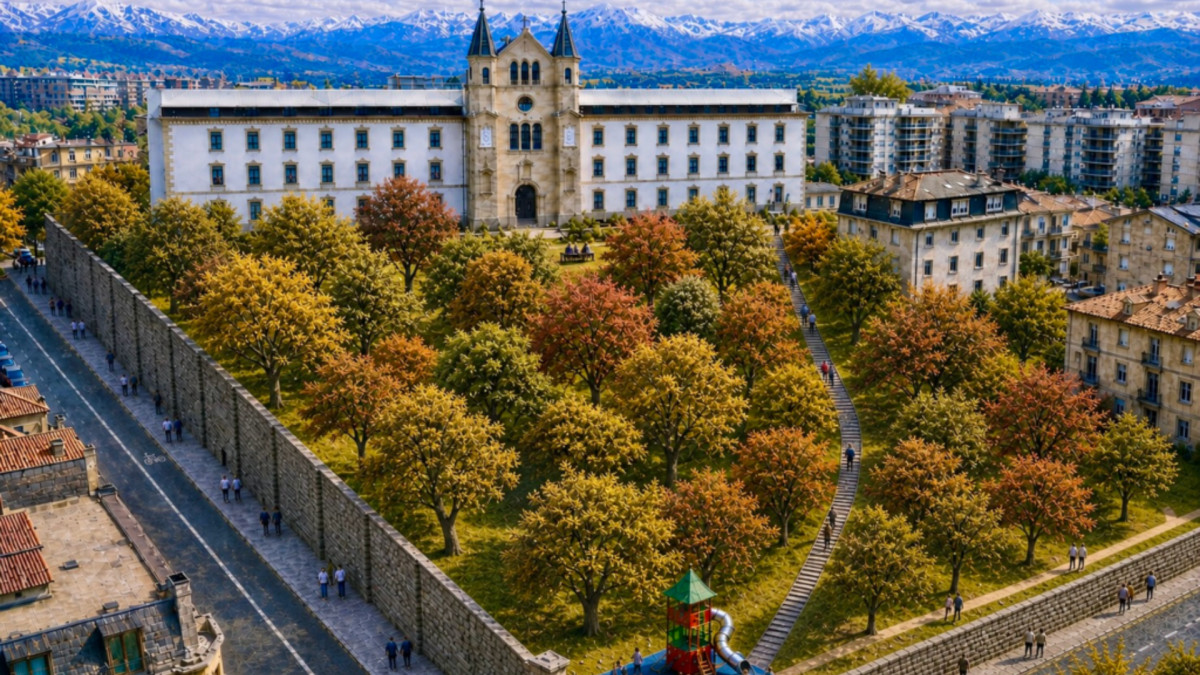
We tend to think that only large projects are useful and innovative for cities that want to be attractive, competitive and ambitious about the quality of life they offer to their inhabitants. But that isn’t true. Interventions such as a small park and a natural vertical garden can also be developed, highlighting a public space and bringing emblematic improvements to a neighborhood and to the environment. That is what I want to talk about.
We live in a era marked by real estate speculation, the interests of investment funds, and the progressive privatization of public space, the gentrifying effect of tourism and the homogenization of urban areas. In too many cases, cities lose identity, local heritage and memory. Meanwhile, housing prices rise and public spaces shrink. Against this, there is also a growing demand for citizens to become protagonists of the city in which they live.
The democratic strength of a society cannot be measured solely by its institutions, but also by the existence of real channels for participation and consultation in decisions. Especially when urban heritage, the environment or spaces destined for meeting and social life are at stake.
“Democratic institutions are strengthened when they listen, engage in dialogue and promote citizen participation”
The experience we are developing in San Sebastián, moving from theory to practice, shows that activating civic lobbies and organizing as collective intelligence allows influence over urban planning decisions when it is carried out with perseverance, creativity and constructive proposals. It also demonstrates that democratic institutions are strengthened when they listen, dialogue and promote citizen participation. In a broader context of political disengagement, these initiatives represent a way to rebuild trust between citizens and institutions and help institutional decisions gain greater legitimacy.
That is precisely the role played by the Civic Platform San Bartolomé in San Sebastián. Faced with the project of a large commercial complex (with more of the same) and its parking in a low-emission zone, approved in 2015 on the green hillside of the hill that housed the San Bartolomé monastery, it leads the defense of a public park and a natural vertical garden on an adjacent 1914 stone wall, 30 meters high and 125 meters long, both in the city center.
We began by treating it as an urban speculative operation, backed by an illegal modification of the General Urban Plan for that territory because it did not meet the legal standard for the provision of open spaces and green areas in that area. That led us to file a lawsuit in court and challenge the license.
Our working method consisted of jointly submitting complaints and proposing alternatives at the municipal registry, to the mayor, the local government, the municipal groups and the media; contacts with local opinion leaders and city entities; drafting numerous articles sent to the media; holding technical working meetings with collaborating professionals and assemblies with neighbors affiliated to the Platform.
In nearly four years we had to file appeals with the City Hall and the courts; present seven complaints to the Basque Ombudsman (Ararteko) for lack of transparency by the City Hall in not providing access to files or data on income obtained by the City in the overall San Bartolomé urban regeneration operation; convene multiple press conferences, inside and outside the City Hall; file nine petitions under Organic Law 4/2001, governing the right to petition (without receiving a response); we have met with all the parties and with the mayor, and we have contributed funds as activists to cover the costs of actions for a association that brings together five hundred people.
“After twelve years during which I considered that operation essential, we have managed to get the City Council to renounce its execution and commit to our proposals”
Therefore, we can affirm that the Platform is a reference for good practices in democratic participation. We are a sectoral, plural and non-partisan civic movement, registered as an association that acts with a creative and innovative strategy in defense of citizen participation and transparency in urban planning and the environment. The struggle, misunderstood and discredited by the City Hall, has meant that urban planning, in this case, does not serve the economic interests of the City of San Sebastián, the real estate sector or an investment fund. And it has managed to prevail that the general interest, sustainability and the right to the city. Something that seemed impossible to achieve.
In short, after twelve years during which I considered that operation essential, we have managed that the City Hall renounce its execution and commit to the proposals we had been demanding through different channels: opening the local government to dialogue and citizen consultation; declaration of expiration of the construction license for the commercial building and its parking; initiation of a targeted modification of the General Urban Plan so that the hillside of San Bartolomé is reclassified as green space, with the opening of a citizen participation process to define the criteria for the public park, and a study to convert the San Bartolomé stone wall into a vertical garden that helps curb climate change and promote biodiversity.
“We have creatively used the tools offered by communication technology”
It is important to highlight that, in the strategy to mobilize public opinion, we have creatively used the tools offered by communication technology: a website, platformatasanbartolome.com, updated and interactive; sending informative emails from the Platform; debate presence on social networks; the use of AI tools to generate images; a permanent online presentation of our proposals, and an in-person exhibition, in preparation, to disseminate the proposals in the Cristina Enea Environmental Foundation’s exhibition gallery, and, finally, an online archive of news and images about the controversial center’s operation.
The Platform is now working on the culmination of a proposal for hillside recovery and the creation of a public park, as well as for the conversion of the wall into a vertical garden. It does so through assemblies of its members, dialogue with the institutions and thanks to the collaboration of environmental organizations, expert gardeners-landscapers, engineers, architects, photographers, documentarians and lawyers, all as neighbors.
