
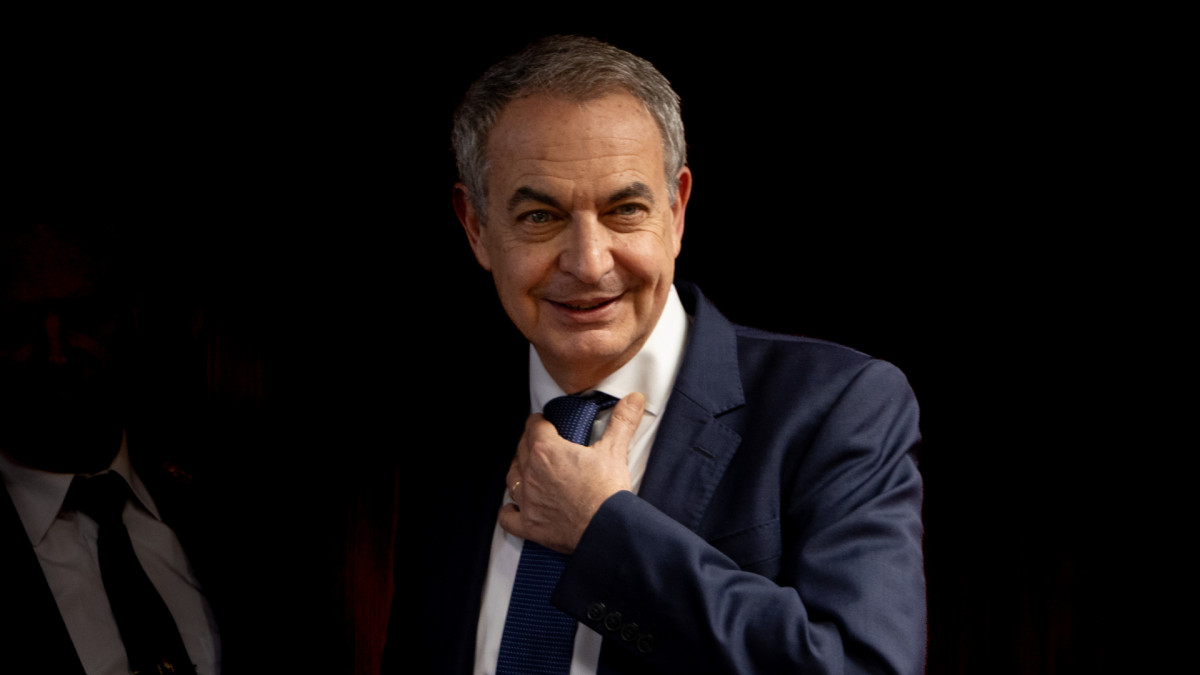
Apparently, in a triangle it is the vertices that connect everything; therefore, that is the essence of such a geometric figure. But in politics, not everything is as it seems: there are invisible vertices, even external ones, which, inexplicably, end up forming plots and subsequent patterns. There are many cases, but today there is one that, as investigations unfold, paradoxically raises more questions than answers. This is the Zapatero case, one that has forged a triangle, a network of opacity linking Washington, Caracas and Madrid.
Before focusing on the Spanish capital as the vertex where everything converges, let’s go back to the beginnings. As everyone knows, former president José Luis Rodríguez Zapatero was charged on May 23 by judge José Luis Calama of the Audiencia Nacional. He is accused of leading an “organized and stable structure” dedicated to influence peddling and money laundering, that is, a case whose epicenter is the rescue of the airline Plus Ultra, which received 53 million euros in 2021. The operation, presented as support for a strategic company, ended up becoming the thread that sparked the investigation.
“Caracas was not only a place of political mediation, but a node of dark capital that would end up staining a former Spanish president”
First vertex: Caracas as the setting. The link to Venezuela is central: Plus Ultra had Venezuelan capital and partners tied to the chavismo. The investigation (now led from Washington) points to Zapatero possibly having used his mediator role with Caracas to facilitate shady dealings, in addition to having received commissions of up to 1.9 million euros. Moreover, shell companies like Análisis Relevante posed as consulting firms to justify payments with a legal façade. In this way, Caracas was not merely a site of political mediation but a hub of dark capital that would end up sullying a former Spanish president. This case triggered alarms about Zapatero’s role as a political and diplomatic mediator. As journalist Lucía Méndez already stated in her column “His luck ran out: his friends told him to be careful,” and indeed, Zapatero’s ties to the opaque operations of Plus Ultra and Caracas would prove extremely costly.
Second vertex: Washington enters the scene. The American agency Homeland Security Investigations (HSI) cooperated with the Spanish National Police, providing documentation on money-laundering operations linked to Venezuela. The Department of Homeland Security (DHS) confirmed last month its involvement in the case, giving the investigation a transnational dimension. It is worth noting that, as one article in El País points out, the United States had already tried to block accounts in Swiss banks related to these operations, strengthening the global scope of the scandal.
“This is the first time, since the democratic transition, that a former Spanish president faces a formal corruption charge”
Tercer vértice: Madrid as the judicial epicenter of the case. Here is where everything converges. This marks the first time, since the democratic transition, that a former Spanish president faces a formal corruption charge. After the Economic and Fiscal Crime Unit (UDEF) searched Zapatero’s Ferraz office, there was no room for doubt: more than one hundred pieces of high-end jewelry, luxury watches, as well as documents from shell companies and false invoices found in his safe put him under the scrutiny of the judiciary.
Now, Pedro Sánchez defends Zapatero’s right to the presumption of innocence; the hearing for the former president’s testimony was postponed to next week and, as J. P. Carroll notes in this outlet, although the United States has given little coverage to the case, it is perceived as a political and judicial earthquake of transatlantic dimensions. What are the key factors of this case and what would be the political impact in Spain of a plot whose epicenter is Caracas?
The Geometry of an Alleged Global Corruption Case
In Washington the inquiry began, as if money had a scent and the investigators from Homeland Security Investigations could follow it through invisible tunnels. The reports speak of transfers crossing through tax havens and companies linked to Zapatero. And thus the triangle was drawn with precision: Caracas as the origin, Washington as the tracker, and Madrid as the judge. Put on a map: every figure seems like a footprint; every invoice, a clue; every name, an echo of corruption.
The Venezuelan key. Caracas is the city from which, allegedly, funds were supplied, disguised as impossible consultancies and contracts that were never executed. In this way, the money traveled like a specter and became hidden commissions in shell companies. There were connections to Plus Ultra, to chavismo, and to a system that, according to the United States, turned political favors into hard euros.
“Washington pushed the investigation, providing information traced from Venezuela; Caracas appeared as the origin of the opaque money; and Madrid is the judicial stage”
Then comes Madrid, the judicial epicenter and the setting of one of the strongest scandals within Spanish socialism. When the UDEF opened the safes in the former president’s Ferraz office, names appeared that only further complicated the case: Laura and Alba Rodríguez Espinosa, the daughters of José Luis Rodríguez Zapatero. After authorities reviewed the false invoices, emails and other documents found there, both were linked to the investigation through their company Whathefav. In other words, the impact of the case did not stop at politics, but reached into the family.
And thus the triangle closes: Washington spurred the investigation, providing information traced from Venezuela; Caracas appeared as the origin of the opaque money; and Madrid is the judicial stage where it will be decided whether Zapatero is innocent, or whether this scandal reminds us of the corruption of the nineties. In the middle of the plot, the former president is caught in a geometry that seems written by a narrator obsessed with evidence, like Sherlock Holmes examining every detail, every minutia. Only, in this case, the scandal is not only judicial, but geopolitical, because the United States appears as the observer, Venezuela as the supplier, and Spain as the judge.
Incidentally, and as one would expect, this scandal has fanned the flames between the two Spains: the left and the right. Again, quoting Lucía Méndez, in another one of her columns she asserts that this case will have consequences not only for the PSOE, but for the entire left. On the other hand, journalist and director of elDiario.es, Ignacio Escolar, maintains a cautious stance: he acknowledges that there are serious indications in this case, but insists that there is not yet direct evidence implicating Zapatero. In his columns and on X, he emphasizes that the collaboration of Homeland Security Investigations with the UDEF was key to the investigation, though he warns that the judiciary must prove whether the former president personally participated in the opaque dealings.
What is the political impact? Undoubtedly, the notion of a political earthquake remains present. While Pedro Sánchez has reiterated his “full support” for his predecessor, some allies such as the PNV or Coalición Canaria have suggested that the route could be to call elections or to table a motion of confidence. The only certainty is that the final word will come from the judiciary. Nevertheless, regardless of the judicial decision that emerges from Madrid, Washington, as in any matter where the word Caracas is involved, will continue to investigate and dispatch its investigators to probe to the deepest depths.
