
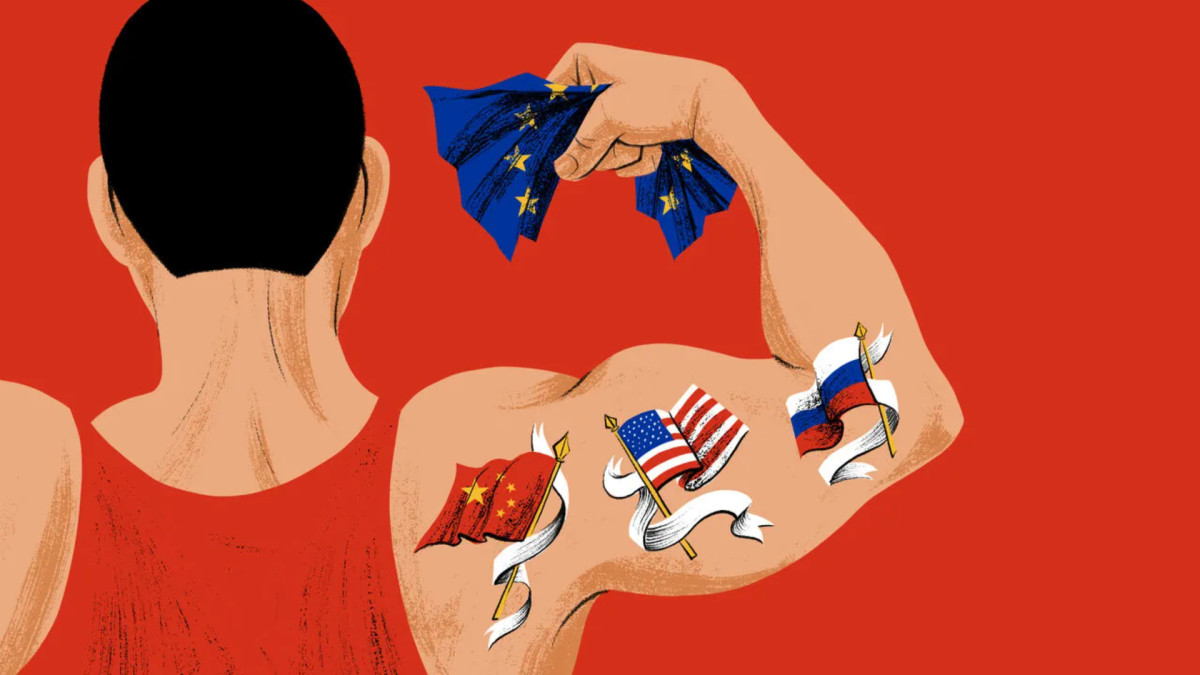
For the hard men who govern the United States, China, and Russia, Europe is soft and, therefore, doomed. The disdain of presidents Donald Trump, Xi Jinping, and Vladimir Putin runs broad and deep.
By branding people by their origin, Trump’s lieutenants present the presence of migrants, even second-generation ones, as proof that Europe is committing a civilizational suicide. The European Union’s need to seek consensus among twenty-seven countries is used by the United States, China, and Russia to apply divide and conquer. A looming trade conflict between the EU and China is on the horizon, while Europeans panic at the possibility that Chinese exports will leave local workers jobless. In response, as The Telegram has learned, Chinese envoys have urged Europe to learn from the United States. According to their account, Trump imposed tariffs on China last year, but he was hit even harder. As a result, the United States now respects China. They refer to China’s 2025 threats to restrict shipments of essential rare-earth minerals. The implicit message is blunt: China defeated Trump. Who do they think they are, the Europeans?
China is losing patience with European demands that its companies stop supplying the Russian war machinery. Ukrainian drones are also full of Chinese components, and China looks the other way, according to Chinese officials who have conveyed this to European governments. And they press: to what extent do they want to push export controls?
“China is losing patience with European demands that its companies stop supplying the Russian war machinery.”
Europe’s vulnerabilities were laid bare at the Stockholm China Forum, held on June 4 and 5. The forum, a closed-door gathering of political and business leaders, officials, and academics from the United States, China, and Europe — the EU, the United Kingdom, and some other Western countries — was co-organized by Sweden’s Ministry of Foreign Affairs and the think tank German Marshall Fund. I have attended these forums since 2008. This year’s was one of the gloomiest.
After China managed to intimidate Trump with controls over rare earths, the United States reached a fragile truce backed by threats of tariffs and export controls on chips. The EU markets offer some leverage, but cannot be easily used, due to economic dependencies on China and the ties of economy and security with the United States.
As the U.S.-China technological competition accelerates, Europe is falling further behind. In Stockholm, Chinese participants labeled Europeans as being too “comfortable” to compete. One of them offered a real example: a European executive of a Chinese technology company told his boss that an overwhelming workload was threatening his marriage. “Well,” replied the Chinese boss, “it’s clear you have the wrong wife.”
Yet, amid the gloom, this columnist was struck by a contrary idea. Perhaps, in this era of radical uncertainty, the European approach, softer and more consensus-based in work and in politics, might prove useful.
“As the US-China tech competition accelerates, Europe is falling further behind”
Trump, Xi, and Putin see a world shaped by power and the will to wield it. The American and Russian presidents endorse a global order in which “peace” is guaranteed when the weaker countries bow to the stronger ones. Both condemn Ukraine for defending itself against Russia’s unprovoked invasion. China is more ambiguous, but when its diplomats accuse the West of provoking and prolonging the war by ignoring Russia’s legitimate security interests, they apply the same logic.
The view of international relations in which strength justifies itself has its counterpart in domestic politics. People around the world are succumbing to the majoritarian doctrine of the winner-takes-all (the winner takes it all). At first glance, that resembles democracy, since power is exercised in the name of a legitimate majority and in respect of the rule of law. But in these systems, minorities and dissidents have little or no rights. What is offered to citizenship is conditional security, so long as one remains on the right side of the dividing line between majority and minority.
It is true that the United States, a fraught but functioning democracy, is vastly freer than China and Russia, both majoritarian tyrannies. But, like Putin and Xi, Trump understands politics as a game in which the winner takes all. To varying degrees, each acts as if the State serves the interests of a single ruling party, demonizing opponents as internal enemies.
Strongmen boast of earning legitimacy by being efficient and effective. The deep unpredictability of the future will test that claim. When leaders place their trust in power, and not in laws and treaties, they bet on staying strong. Trump, Putin, and Xi are all leaders willing to take risks, seemingly drawn to dangerous adventures from the Middle East to Europe’s eastern borders, or the Taiwan Strait. No one can safely predict what the relative strength of the United States, China, and Russia will be in five or ten years.
“When leaders place their trust in power, and not in laws and treaties, they bet on staying strong”
Thanks to artificial intelligence and other disruptive technologies, the fault lines between winners and losers in the economy are about to move abruptly. No one knows which industries will disappear or prosper, nor what kind of education will make people employable. In such an era, who can be sure of belonging to a “good” majority that plays by the rules and therefore deserves to be safe?
Building coalitions while the world is turning upside down
It’s easy to mock Europe, with its unsustainable welfare systems and long vacations. But there was nothing ridiculous in its post-1945 bet on a consensual, rules-based policy. The continent’s numerous castles were not recently built by tourism ministries. They stand as witness to centuries in which Europeans resolved their disputes by blood and fire. History taught Europeans to fear tyrannical majorities. Time and again, across the centuries, lines moved. Without inalienable legal rights for individuals, belonging to the wrong religion, social class, or group could mean sudden ruin, exile, or something worse.
Europe has problems. But there are scenarios in which its rules-based approach pays off. The United States can choose a president who seeks to serve the whole country, not just one political tribe. A United States open to diverse cultures and opinions could ally with Europe to counter China and Russia’s predatory practices. Perhaps the hard men aren’t the owners of the future. Maybe consensus politics could help prevent the citizenry from panicking. The softness may not yet spell Europe’s doom.
