
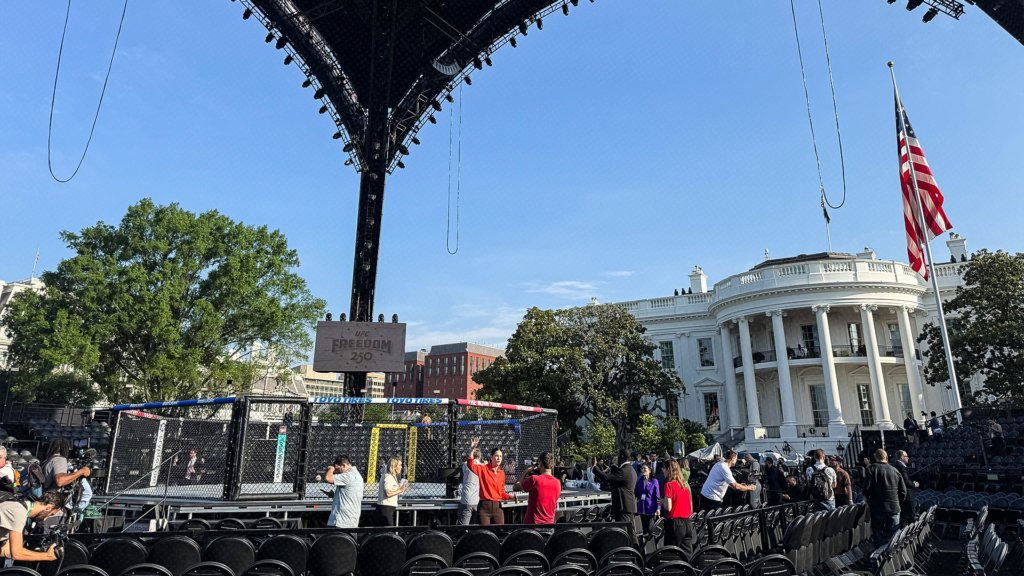
A cage match on the South Lawn may seem like an odd way to commemorate the Founding. Yet it mirrors the current state of our politics.
As you stroll the White House South Lawn today, a few details come into view. There’s a tiered dais equipped with microphones and music stands. Folding chairs fill a circular seating area, each stamped with: “WARNING: PLEASE DO NOT STAND ON CHAIR.” The stairs carry the logo crypto.com. And towering above all, there is “The Claw”: the massive, four‑legged, provisional canopy hovering 92 feet in the air, finished in red, white, and blue.
Selfies abound.
On Thursday, the Trump administration offered the press pool a preview of the Ultimate Fighting Championship (UFC) Freedom 250 event slated for Sunday night, when an international roster will clash for multiple titles. There was no formal briefing. Yet the White House allowed us to wander for roughly half an hour to soak in the spectacle. After a few minutes, I passed attendees crowded around the centerpiece—the octagon—for self-portraits. One woman even attempted to step into the ring; the attempt, halted by an official standing nearby, was brief.

UFC Freedom 250 has, depending on who you ask, become the apex of America’s semiquincentennial celebrations. A string of cage bouts is an unconventional way to honor the Founding. Yet it could be the perfect event to encapsulate this moment in time.
The arc of mixed martial arts itself functions as a microcosm of social change. It would have been hard to imagine the sport gathering a sizeable following only a few decades ago when it faced bans in 36 states, and when pay‑per‑view outlets shunned cage fighting even as they tolerated adult entertainment.
This isn’t merely a cultural trend anymore. “There are only a handful of things that bring people together in one spot, at one time, united by a single interest,” said Secretary of State Marco Rubio in announcing a public‑private partnership between the federal government and UFC. “We need more of those. We need more of those formats and settings where people can connect, enjoy something together, and discover common ground, and if you’ve attended UFC events…the crowd is as diverse as you can imagine.”
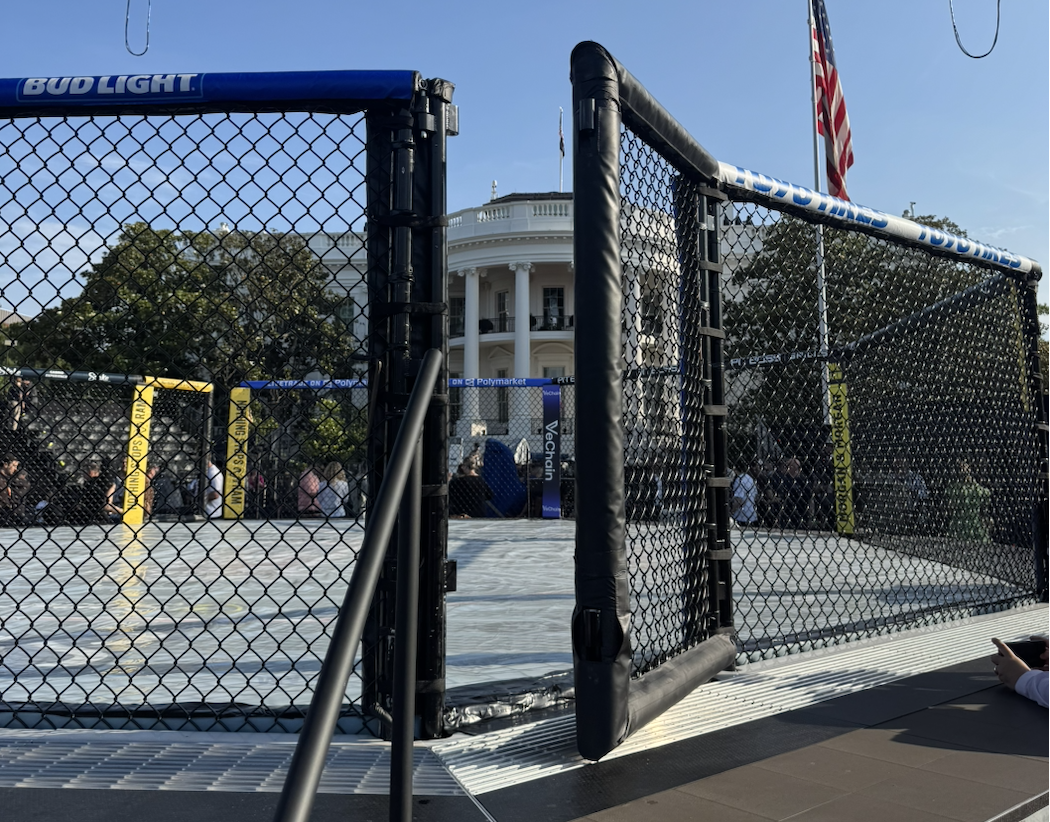
There is a certain irony in insisting that a sport built on battering one’s opponent—the audience tends to skew male and young—is a force that unites. Yet Rubio is still correct in saying it mirrors where we stand today.
Look no further than the nation’s birthday festivities. They began under America250, an initiative born a decade ago with broad cross‑partisan support. President Donald Trump countered with his own project, Freedom 250, sparking a contest of aims that has taken on a life of its own. A celebration that would cross party lines to honor founding principles and the freedoms that define America would have been ideal. It would also have required politicians to walk the talk about unity while still seizing every chance to attack rivals. That kind of rancor isn’t unique to semiquincentennial debates. What better emblem of today’s moment than a spectacle drenched in blood?
Perhaps this is an odd way to exalt American exceptionalism. Yet what it sacrifices in terms of solemn remembrance, it gains in immediacy. After all, UFC Freedom 250 doesn’t merely kick off commemorations of the Founding, whose anniversary is still weeks away. It also aligns with a different milestone: June 14, 1946—the day Trump was born.
