

The mysteries of China remain almost inscrutable to the European observer, and for this reason, during the last week of May I participated in a visit by the European Parliament to Beijing and Wuhan, in search of some certainty that could also help me reassess my initial impression of the country, formed in the spring of 2012 when I attended a seminar in Shanghai at the Europe-China Business School (CEIBS), while pursuing the second year of my master’s in management and business administration at IESE.
Well then, I now consider it necessary to convey to my “representatives” my impressions from this institutional visit.
This opening note, to be followed by a second part, is divided into two sections. First, a quick interpretation of China’s strong economic growth from the eighties to the present decade. Next, the problems facing the Chinese economy are analyzed, which has seen its growth rate halved compared to the expansion rates of previous decades. In this section, the issue of the “involution,” identified by the Chinese authorities themselves, is addressed, and the major pillars of the fifteenth Five-Year Plan that aims to correct it are presented.
In a subsequent installment, a rapid political panorama of the country will be provided and the development of a possible European Union response will be explored. But for now, let us begin at the beginning.
The European Parliament member and S&D coordinator in the European Parliament’s Committee on Economic Affairs, Jonas Fernandez, during his visit to China. Photo: European Parliament
How Did We Get Here?
Politically, economically and socially, China has built and consolidated in recent decades a prominent role on the global stage, reclaiming an international position it held throughout history up until the dawn of the Modern Age. At that time, Europe threw itself into the seas to conquer the globe while China closed itself off, hindering sea ventures, prohibiting shipbuilding, and limiting foreign trade under the Ming dynasty. This isolation, coupled with Europe’s economic and political development after major discoveries, the Enlightenment, liberal revolutions on both sides of the Atlantic, and the Industrial Revolution, would lead China to the century of humiliation inflicted by the early Western industrial and maritime powers and their “Opium Wars”, in which the already ailing Qing dynasty would fall before that external pressure and its own contradictions.
After the secular dynasty collapsed in 1912, China underwent decades of civil wars and internal fragmentation, and had to contend with continental occupation, especially from Imperial Japan and Russia, a stagnation from which it would emerge with the victory of the Communist Party and the proclamation of the People’s Republic of China in 1949 to enter another period of intense instability under Mao Zedong.
“China, in political, economic and social terms, has built and consolidated in recent decades a prominent role on the global stage”
Mao Zedong steered a vigorous industrialization in his early years at the helm with Soviet support, though later he reintroduced China to permanent chaos. From the Hundred Flowers Campaign (1956-1957) to the Cultural Revolution (1966-1976), passing through the Great Leap Forward (1958-1962), Mao would end up tearing the country apart from top to bottom. It is hard to find in history another political leader so long-lived in power and so utterly disoriented when exercising that leadership.
Thus, by the late 1970s, China was scarcely a wasteland marked by famine and repression. In that state of stagnation, only Zhou Enlai, the prime minister who managed to preserve his position during the Cultural Revolution, kept a minimal order and a vision of China’s role in the world. Yet the country hit rock bottom after more than a century of decline, domination, fragmentation, chaos, fantasies, and underdevelopment.
The rise to power of Deng Xiaoping signified a fundamental redirection of the Chinese vessel that, economically, was framed under the euphemism of “socialism with Chinese characteristics,” which meant embracing markets and capitalism while keeping the ruling power in the hands of the Communist Party. The problem to be addressed was not so much the transition from a planned economy to a market one, as occurred in the Soviet Union, but the construction from its foundations of an orderly economic model that China had lacked during Mao Zedong’s decades in power. Undoubtedly, the Chinese leader was more focused on visions and permanent revolutions, perhaps in pursuit of the “new Chinese man” under an oriental-Marxist teleology, than on the country’s economic development.
Xiaoping steered China toward capitalism from almost nothing, a process perhaps less complex than dismantling the Soviet economy in Russia, since the latter, albeit inefficient, carried a bureaucratic-administrative structure that China lacked after Mao. On the other hand, while the Soviets tried to modernize the economy (perestroika) and politics (glásnost), Xiaoping concentrated solely on guiding that market-opening without altering the autocratic nature of the regime, though improving its predictability. Perhaps these two aspects—the initial conditions differentiating the Soviet Union and China and the degree of reform ambition—help to partially explain the evolution of both countries from the eighties onward.
“The arrival to power of Deng Xiaoping signified a profound reorientation of the Chinese ship, which, economically, was framed under the euphemism of ‘socialism with Chinese characteristics’.”
In any case, focusing on China, the acceptance of capitalism with a certain gradualism, from the early moves under Xiaoping’s rule to its entry into the World Trade Organization (2001) under Jiang Zemin, generated decades of rapid growth. This pattern, the shift from autarkic policies toward market development and integration into the global economy, had previously been followed by other countries on their path to prosperity. Japan, South Korea, or even Spain experienced a phase of growth explosion driven by liberalizing policies (in our case, the Stabilization Plan of 1959) marked by the relocation of labor from the agricultural sector in rural areas—where productivity might even be negative—toward new industries, directed and financed from the public sector. The ample “idle” rural labor moved to the cities and industry, triggering a growth surge.
This growth model, as I said, is common to other countries’ experiences, and its long-term persistence depends on the starting point. That is, it depends on how far the country was from fully utilizing idle resources at the start of the liberalization process, and how many resources it could mobilize during that process. Likewise, these processes are subject to the emergence of political, economic and social imbalances that likewise determine their success.
Thus, China began that path from almost nothing. Its population, close to 1.0 billion and growing until quite recently, has allowed the drainage of rural population toward industrial activities with positive productivity to last for several decades, from the eighties to probably this early part of the twenties of the present century. The Asian Tigers or Spain experienced shorter periods of hyper-growth, given, among other reasons, that the nominal volume of idle resources to mobilize was infinitely smaller.
This interpretation of China’s economic success does not diminish a jot the capability with which the Communist authorities have guided this expansion process for so long in a country of enormous size. As noted, these development stages also generate new sources of imbalance. The internal tensions that surfaced—from political disputes to managing rural-to-urban population flows, through building public services capable of preventing destabilizing social fractures or the institutional accompaniment of various interest groups—show an extraordinary capacity for adaptation. Now, however, after this economic success, we still do not find the construction of a revolutionary theory of economic policy that has toppled all prior academic paradigms.
In this sense, under this interpretation of Chinese development, we should ask how long China can sustain growth rates that have lifted hundreds of millions out of extreme poverty and have legitimized an autocratic regime, or whether it will fall into the “middle-income trap,” as other countries have, turning consent into disenchantment.
How this question is answered will crucially determine the scenarios we should work with for the coming years, given China’s global influence and, therefore, the policies and the accommodation we Europeans must seek with the renewed Middle Empire.
“After this economic success we do not find the construction of a revolutionary theory of economic policy that has destroyed all prior academic paradigms”
In my opinion, China has already entered a period of economic slowdown, as current growth figures show. At the same time, there is also the emergence of sectoral and financial bubbles resulting from its state-led policy. Thus, growth rates will continue to moderate while we wait to see whether Chinese authorities reorient their economic policy, which must, first and foremost, erase the losses incurred from failed industrial bets in economic terms.
I do not anticipate, however, a recession or systemic crisis. It is impossible to forecast future scenarios given the country’s information opacity. In any case, for now, there are no signs to suggest the current obstacles to growth in the Chinese economy will be overcome soon, nor is there a clear horizon for renewed bets with the level of ambition Deng Xiaoping propelled in the eighties. Let us proceed.
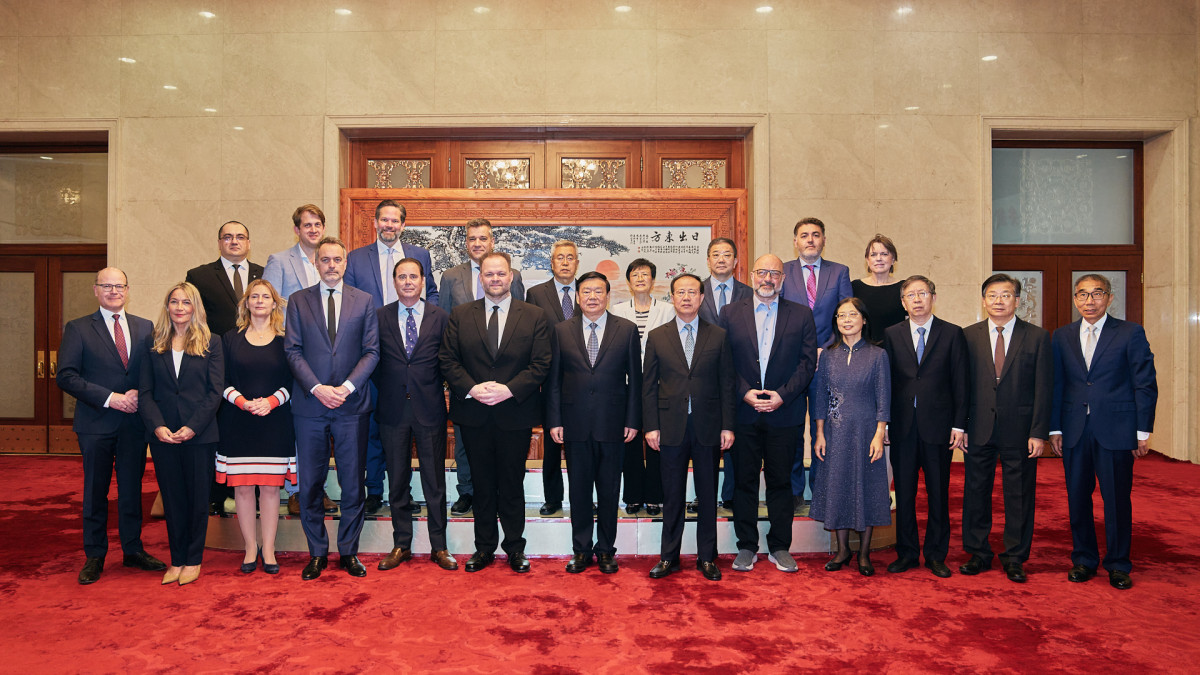
In Beijing, the 3rd EU-China Interparliamentary Meeting took place, with representatives from the Chinese National People’s Congress. Photo: European Parliament
A Preliminary Analysis of the Government’s Economic Plans
First of all, demographics always take precedence. China reached its population peak in 2021-2022, with more than 1.4 billion people, but now faces challenges that sound familiar. At present, the fertility rate hovers around one child per woman of reproductive age, which signals a population decline, potentially dropping to 1.3 billion by 2050, and a dramatic reduction to 600–800 million by the end of this century. The review of the one-child policy or the current push to boost birth rates confront economic and cultural constraints that do not bring any correction to the current trends. Additionally, the youth unemployment rate is around 16%, which also signals delaying family formation and, hence, motherhood.
“At present, there are no signs to suggest the current obstacles to growth in the Chinese economy will be overcome soon”
Thus, China begins to suffer a shortage of a key production factor, the population, while the resource of moving rural workers toward industry is also running dry. Therefore, the demographic dividend that has propelled the Chinese economy for decades is fading, and the exact opposite effect is already looming: the demographic winter.
Secondly, dirigiste economic policies, characterized by industrial policy that has drawn the attention of all observers, also face serious challenges. The development of the current five-year plan, which culminates this year, has accumulated a real estate bubble that takes time to absorb. Housing prices have fallen for two and a half years, with declines of between 20% and 30%. This sharp collapse in real estate prices is eroding the main household savings asset, raising the saving rate and reducing consumption. Consequently, inflation in consumer goods and services, the CPI, ended 2024 at 0.2%, according to official statistics, while the GDP deflator, which also includes investment goods prices, shows negative rates.
Moreover, the overinvestment in housing leaves behind unsolved real estate debt in the banking balances. The central government is trying to absorb part of the bank losses, especially in local credit institutions owned by the public sector, by transferring bad loans to the central state to maintain credit flows. In any case, official statistics do not show an increase in mortgage delinquencies corresponding to the collapse in housing prices, raising serious doubts about the success of this balance-sheet cleanup and, in any case, increasing public debt held by the state.
“This sharp drop in real estate prices is depreciating the main saving asset of Chinese households”
This environment of zero or negative inflation signals a weak situation across domestic demand, victim of dirigiste industrial policies, whose investment bets have not found demand, a problem that could intensify in the coming years and that spills over to the rest of the world through the current account of the balance of payments.
This reality is evident in specific sectors, such as renewable energy. China has an installed capacity for solar panel production that doubles global demand. There is therefore no firm demand to absorb all the investment incentivized in recent years by the government. As a result, prices are collapsing, the sector is posting multibillion-dollar losses, and workforce reductions in some companies have already exceeded a third. And, of course, behind these problems lie bad debts from Chinese public financial institutions, whose delinquencies do not appear in bank balances, delaying the resolution of a grave issue for the country’s financial stability.
There will be those who argue that this excess capacity will yield future benefits, despite the current losses, justifying such views with theories about protecting nascent industries. Yet, if your installed capacity doubles world demand, you cannot exploit falling average costs soon enough to recoup current losses. That is why private analysts believe this sector must adjust its installed capacity by about 20% to 30% of its current size to restore profitability for firms.
In the short term, however, exports surge as China seeks external demand that domestic demand cannot supply, but at prices well below costs, which merely increases losses. China controls the global solar panel market, but that leadership has been built by destroying value. Meanwhile, consumers in other jurisdictions benefit from China’s industrial policy through subsidies flowing into their pockets, but these same exports exert destructive forces on the industrial fabric of the rest of the world with strong economic and political consequences.
Thus, China’s industrial policy, even with elements of competition aimed at the micro-distribution of public support (credit, taxes, regulation, etc.) among companies and regions, rests on macro-level resource allocation decisions that have already begun to show inconsistencies.
When an economy is far from its production frontier, misallocated resources have a relatively small negative effect on growth. It’s usually better to do something than nothing. However, when countries are already in the middle-income league and operating at full capacity, misallocating resources from more efficient investments to less efficient ones exacts a heavy toll on growth and welfare.
Consequently, not all that glitters in the implementation of China’s industrial policy is golden, as public European debates sometimes suggest. Government bets on batteries, electric cars, steel, cement, wind turbines, high-speed rail infrastructure, etc., encounter similar problems: low profitability or outright negative returns, with excessive capacity that markets cannot absorb within a reasonable horizon, generating deflation, bad debts, banking instability and destabilizing patterns of international trade.
It is worth noting that all economies have excess capacity in goods or services they export. The Chinese authorities are right to reject talking about their economy’s excess capacity. Spain, for example, has excess capacity in the tourism industry. There is no problem if those exports contribute to the profitability of the investments made. However, if your exports result from investments that you cannot monetize at home, and you also cannot monetize abroad by underpricing, the problem is not excess capacity but value destruction. This problem, very present in conversations with Chinese authorities, has been labeled as “involution.”
“Not everything that shines is gold in the implementation of China’s industrial policy, as it is sometimes perceived in public debate in Europe”
Nevertheless, despite the accurate diagnosis of the “disease,” the Chinese authorities misidentify its causes, at least in the meetings held during our official mission. According to our Chinese interlocutors, the ”involution“ is the result of predatory competition among companies operating in such markets, a dispute over market shares beyond any economic rationality that leads to prices below costs. Thus, the causes would lie in the extraordinarily high level of competition in the market.
However, the excess supply in sectors specifically promoted by the authorities through vertical dirigiste policies is precisely the fruit of those policies. Blaming excessive competition for falling prices is reminiscent of campaigns against “speculators” when a government fixes a maximum price on an imported good, which naturally leads to scarcity and the black market.
Therefore, Chinese authorities are right to insist on differentiating ordinary excess capacity from their problems of “involution.” On the contrary, they are wrong in identifying the disease’s causes, and therefore do not adjust their road map for industrial policy in the current five-year plan, where they simply redirect sectors to which similar support policies should be applied.
On the macroeconomic front, the Chinese government aims to strengthen domestic demand, essentially through consumption, to overcome the deflationary pressures and to monetize the installed investment. Thus, the government seeks to reduce its current account surplus, alleviating tensions of international trade that could prompt protectionist measures by third jurisdictions. To achieve this, it plans to expand social benefits coverage, from incentives for childbirth to strengthening public pension systems, which should reduce the propensity to save, intensified by the current housing crisis.
“The Chinese authorities are right to insist on differentiating ordinary excess capacity from their involution problems”
Now, however, reducing the current account surplus must also address its deficit in the capital and financial account, i.e., they must facilitate capital flows between Chinese households and firms and the rest of the world, moving toward liberalization of the financial sector and foreign investments.
In other words, the overall balance of the current account must equal the balance of the capital and financial account. This accounting identity is not a theory or a valuation. The relationship of an economy with the outside world, both in real terms and in the financial economy, must reconcile to yield the same net balance (though with opposite signs). Thus, a reduction in the current account surplus should be accompanied by a decrease in the deficit associated with financial relations with the rest of the world, i.e., they should facilitate a net inflow of capital into the country. Acting on one side of that accounting identity, the current account, without accompanying complementary measures on the other, the capital and financial account, only affects export and import volumes and not their net balance.
To meet the objective of reducing the current account surplus, the authorities must advance in the liberalization of financial flows and the facilitation of foreign direct investment. And for these policies, I have heard no proposal from Chinese authorities. Likely, reducing controls on foreign investment within the framework of the Communist Party’s business-control policy would be antithetical.
Thus, without a policy of support on the capital flows side, it will be impossible to reduce the current account surplus, so any policy to increase consumption that raises imports will also raise exports to keep the net balance on par with the capital and financial account, maintaining the current imbalance.
Additionally, the aging population, together with current deflationary pressures, high youth unemployment, and weak social policies, would require a public push to consumption and institutional reforms of substantial scope. In my meetings with Chinese authorities, when I asked about the need to roll out a social safety net worthy of the name to reduce saving rates, my interlocutors replied that they did not want to create a “society of the irresponsible.”
This response, which would delight our local neoliberals, reminded me of the term “Calvinist communists” used by a European official to describe the cultural influences shaping the authorities’ approach to social policy. It is therefore not the best starting point, from a strictly intellectual framework, to advance active policies that reinforce income redistribution, measures that, moreover, do not appear on any official list of the Chinese Communist Party’s objectives.
Without a plan to liberalize capital flows and attract investment, and with a weak policy to accelerate consumption, I would not expect any correction in the country’s macro variables, nor a shift in its growth model—from exports to domestic demand—that China needs to reorient its economic model and international trade to minimize the negative effects of China’s industrial “involution.”
“When I asked about the need to deploy a social safety net worthy of the name, my interlocutors said they did not want to create a ‘society of the irresponsible'”
Moreover, boosting public sector demand should redirect part of the budgetary efforts from current investment backed by its industrial policy toward the deployment of new social policies. However, the five-year plan shows no deep budgetary reorientation that would prioritize spending over investment at the level of the country’s challenges. Thus, in the industrial policy announced in that plan, there is a preview of sector bets by the government, but no changes in how those policies are implemented.
Undoubtedly, regional and corporate competition in implementing a dirigiste industrial policy reduces the inefficiencies inherent in such policies when territories and the public sector choose which regions and firms to back. These inefficiencies, in any case, carry lower costs when an economy is far from its production frontier, but they can be lethal if one is already operating at full capacity of the factors of production.
Nevertheless, the costs already present in the Chinese economy from a real estate bet without demand backing, or bets in solar panels and other sectors where installed capacity far exceeds not only Chinese demand but global demand, forewarn of growing problems for the sustainability of current growth rates.
Certainly, some of these new bets will succeed and perhaps lead China to lead certain sectors in global markets, but the overinvestment they bring—given the current problems of “involution,” which are not merely excess capacity but value destruction from selling below costs—will, without any learning curve on a sustainable timeline, not bode well for China’s economy.
In short, without institutional changes that activate public coverage of essential services (education, health, pensions) to reduce the savings propensity that aging will continue to drive, and a reorientation of public demand from investment to spending, i.e., from industrial policy to social policies, the transition from an investment- and export-led economy to one based on domestic consumption will not be possible. And this will not be possible without measures on financial markets that accompany that shift in the current account, which must be paired with a rebalancing of the capital and financial account.
Therefore, the problems of “involution”—whose causes the Chinese authorities do not identify well—prevent raising growth and welfare levels in the Chinese economy, and they will not be solved, as well as the destabilizing effects on global trade arising precisely from that “involution.”
