
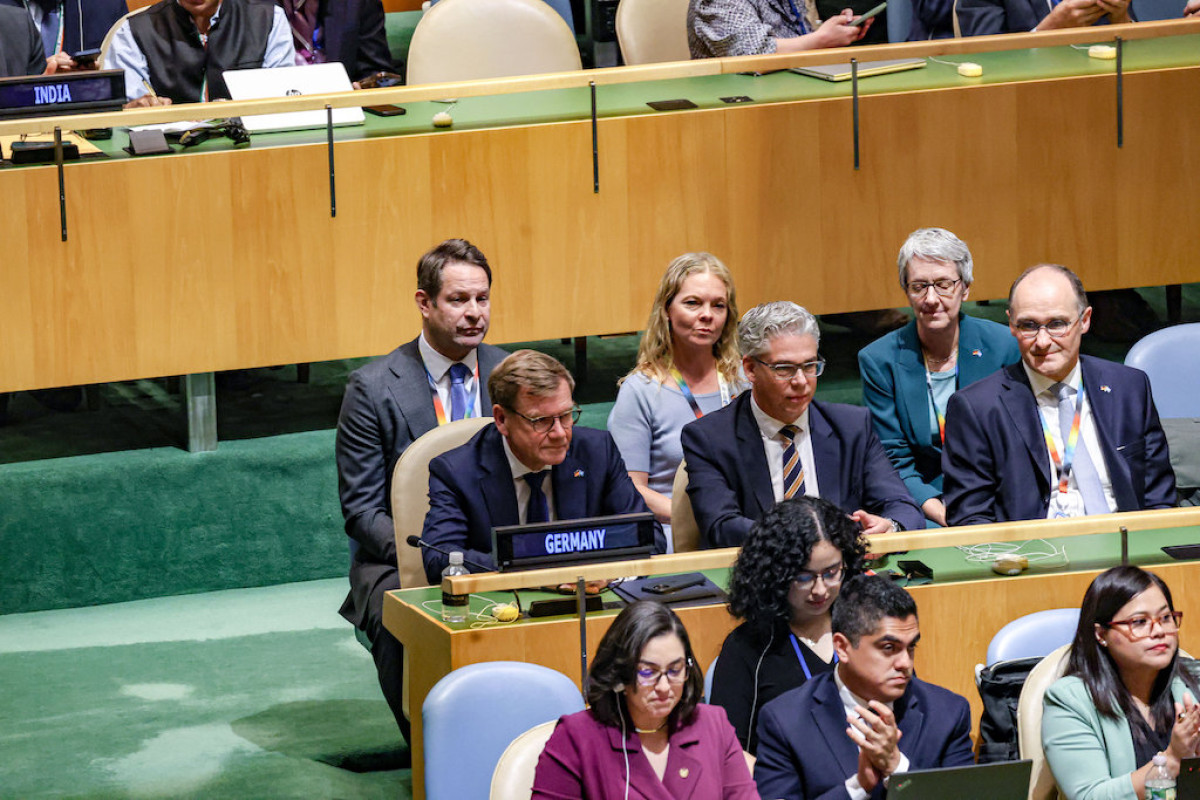
On May 20 last year, José Manuel Albares travelled to Berlin to hold a working meeting with the new German Foreign Minister, Johann Wadephul. Officially, the objective was to strengthen bilateral relations and address issues on the European and international agenda, from multilateralism to the conflicts in Ukraine and the Middle East. But the meeting also had a much more concrete (and sensitive) dimension.
Spain arrived in Berlin with two clearly defined diplomatic priorities. The first was the official recognition of Catalan, Basque, and Galician as co-official languages in the European Union. The second, the evolution of the European position on Israel and the war in Gaza. According to sources familiar with the meeting, both issues occupied a significant portion of the conversation between the two ministers. And in both cases Madrid encountered a negative response from Berlin.
“The position German on the co-official languages is particularly important for Spain”
The German position on the co-official languages is particularly important. Germany has for months been the main reference among the group of countries that continue to express legal and financial reservations about the Spanish initiative. Albares himself publicly admitted in Berlin that he had discussed the matter “in depth” with his German counterpart, though he avoided going into details. Sources from the German Foreign Ministry were more explicit: Berlin “has not changed its position”.
The second discrepancy turned on Israel. The official agenda of the meeting expressly included the conflicts in the Middle East and, that same day, Albares announced from Berlin the summons of the Israeli chargé d’affaires in Madrid because of the treatment afforded to activists of the flotilla bound for Gaza, which he described as “monstrous, disgraceful and inhumane”. Spain and Germany have held substantial differences for months regarding the European response to the Gaza war and the advisability of increasing political pressure on the Israeli government.
Fifteen days after that meeting, Germany suffered an unprecedented diplomatic defeat. For the first time in its history, Berlin failed to secure a seat on the United Nations Security Council.
“In some European capitals a different question is beginning to form. Had the backing of its European partners been sufficiently worked out? Or did they assume that it would come by inertia?”
In Germany, the debate has focused on the global reasons for the defeat. There is talk of the deterioration of relations with the Global South, Germany’s support for Ukraine, or the political cost of certain positions on the Middle East. However, in some European capitals another question is beginning to be asked. Had the backing of its European partners been sufficiently worked out? Or did Berlin assume that these would come by inertia?
Spain is a particularly interesting case because it highlights a phenomenon increasingly visible in European politics: the disappearance of automatic support. No one knows how Spain voted at the United Nations because the vote is secret. And there is no evidence of a direct link between bilateral disagreements and the outcome of the vote.
But diplomacy rarely operates in a compartmentalized way. Governments accumulate political capital or erode it. They build trust-based relationships or drift apart, usually in silence. And when the threads of the positions adopted are joined, seemingly disconnected files end up shaping a broader political climate.
Angela Merkel’s Germany could afford to say no many times. After all, it was the EU’s center of gravity. Its economic and political weight meant that, even when disagreements arose, few partners were willing to challenge its leadership.
“The logic of partner relations has become much more transactional”
Europe in 2026 is a different thing. The war in Ukraine has amplified national sensitivities. Industrial policies have rekindled competition among member states. The Middle East has highlighted deep political differences within the Union. And the logic of partner relations has become much more transactional.
In this new context, national priorities matter more than ever. For Pedro Sánchez’s government, the official status of the co-official languages has become a matter of political identity and European credibility. It is not just another file. It is a highly visible initiative of Spain’s foreign action and is also closely related to Junts’s support.
The issue of Israel also occupies an equally central place. Spain has made the defense of international law and a more demanding stance toward Benjamin Netanyahu’s government one of the hallmarks of its foreign policy.
Precisely on these two matters, the two governments acknowledged in Berlin that they remained in different positions.
That is why the question left by Germany’s defeat at the United Nations goes beyond Spain. It is time to ask whether Germany has understood to what extent its partners’ priorities have ceased to be secondary matters.
“Germans have a saying for this kind of situation: ‘Misere auf hohem Niveau’ — lamenting from a privileged position —. The paradox of someone who continues to hold a privileged position but discovers that some advantages are no longer automatic”
The defeat at the Security Council does not alter Germany’s economic weight nor its centrality in Europe. Even so, it suggests that even the continent’s leading power can no longer take the political backing of others for granted. The Germans have a saying for this kind of situation: Misere auf hohem Niveau — lamenting from a privileged position —. The paradox of someone who continues to hold a privileged position but discovers that some advantages are no longer automatic.
Perhaps that is exactly what happened at the United Nations. Germany remains an indispensable European power. But Europe in 2026 no longer operates on the basis of automatic support nor implicit deference. Even Berlin needs to persuade, negotiate and listen.
Because European leadership has changed and because it is no longer enough to be indispensable. Today, you also have to convince others that their priorities matter. While Berlin sought backing for one of its major diplomatic priorities, did it truly listen to the priorities of its closest partners?
