
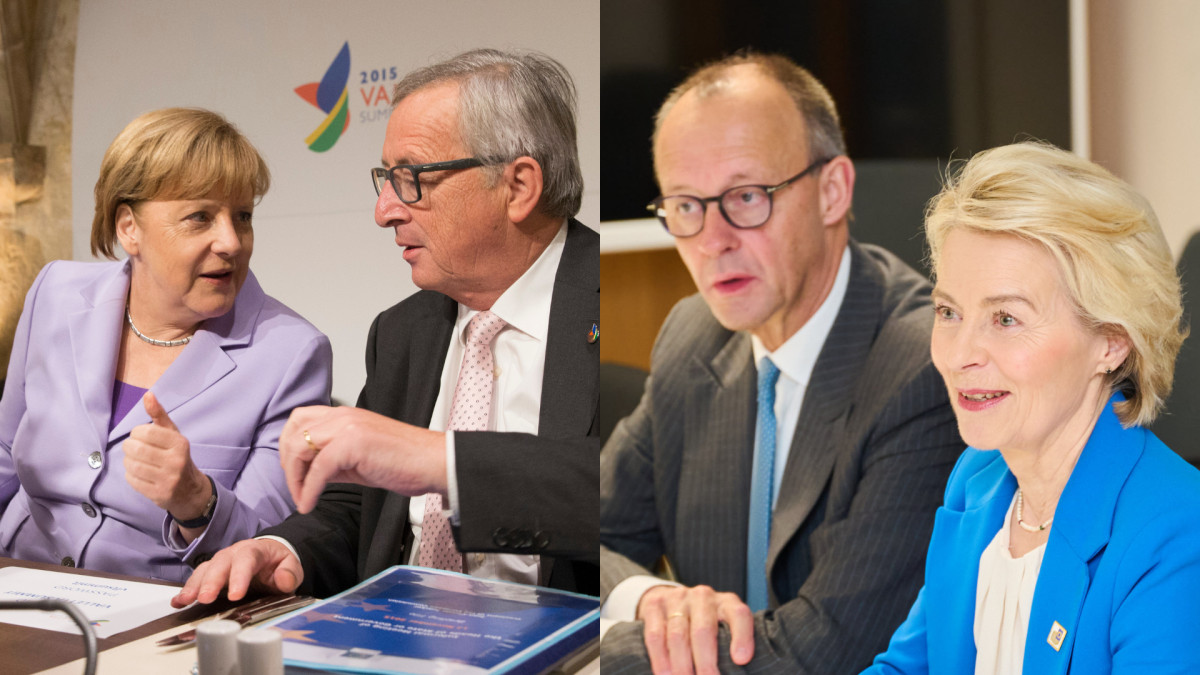
Let us suppose we are in 2016 and not in 2026. In the Brexit-era EU and not in the one of wars in Ukraine or Iran. Politics, like life, is full of “what ifs,” and the European bloc is not immune to that question, especially at a moment when Ursula von der Leyen, Kaja Kallas, Emmanuel Macron, Giorgia Meloni, Pedro Sánchez or Mette Frederiksen are in the spotlight: they are the decision-makers, and none of them, in truth, were in office eight, ten or fifteen years ago, when the Union experienced another turning point in its recent history.
“The key characteristic of the European Union is that it will never stop being an unfinished project”
In a dystopian exercise, it is worth asking how the bloc would act with leadership like Jean-Claude Juncker, Donald Tusk, Angela Merkel or Josep Borrell. The EU’s role would not have to be better or worse, but the way of doing things would indeed be different: due to experiences, personalities, alliances or political pasts that at that moment were present. They say Jenaro Talens and Nicolas Levratt in Quo Vadis, Europe? (Ediciones Cátedra, 2021) that— in a mantra quite repeated in Brussels— the key characteristic of the Union is that it will never stop being an unfinished project; that is, faces may change, but the challenges either persist or mutate, and not everyone would confront them in the same way.
Juncker, another personality
Jean-Claude Juncker would be hardly like Ursula von der Leyen. The temperament is different, to begin with, although Juncker himself acknowledges that criticisms of the German for accumulating competences were also experienced by him during the Greek crisis, to name but one. But if anything the Luxembourger managed to calm Donald Trump’s bluster during his first term, something the current president is far from doing, as evidenced by the criticized trade agreement last August or by her relentless drive to maintain a transatlantic relationship that already harms more than it benefits Europe. “The only predictable thing about Trump is his unpredictability,” Juncker himself acknowledged in an interview; that uncertainty is something Von der Leyen has not yet adapted to.
Diplomacy is another delicate matter, and Kaja Kallas bears little resemblance, for example, to Federica Mogherini or Josep Borrell. Leaving aside the Italian, Borrell’s presence on the global stage was far greater than the Estonian’s; Russia tried to corner the Spaniard in 2021, when Putin’s foreign minister Sergei Lavrov invoked Catalan independence after a critique of the Kremlin by the former high representative. But Borrell right now would likely have a much broader view than Kallas: Ukraine has always been the priority of the European Union’s top diplomat, less adept with Gaza or Iran… but there is life beyond Russia. Kallas excels in understanding what Putinism is, but lacks political finesse in other areas of total EU interest.
“If the Union came out relatively unscathed from the first loss of a member in its history, it was largely because Donald Tusk did not yield to fears”
Donald Tusk, to give another example, has also evolved. His presidency of the European Council was complex, as were those of Charles Michel or now António Costa, and perhaps the Portuguese and the Polish (currently prime ministers of their countries) are the ones who resemble each other the most: Tusk would in 2026 take the same decisions, or similar ones, to those taken by the Portuguese, because they are similar personalities as well. Tusk faced the United Kingdom’s exit from the EU and a post-crisis economic era that was quite challenging, with the first modern surge of the radical right; Costa can look to the Polish to understand that calm is a good ally of agility. A president of the European Council is there to seek solutions where none seem to exist, and if the Union came out relatively unscathed from the first loss of a member in its history, it was, in large part, because Donald Tusk did not yield to the fears that were raised.
Merkel is not Merz
The Franco-German engine would also be better structured than it is now, most probably. Merkel is not Merz and the question of how the eternal chancellor would address issues such as migration, but also Russia’s distancing or the stance on the new United States, as well as a certain camaraderie—so to speak—with China, as the new Berlin chief points out, will always linger. Merz is not at all heterodox and it is still early to speak of his legacy, but it well illustrates that in Germany—and in the EU—the “post-Merkel day” is more filled with unknowns than certainties, with a country navigating an economic and industrial crisis that in 2016 other states faced under the German iron fist.
France is in a similar process: a decade ago a Macron emerged who now appears to be approaching the end of his term without a clear successor and with institutional problems never seen in the French Republic. Meanwhile, the radical right awaits its moment and the Parisian aura of Europe’s saviors remains in the messaging, but not so much in deeds. The Franco-German axis will survive everything, because it has done so before, but it increasingly needs more footholds because by itself it does not keep the European Union moving.
The unity in 2016 was not a problem; now, it often is. It was visible in Brexit, yes, but also in a first term of Donald Trump that was much less tumultuous — far less — than the current one. Today, however, within the European Union fractures have become evident in very concrete cases: years of blockage of the migration pact, with countries like Hungary rejecting refugee-sharing systems; Viktor Orbán’s government clashing with Brussels over the rule of law, which has led to the freezing of European funds; divisions over the energy response after the invasion of Ukraine, with Germany prioritizing its own industrial interests; or budgetary tensions, which persist, continuing to reveal what the EU really is: a place of agreements and eras, where pacts are possible, but where there is no era identical to the previous one.
“Despite those advances, Madrid still cannot match Berlin, Paris and, at times, Rome. For one reason or another, Spain, as in 2016, remains a ‘middle power’.”
And Spain? Its role is far more active now than a decade ago, when the country was still peering out after the Great Recession and barely leading debates at the European level. Now the government of Pedro Sánchez, with varying degrees of success and luck, heads Trump’s “no to war” stance on Iran, has steered energy measures due to the war in Ukraine and has fervently defended the Palestinian cause, often nearly solo, earning praise and also some significant criticism. The latest step, that said, has been to rally nearly all European allies in rejecting military action in the Middle East, as demonstrated at the last European Council summit. Yet there is a caveat: despite these advances, Madrid still fails to rise to the level of Berlin, Paris and, at times, Rome. For one reason or another, Spain, like in 2016, remains a middle power within the EU.
In short, the world changes and so does the European Union. Contemporary Europe, despite the upheavals of the last decade, still contemplates itself in the reflection of its earlier years: a union that progresses through subtle agreements, prioritizing mutual support and plurality as its guiding principles. Its processes remain measured and ceremonial, where understanding arises from precise balances, and that collective purpose endures, like an unbroken current flowing beneath the conflicts of the moment. Although the protagonists and the difficulties vary, the structure of understanding persists, that tenacious effort to orchestrate the diversity of opinions into a harmonious collective.
