
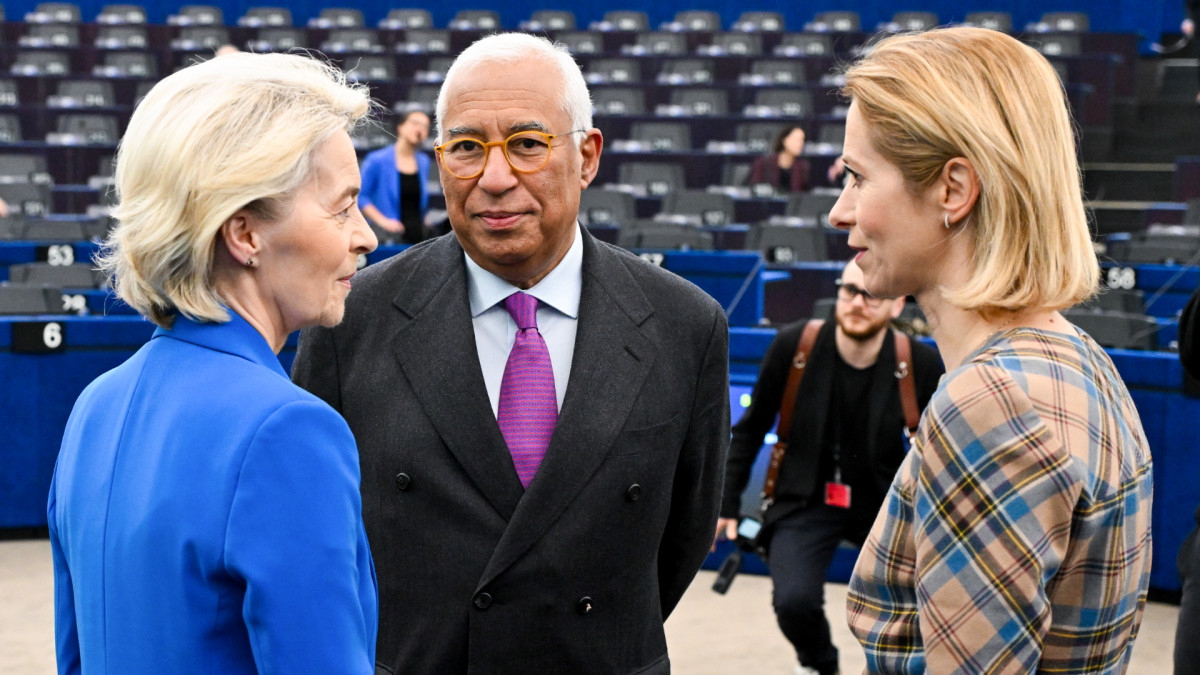
Should the EU be the guardian of the rules-based international order? Yes. And Ursula von der Leyen thinks so too, although her speech at the Conference of Ambassadors muddied the debate on this issue somewhat.
“We will always defend and uphold the rules-based system that we helped build with our allies, but we can no longer rely on it as the sole way to defend our interests nor assume that its rules will shield us from the complex threats we face,” she said in a series of remarks that sparked controversy in Brussels: “The old world no longer exists,” she added.
The Union, according to the President of the European Commission, can no longer be, by itself, the guardian of that stable global map; the era — or rather, it has returned — of spheres of power, and Europe has no choice but to adapt to it. That is as true as two other things: Von der Leyen took a big risk with her message, and at the same time the picture left by the last days is of an EU that still lacks clear leadership, something that was already evident, for example, during the Gaza war.
“The step taken by Von der Leyen to raise the banner of realpolitik is nothing more than a way to accumulate power”
Casi nadie discute que la Unión se tiene que volver más autónoma and, above all, more agile in decision-making, but at the same time it seems that the focus on what is really happening has shifted: in the Community institutions there is now a struggle of egos. For as trivial as it may sound, the step taken by Von der Leyen to champion the discourse of the realpolitik is nothing more than a means to accumulate power in the face of the High Representative, Kaja Kallas, the President of the European Council, António Costa, and even ahead of the leaders of the Twenty-Seven.
Literally, Article 17.1 of the Treaty on European Union (TEU) states that the Commission “promotes the general interest of the Union and shall take the appropriate initiatives to that end. It shall ensure the application of the Treaties and the measures adopted by the institutions pursuant to them. It shall supervise the application of Union law under the control of the Court of Justice of the European Union. It shall implement the budget and manage programs. It shall also carry out coordination, execution and management functions, in accordance with the conditions laid down in the Treaties.” And then comes the key part: “With the exception of the common foreign and security policy and of the other cases provided for by the Treaties, it shall assume the external representation of the Union”.
That is to say, in strictly legal terms, the president of the European Commission cannot take on external leadership that does not fall under her remit: she overshadows the High Representative, who has chosen to maintain a softer profile, letting member states — which are the ones who do have the competence — do as they will and who prefers not to get embroiled in seeking a consensus among governments that is impossible to find from the start.
“Teresa Ribera también se ‘plantó’ ante su jefa y alertó de que su mensaje fue «muy peligroso» porque alimentó «a los matones», en referencia a Putin y al presidente Trump”
Such is the muddle within the EU that the leadership crisis is evident: Von der Leyen wants prominence, Kallas has little room to maneuver, and Costa has clashed with the Commission president almost by accident. “In times like these, values and trust are more important than ever. They are the basis of our influence and authority, and that is what makes our Union strong,” warned the President of the European Council, who also stressed that the EU must defend the international order against a reality “in which Russia violates the peace, China disrupts trade, and the United States challenges the rules-based international order.” He also recalled the “unity” of Europe in the face of Trump’s Greenland gambit as the example to follow. In that vein, the Commission vice-president Teresa Ribera also stood up to her boss and warned that his message was “very dangerous” because it fed “the bullies,” referring to Putin and the American president.
“Ese «no a la guerra» de Moncloa tiene mucho de política para consumo interno, pero también una buena parte de coherencia”
And among the heads of state and government, Sánchez, on the other hand, raises a banner that, each in his own way, more and more colleagues are taking up. That “no to war” from Moncloa carries a lot of domestic political weight, but also a good portion of coherence. At his side, Emmanuel Macron and Keir Starmer have urged participating in “defensive actions” alongside the United States without it being very clear what they mean; or a Friedrich Merz who justified that Washington and Tel Aviv are acting “in their own way” for days before admitting that the offensive is contrary to international law. In reality, everyone agrees, but fears or incapacities are poor friends of clear and concise language, which is what the EU needs right now.
The Union not only lacks action; it lacks leadership. Or at least an order among them. There’s a saying that “the shoemaker should stick to his last”, but it is no longer clear which shoes belong to Ursula von der Leyen, because she wants to wear the same ones as Kallas. In the end, the EU has again found itself with itself and with its competences. She and her circumstances, those that at this moment do more harm than help; another example of why it must reform… and truly.
