
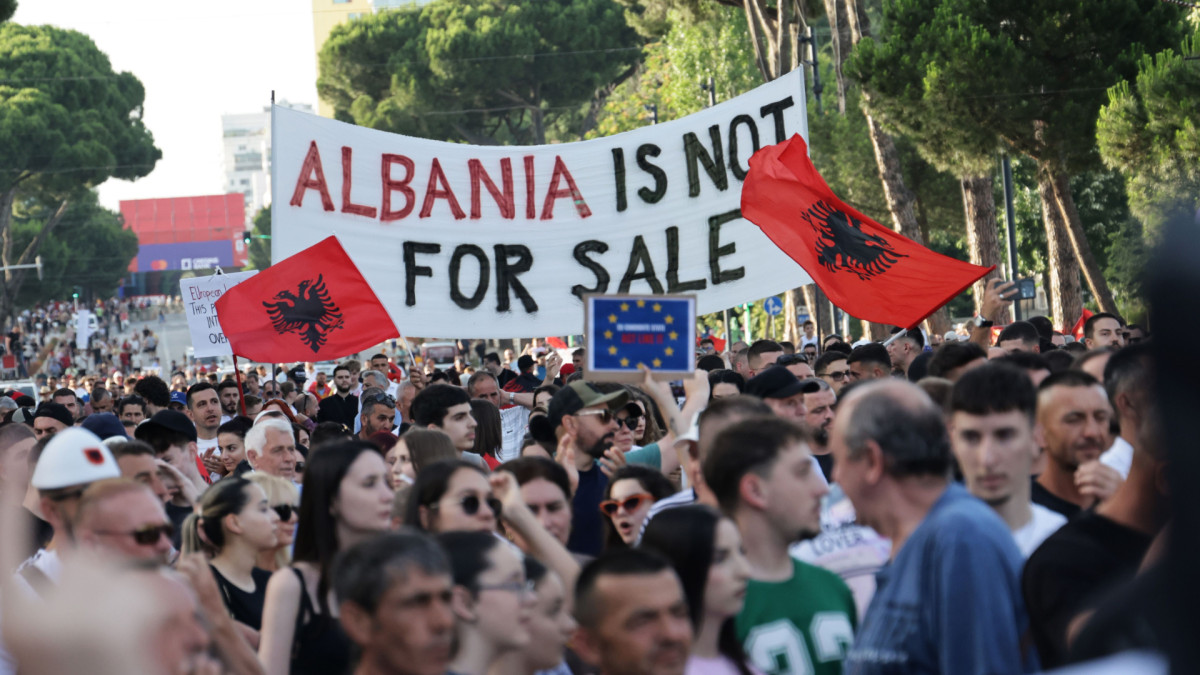
Revolutions rarely begin where one expects. In Albania in 2026, one of the most significant social mobilizations of recent years has arisen around a coastal lagoon inhabited by flamingos and pelicans. What might have appeared as a local environmental protest has quickly grown into a national debate about corruption, political power, and Europe’s future.
The already named “Flamingos Revolution” has driven thousands of citizens to take to the streets to protest a mega-tourism project promoted by Ivanka Trump and Jared Kushner
The move linked to the Trump family, through the investment firm Affinity Partners, envisions an estimated investment of more than $5 billion and would include roughly 10,000 hotel rooms, hundreds of villas, and a luxury resort complex that its promoters present as a model of sustainable development. It is an unprecedented-scale initiative for Albania, comparable to the project Jared Kushner had intended to develop in Serbia, at the Generalštab complex (the Yugoslav Army General Staff) in Belgrade, by demolishing it and building a luxury hotel. This ended up being abandoned in 2025 after being swept up in a major political and economic scandal, following the Serbian government’s withdrawal of heritage protection for the building. In the wake of this scandal, the Serbian Minister of Culture was indicted.
The involvement of the Trump family has inevitably drawn international attention. Their name adds media visibility, glamour, and controversy in equal measure. However, focusing the debate solely on American investors leads to a simplistic reading of the issue. What really matters is not who invests, but how the political decisions that enable those investments are made and who benefits from them. Thus, the fundamental question for many Albanian citizens is not the presence of foreign capital, but the persistence of power mechanisms characterized by opacity, weak institutions, and the proximity between political and economic elites.
In this sense, the Flamingos Revolution has become a symptom of discontent that runs across several layers. The protests express the growing frustration of a society that, despite the advances of the past decades, continues to perceive that access to resources, economic opportunities, and strategic decisions remains conditioned by clientelist networks and influential relationships.
The truly relevant issue is not who invests, but how the political decisions that permit those investments are made and who benefits from them
The corruption remains one of the country’s main structural challenges. And this persists despite the progress of recent years in this area, such as the creation of the Special Structure Against Corruption and Organized Crime (SPAK), which has been regarded as one of the most consequential institutional reforms pursued within the framework of the European Union accession process. The significance of SPAK lies precisely in its independent nature. For the first time, high political officials, influential entrepreneurs, and figures traditionally protected by the power networks have begun to face judicial investigations. In the Zvërnec case, the agency has opened an inquiry into possible irregularities related to legislative changes, licensing procedures, and the actions of certain local businessmen currently under judicial proceedings.
Although it is still early to draw conclusions, the investigation could have significant implications for the project’s timeline and could even generate new legal obstacles to its development.
The paradox is that this controversy arises precisely at a moment when Albania seeks to project an image of institutional modernization and reformist commitment. The most striking example perhaps was the creation, last year, of “Diella,” a virtual minister designed through artificial intelligence with the aim of supervising public spending and detecting possible corrupt practices in the administration. The initiative was presented by the Government as a demonstration of technological innovation applied to public governance. Yet, political irony has not gone unnoticed by the Albanian public, since the agency responsible for developing this tool is currently under investigation for alleged irregularities.
Beyond the anecdotal, the episode offers lessons. The fight against corruption does not depend solely on technological tools or institutional communication campaigns. It requires strengthening oversight mechanisms, guaranteeing judicial independence, and consolidating a political culture based on accountability.
The fight against corruption does not depend solely on technological tools nor on institutional communication campaigns
All this takes on special relevance in the context of Albania’s prospective European Union membership. For years, Brussels has insisted that the progress of the Western Balkans will depend as much on economic reforms as on the consolidation of the rule of law. Democratic quality is no longer measured solely by the holding of free elections, but also by the ability of institutions to guarantee transparency, curb state capture by private interests, and protect the public interest.
Thus, the mobilizations in Albania far transcend the Zvërnec case. In fact, they reflect some of the fundamental dilemmas facing today’s European democracies. That is why the importance of these protests goes beyond the future of a lagoon or a luxury complex. What is at stake is the credibility of Albania’s democratic transformation process. The flamingos have ended up becoming a symbol of something far broader: the citizen demand that economic development cannot be built outside the framework of transparency, legality, and the public interest.
On this occasion, it seems unlikely that the project will be canceled, although perhaps the results of ongoing investigations and the social pressure generated by the protests could substantially alter its implementation terms. In any case, the Flamingos Revolution is already achieving a significant political objective: the transformation of a seemingly environmental issue into a national debate on the quality of democracy.
Perhaps that is the main lesson Albania offers today. Because behind the flamingos, the luxury hotels, and the famous surnames, what is surfacing is a discussion about power. About who wields it, who benefits from it, and under what control mechanisms. A discussion that directly affects the country’s European future and that, in truth, also speaks to Europe as a whole.
