

The 2026 midterm elections offer Democrats an obvious opening due to President Trump’s unpopularity, weighed down by high prices and a poorly framed Middle East conflict. They can also expect the usual midterm pattern to work in their favor: the president’s party almost always loses ground in these elections. Consequently, the Democrats can reasonably hope that the new Congress, taking office in 2027, will begin with a noticeably larger share of seats on their side.
But wins for both parties have been brief in recent years. In 2016, the Republicans achieved unified control of the federal government, but in 2018 the Democrats won back the House of Representatives. The Democrats did well in 2020, but the Republicans retook the House in 2022 by a margin of just four seats. And Trump returned to the White House in 2024 with majorities in both the House and the Senate.
“The Democrats can expect that the usual pattern of the midterms will work in their favor: the president’s party almost always loses ground in these elections”
Our research points to one reason for this pattern. The two parties have built bundles of positions that are highly differentiated. We often refer to those bundles, taken together, as ideologies described as “progressive” or “conservative,” but voters do not accept those ideological bundles in one piece. Each party now faces a different kind of mismatch between its coalition and the positions it tends to insist on.
Political scientists have long debated whether everyday Americans are ideological. If we understand ideology as a fully developed political philosophy, most people are not. They do not build all their political opinions from first principles, and most do not think about politics the way political theorists, activists, or elected officials do. Yet voters can recognize partisan signals. They know backing a border wall typically points to one party, while backing universal health care points to the other, and they can draw those associations across many issues. However, simply knowing that information does not mean voters embrace those issue bundles wholesale.
How we conducted our research
Using data from the Cooperative Election Study surveys, we identified two kinds of issues. The first are classic governance questions that have long structured the national partisan conflict: taxes, government spending, health care, climate regulation, guns, defense, and the size of the federal government. The second are identity and cultural battles that have taken on a more central role in party debates in recent years: immigration, borders, voter ID requirements, racial biases, school curricula, transgender athletes, COVID restrictions, freedom of speech on social media, and related disputes. We do not mean that all issues in the second group are new. Immigration, for example, has a long history in American politics. Our point is that these issues occupy a new place in the public rhetoric of the parties.
Americans do not respond the same to these two sets of issues.
Issues on which voters agree and the ones that test party loyalty
The Republicans appear stronger and more united on these more recent issues. Across all education levels, Republican voters tend to endorse conservative positions on immigration, voter identification, school curricula, COVID restrictions, transgender athletes, and related issues. These issues keep the Republican coalition together. But, on traditional economic and governance issues, survey data show the public, including many Republican voters, more often leaning toward the Democrats.
The Democrats face the opposite problem. Their voters are comparatively united on traditional economic issues and tend to favor higher spending on health care, education, environmental protection, and aid to the poor, positions that are popular with the public. But Democrats are divided on identity and cultural issues, especially by race. Black Democrats are not far from conservatives. They are more moderate and internally heterogeneous than many white, progressive activists assume. That opens an opportunity for Republicans to win votes.
The following figures illustrate this pattern directly. Each dot indicates the share of a party sub-coalition adopting the conservative stance on a given issue. Dots to the right of the 50% line show issues where the majority of that group supports the conservative position. The top panels show the newer identity and cultural issues, while the bottom panels show the older issues.
“Black Democrats are not far from conservatives. Yet they are more moderate and more internally diverse than many white progressive activists assume”
We focus on education among Republicans and on race among Democrats because the divisions around those specific issues reveal the main fault lines within each coalition. Among Republicans, identity and cultural issues generate broad agreement across educational groups. Republicans, with and without college degrees, are highly conservative on most of these issues. Some differences persist, especially on school curricula, but the basic pattern holds. On traditional governance issues, shown in the bottom panel, Republicans are less cohesive and the coalition is more divided. The old agenda of shrinking the state does not unite the Republican coalition as strongly as the cultural conflict.
Each dot indicates the share of a party sub-coalition that adopts the conservative position on a given issue. Dots to the right of the 50% line show issues on which the majority of that group supports the conservative position. The upper panels display the more recent identity and cultural issues, while the lower panels display the older issues. Content translated by AI.
The Democratic figure shows the mirror image, but with respect to race. On economic and traditional governance issues, both Black and White Democrats tend to cluster on the liberal side. Identity and cultural issues split Democrats more clearly. Black Democrats are clearly more conservative than White Democrats on school curricula, voter identification, freedom of expression on social media, and other issues. Some issues, specifically racial ones, work differently, though. Black Democrats are much less conservative than White Democrats on reparations and on removing racist street names. Still, the overall pattern shows far more variation in identity and cultural issues than a simple left-right explanation would suggest.
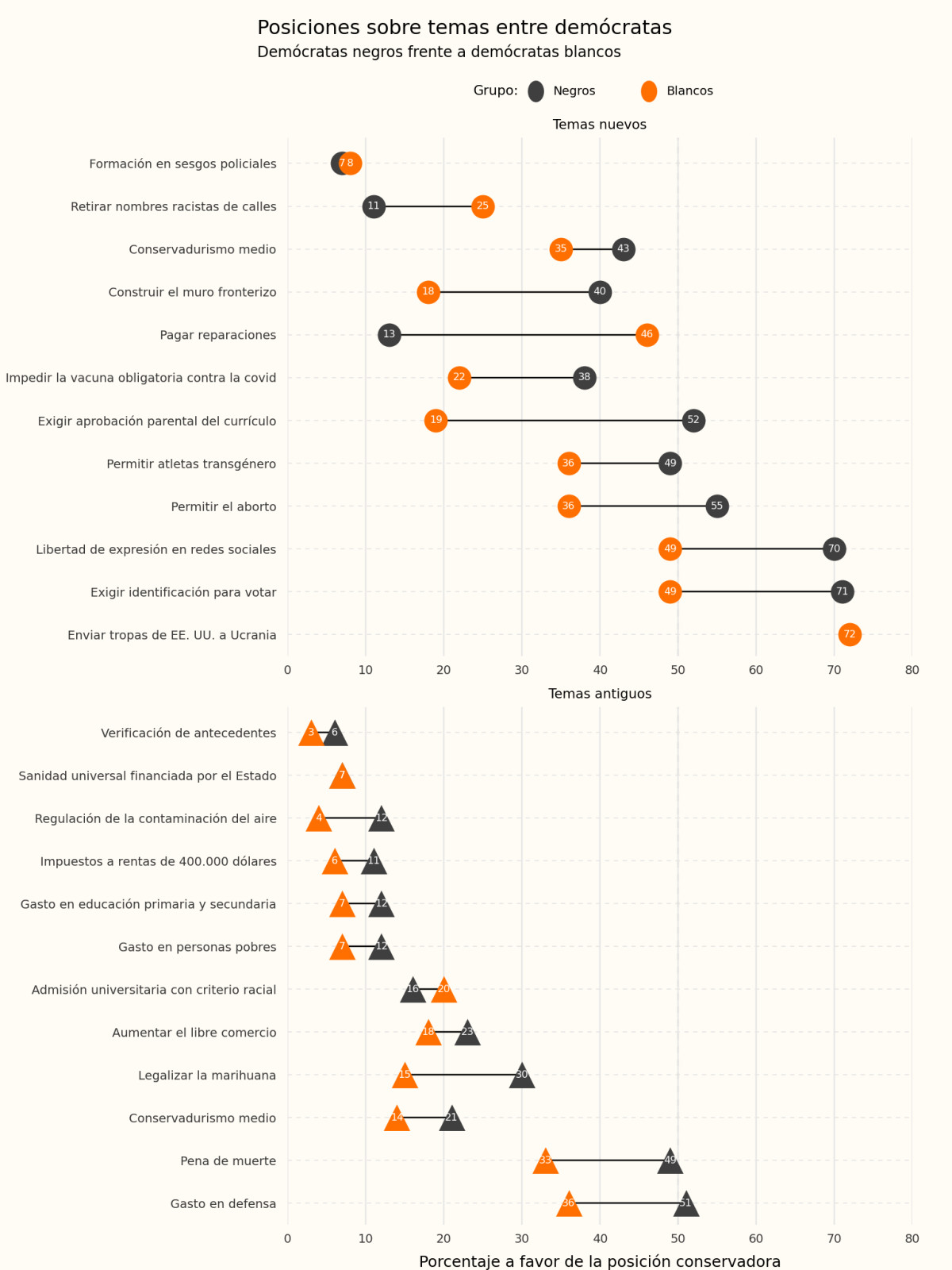
Each dot indicates the share of a party sub-coalition adopting the conservative stance on a given issue. Dots to the right of the 50% line show issues on which the majority of that group supports the conservative position. The top panels display the newer identity and cultural issues, while the bottom panels display the older issues. Content translated by AI.
Each party has its own turf
Taken together, the figures help explain why the two parties can look strong and weak at the same time. The Republicans enjoy a clear cultural edge. The Democrats hold the advantage on traditional economic issues, where their coalition is more cohesive and closer to the public’s general preferences. But voters in either party do not uniformly back their entire policy package.
How does this translate to elections? Democrats want elections to revolve around economic policy, while Republicans want contests to center on identity and culture. Each party can win when American politics shifts to its own turf. But neither party can keep it there for long, because in our political environment parties do not control the agenda by themselves.
“The old agenda of shrinking the state does not unite the Republican coalition as strongly as the cultural conflict”
Governing forces the Republicans to make decisions about budgets, taxes, and spending, which can reveal the old divisions within their coalition. Democrats in government may face the same issue on a different front, because opponents, interest groups, and the news cycle can bring school, immigration, racial, and gender issues to national politics. The party in opposition has a strong incentive to push the governing party to fight on a turf where its own voters disagree.
That is why it will be easy to misread the 2026 elections
In November, Democrats are very likely to gain seats for all the usual reasons behind midterm elections and because traditional economic issues, especially rising prices, are now salient. But it is unlikely that those gains signal a new, lasting coalition.
The broader takeaway is that voters are neither blank slates nor perfectly loyal party members. They recognize the signals the parties send, but many do not buy the entire package. Some Republicans like the cultural message but balk at the old state-shrinking agenda. Some Democrats like the economic message but feel uneasy about the new cultural battles.
When the agenda shifts, these voters may move, stay home, or vote with reluctance. That dynamic yields a curious blend of volatility and stagnation in American politics. Power shifts hands frequently, but margins stay narrow. American politics will continue producing close elections, frustrated voters, and victories that vanish almost as soon as they appear.
© Good Authority, Washington D. C., 2026
