

“If we do not agree on structural actions, there will always be a portion of the population left on the sidelines.” This is the warning raised by Marc Simón, Deputy General Director of the Fundación “la Caixa,” in conversation with Agenda Pública in Barcelona. As the person responsible for all of the foundation’s social programs, he is aware that if you want to “have an impact on society,” “the medium and long term is necessary” and you must “avoid dispersion.”
With more than a century of history behind it and a record-breaking budget of 655 million euros in 2025, the Fundación “la Caixa” has continually adapted its priorities to the evolving needs of Spanish society. According to Simón, today the “greatest challenge is child poverty,” but they are also concerned with and engaged in the sociolaboral integration of the most vulnerable groups or the care of the elderly, facing the challenge of loneliness. “Economic assistance is often necessary, but it has to be accompanied by care that puts the person at the center and makes them the protagonist of their own future,” he emphasizes.
Before speaking about his current work, if my research is correct, you joined “la Caixa” in 1981. How has Spain changed since then?
Spain has changed a lot since 1981. My relationship with “la Caixa” and with the world in general was not the same then as it is now, neither in age nor in occupation. There is one clear element that defined what I dedicated myself to for many years and that has been a central axis of society’s transformation: the entry of technology. At that time I was studying Economics and I first went to work three months at Telefónica as an IT assistant. Soon after I joined “la Caixa,” and that small experience led that on the very first day I was sent to the IT department.
“In the past the general sense was one of continuous growth. And that, in recent years, has changed. The 2008 crisis was a tip of the iceberg, and since then we have almost lived in permanent crisis.”
Years later, after the merger with the Pension Fund, I ended up becoming IT director. I went through every possible role in a moment of genuine technological boom. Looking at it with today’s eyes, it’s hard to understand what some changes in 1981 entailed. For example: we developed a machine capable of doing virtually anything a client could request in an office. It was a revolution. Today all of this has been surpassed. Technology has become present in everything and it forms a clear foundation for how society has transformed.
At the same time, we were emerging from the period after the dictatorship, with the introduction of democracy. There were ups and downs and moments with unemployment peaks and difficulties, but then we entered a period of important economic prosperity.
Early nineties, Olympic hangover…
Exactly. There was a fairly general perception that “everything was going up.” Despite some difficult moments, the overall feeling was growth. And that, in recent years, has changed. The 2008 crisis was a tip of the iceberg, and since then we have almost lived in permanent crises.
The perspective I have today — and I would probably not be the same if 2008 had not happened to the foundation — is that all that prosperity continued to leave many people on the margins. The reality is stubborn, because the more time passes and the more it seems that things are getting better, the more inequality grows.
Simón is responsible for all of the foundation’s social programs. Photo: Agenda Pública / Tsun Ho
I read in a memory of the Fundación “la Caixa” that it turned 120 in 2024. Over these years there have been challenges and crises of all kinds, beyond 2008…
When “la Caixa” was created, the most pressing vulnerability was that of workers in a context of strikes, with no public pensions: when you stopped working, you had no income. The first action documented as the entity’s activity is the tributes to old age, dating back to 1915. In fact, for us the program for older people begins there and continues today.
Later on, the creation of housing was also very relevant. The first social housing lotteries were carried out by “la Caixa” in the sixties, before there were public lotteries. Additionally, there is the research into diseases that affected many people at that time: tuberculosis, then AIDS…
In relation to 2008, there was a key moment in the early 2000s: senior management organized sessions with various scholars who predicted that the economic boom would end. These reflections shaped later decisions that were important. It was decided to start planning new social programs. At the same time, “la Caixa” —from a financial standpoint—decided to stop opening offices and the profits allocated to social work grew exponentially. The first time we reached a budget of 500 million euros was in 2008. With this evolution, our employment integration program, the fight against child poverty, the strengthening of the elderly program, etc., were born.
At the same time, an effort was made to specify what model we would use to achieve the impact we sought in society. The decision was to devote as much of the money earned through economic activity to initiatives that directly affected people. For social action there already existed a third sector very close to vulnerability, and the most responsible approach was to do it through these entities.
You said they surpassed 500 million in 2008. In 2025 they were around 655 million. Within that budget, what are the foundation’s crown jewels?
The greatest challenge today is child poverty. It is the program to which we allocate the most direct budget: a little over eighty million euros annually, excluding overhead. These programs, for the most part, end up enabling social entities to hire people, and that implies updating remuneration so that professionals are paid with dignity.
“Childhood is key. If you act well, you prevent many consequences for people who, by their background, seem destined to a lifelong situation”
For us, childhood is key, also in the realm of inequality. It is the element where, if you act well, you prevent many consequences for people who, by their origin, seem destined to a lifelong situation.
There are reports that are critical of Spain’s role in this matter.
We are at the European tail. And this is explained by the poor efficiency of the administrations’ economic aid when they try to alleviate poverty mainly through transfers. For years we have known that the efficiency of pure monetary aid is very low.
If you dig deeper into child poverty and the inheritance factor, you clearly see two levels. There is a group close to the threshold, which with small aids can get by. Then, the one that falls below is the group that transmits poverty generation to generation. Recent studies show that if a child already had a poor grandfather and a poor father, they have about a 60% probability of being poor their entire life.
It also happens with access to housing.
Everything is connected. That is why we believe this is the main focus. The second program in scale is the sociolaboral integration of disadvantaged groups: people more vulnerable to employment. It is sociolaboral inclusion, not just employment. We go directly to ordinary companies, not to protected employment, because we understand that it is not only about a job and an income, but also about widening and equalizing your social network with others. Because poverty is local and concentrated in specific places.
Together with CaixaProinfancia and Incorpora we work with a broad representation of social entities: almost five hundred in childhood and about 420 in Incorpora. We work with them in a network, which is important, and in each one we have developed an intervention method that works with a common software application.
The third major budget block is for older people, with about thirty million euros per year. There we have two lines: the traditional one tied to senior centers, and a newer one focused on loneliness and quality of care.
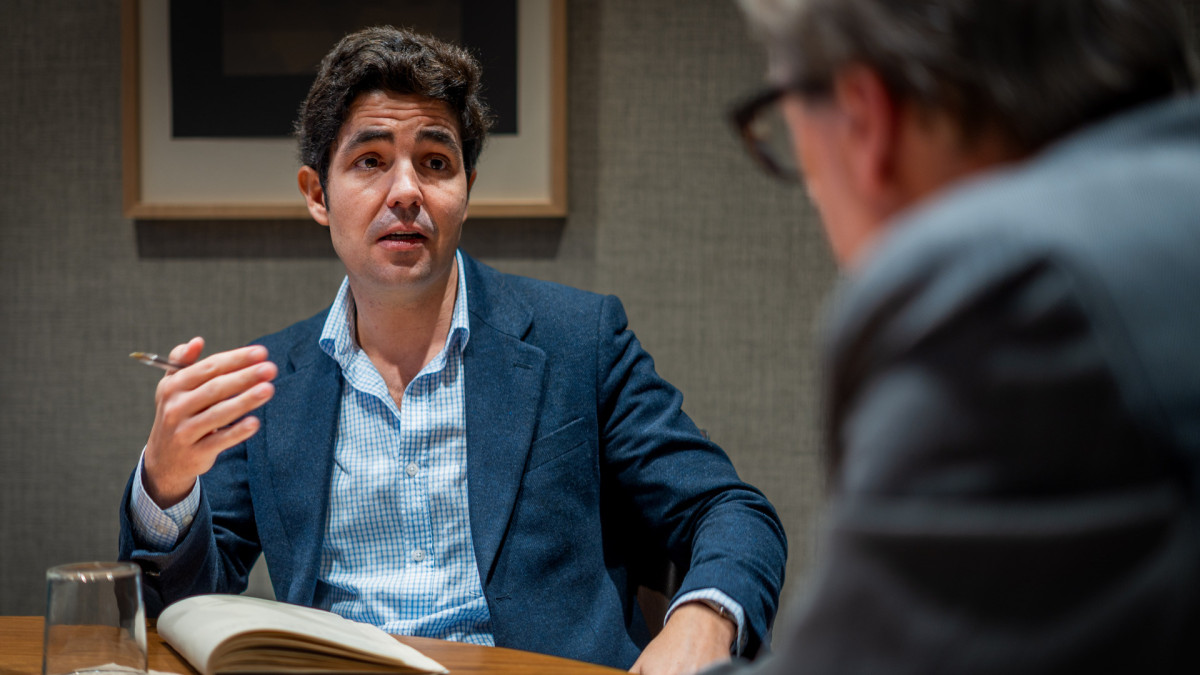
The vice president of ‘Agenda Pública’, Rodrigo Pinedo, during the interview. Photo: Agenda Pública / Tsun Ho
In its origins, the foundation acted when there was no pension system. Today we live in a context where the welfare state itself must rethink what it does with pensions. How has this aging program evolved?
It is the oldest program, but it is constantly innovating. First it was ahead of public pensions. Then, in the seventies, we began opening senior centers —now called participation centers— and we reached more than 600 of them, both ours and affiliated.
In most of them there is a computer classroom installed by the Fundación “la Caixa.” Technology has been a hallmark: we started in 1997 and for years we have been introducing computing among older people. There have been years with more than 75,000 people trained. Last year around 534,000 people participated in program activities.
And helping to reduce the generational and access gap, because every day we depend more on technology for everything…
Yes, but in the early years it wasn’t as obvious as it is now. Over time, associations of older computer volunteers have been created, which we later encouraged to expand into other volunteering areas. We have programs like older people who go to correctional centers to teach computer skills to young people deprived of liberty. It’s not only what they teach, but the bond that is formed to guide them when they leave and act as mentors.
On the other hand, in 2015, coinciding with the centenary of the first tribute to old age, we promoted two new focal points: dignified treatment of older people and personal development workshops. In these, the idea is that old age has many stages and you decide how they will be. Traditionally, the image was to be carried along: you have cared for the previous generation and the next will take care of you. But here we work from the start with this development in mind.
“Today, 15% of people between 65 and 75 already live alone. And from 75 onward the figure rises above 20%. In total, about three million older people live alone in Spain”
Two years later we also began to bet on preventing loneliness. Although pensions can be secured, a generation of older people who lived through the crisis arrived —during which the number of home owners declined— and faces skyrocketing rents in many cities. If we are already talking about working poor, when they reach retirement they may become poor pensioners.
This is a mandatory challenge; then there are others we choose, such as loneliness. Today, 15% of people aged 65 to 75 live alone. And from 75 onward the figure rises above 20%. In total, about three million older people live alone in Spain. Our program is based on the idea that the community steps in to care and creates groups of social action; many entities participate in each place and there is a lot of volunteering.
The fourth major program is comprehensive care for people with advanced illness and their families, which approaches twenty million euros annually for Spain. We have equivalent programs in Portugal, but on a smaller scale due to population and because we started them later.
So far we have talked about the foundation’s own programs, which mark the foundation’s main concerns. Add to that the social calls, cultural activity, research…
Social calls are very important and have several differentiating elements. In total, the budget is around forty million euros and we receive about 5,000 proposals per year in Spain, of which around 1,400 are approved.
Here we have moved toward territorial distribution: we ensure that each year there are projects in all of Spain’s provinces. That design matters because it allows the population that needs it to have access. If the call were only national and we selected the “best” projects, the big capitals would take almost everything. This way we avoid leaving territories unattended. We do it while respecting historical proportions—never having taken anything away from any territory—also linked to the population: with growth we better complete the coverage.
To this is added the cultural aspect, which has a clear connection to bringing it closer to the most vulnerable people. Our cultural centers are hubs of social debate. And research is added to that. This field —especially the medical one—, by nature, has a curious effect: any advancement ends up available to everyone. That costs much more in the social sphere, where there is no public repository of everything that is done.
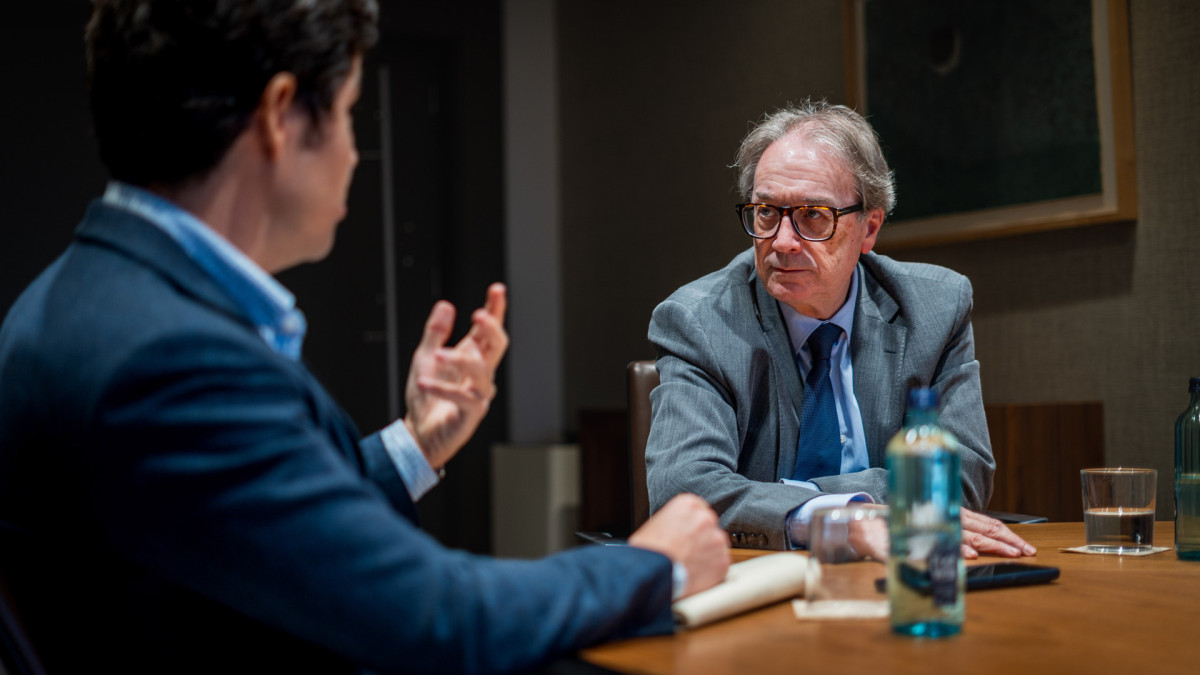
Simón insists that one of Spain’s greatest challenges is child poverty. Photo: Agenda Pública / Tsun Ho
Looking back at Spain in 1981, you mentioned that the Fundación “la Caixa” has sought to “anticipate.” It is doing so with the elderly. Is there any other front like that?
As I said, the first and main one is child poverty. It is the source of the greatest inequality. With CaixaProinfancia, with those more than eighty million euros, we reach about 67,000 boys and girls per year. The children in this program, when finishing secondary school, have a graduation rate even one point above the general population. When we carry out focused studies in the same “band” — families under the poverty line — without intervention they would not have half the academic success they achieve.
Since its start in 2007, the basic elements have remained, but have evolved a lot. It is a model program because it introduces, in a very professional way, a layer of social action that is key. Social services are very heterogeneous in Spain; depending on where you are, there are more or fewer resources and greater or lesser capacity. We add a part that aligns with what social services have managed to do, but it creates an inclusion itinerary in which the family commits to following it. It has components specific to childhood, but also others. And it adds a second important step: not everything for everyone, but giving each person what they need, also achieving efficiency in the funding.
“We have neighborhoods where inequality concentrates very strongly. If we do not act, those spaces run the risk of deteriorating and becoming ghettos.”
The average annual investment per child is around 1,100 euros, which is not a big overreach. Another issue is that we do not have funds to work on the two and a half million children living in poverty in Spain. But the model itself offers a scalable solution.
Another major challenge is territorial inequality. There is geographic inequality, which adds to all the others, but ultimately provides common explanations: you can view it through ethnic or diversity lenses, but there is always a geographic dimension underneath. We have neighborhoods where inequality concentrates very strongly. If we do not act, those spaces risk deteriorating and becoming ghettos. Add to that depopulation; 90% of the population concentrates in 30% of the territory.
Social services are unequal across the territory…
Yes. We must reverse dynamics to better leverage resources across the entire country. This year we launched a social call to try to prevent depopulation from worsening.
In the strategic plan we developed for 2025 additional topics appeared: besides labor inclusion —which already acts on groups with particular difficulties accessing employment and is closely linked to training— we introduced homelessness, mental health, and, again, diversity, delving into the intersections between illness, diversity, and aging.
In Agenda Pública we focus on public policies and their analysis, and a portion of our readers have a special interest in this. What request could be made today of politicians to address the challenges we have discussed?
Avoid dispersion. We have a landscape that has yet to accept that, to have a real impact on social issues, you need a medium- to long-term horizon.
Take the Incorpora example. It started in 2005 and by 2008 it integrated around 3,000 people per year. In 2024 it integrated 43,000. And the budget is, roughly, about 20% higher than in 2008. The difference is made by a mature network: entities that at first asked me, “Hey, will the program continue next year?” Now they no longer ask, because they have seen that the commitment is serious and medium- to long-term.
With childhood it’s the same: if what you want to prevent is school dropout, one year is not enough. School trajectories are long. If you intervene only one year, if that boy or girl was going to fall, most likely they will fall the following year. You need continuity.
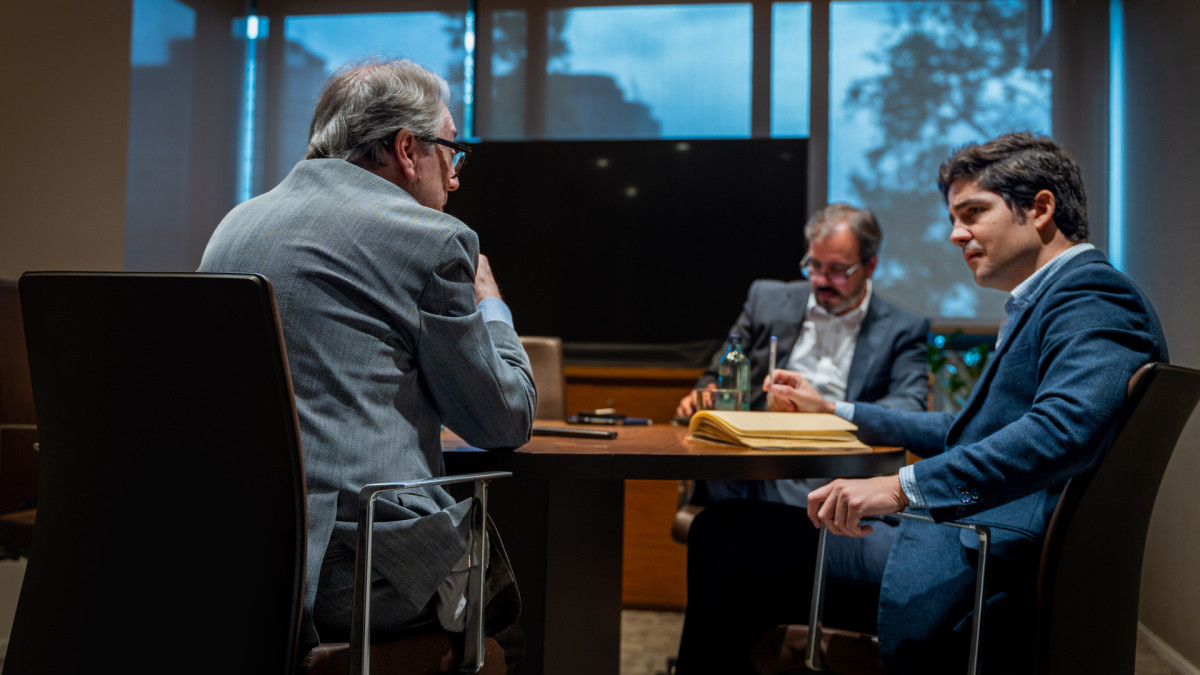
Pinedo asks Simón at the foundation’s headquarters in Barcelona. Photo: Agenda Pública / Tsun Ho
In this scenario of permanent electoral campaigning, it is complicated.
Then a pact among all would be desirable. If we do not agree on structural actions, there will always be a portion of the population left on the sidelines. We must focus our efforts. If you carry out very dispersed actions, it is difficult for them to have an impact. If we focus and unite efforts, we will be far more effective together. That enables economies of scale, allows evaluation, and the generation of evidence that can later translate into policies.
The third idea concerns benefits. It is very important that there are benefits for people, but also that all who are truly entitled can access them. Often the way of processing them is very complicated. In our project calls many entities propose accompanying people to process the benefits to which they are entitled.
And finally, a monetary benefit, on its own, does not generate equality. It may mask the result, but it will not deliver equality. If we think in terms of equity, the classic metaphor remains valid: teaching a person to fish or giving them fish. Economic aid is often necessary, but it must be accompanied by care that puts the person at the center and makes them the protagonist of their own future.
Thank you very much.
In collaboration with the Fundación “la Caixa”
