
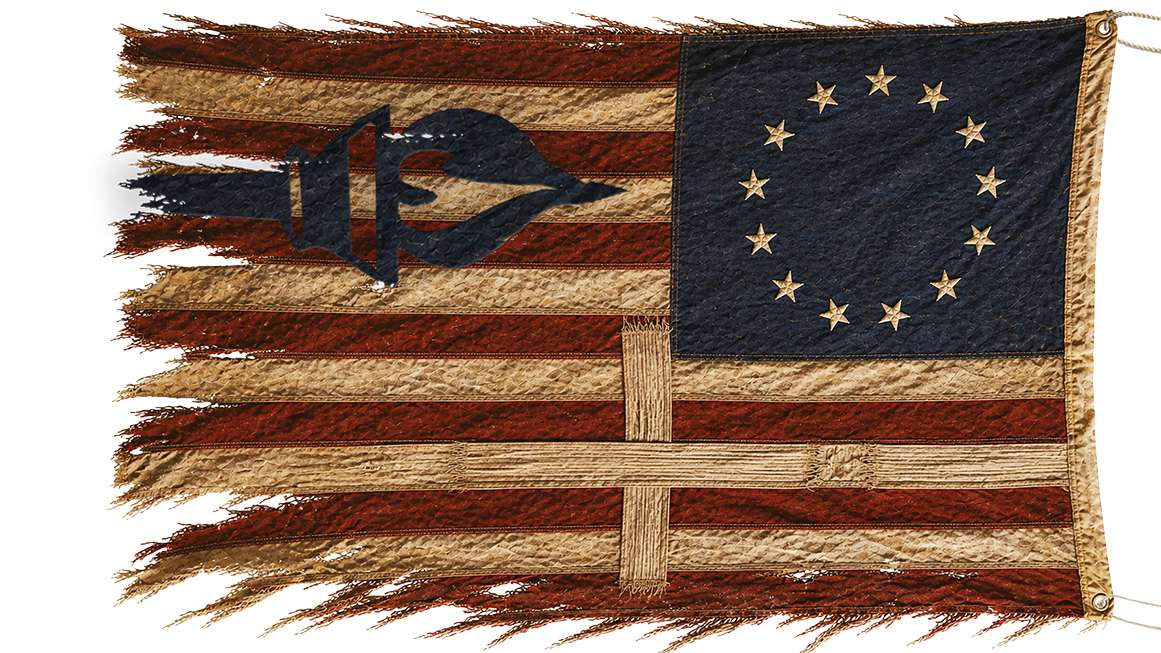
If the fusionist interpretation of history is correct, the anti-fusionists are pursuing a project far more radical than most of them are prepared to acknowledge.
In a special America 250 issue, Reason takes a look back at our country’s founding people and ideas. Read more here.

In “Why I Am Not a Conservative,” the economist F.A. Hayek averred that “what in Europe was called ‘liberalism’ was here the common tradition on which the American polity had been built.” He was neither the first nor the last to see America primarily as a nation rooted in individual liberty.
Yet to think the United States is purely a liberal country is to overstate a truth. The Founders drew upon a broad spectrum of sources, ranging from classical philosophy to biblical theology, from the natural and common law traditions to Enlightenment ideas. They borrowed from each stream those insights that best served their undertaking, and in doing so they forged something both revolutionary—a novus ordo seclorum—and deeply anchored in the wisdom of what came before.
‘All Americans Are…Liberals of One Sort or Another’
To defend their liberty, the Founders distributed power across the different branches and levels of government while guaranteeing that the most essential rights could not be decided by a simple majority. Since then, Americans have taken pride in having toppled a tyrannical king and in creating a regime suitable for a free people, where citizens steer their own lives rather than being determined by the accidents of birth.
In the spring of 1906, the English science-fiction writer H.G. Wells visited the United States and described his impressions in The Future in America. He remarked that America lacked a social ladder marked by servile or patrician ranks. “There is no lower stratum,” he observed, and “no aristocracy at all.” Nearly all Americans resembled what in Europe would be called the middle classes—engaged in “trading and manufacturing” and occupying positions somewhere between “the magnate and the clerk and skilled artisan.”
That arrangement had consequences for American politics. “The two great political parties in America represent only one English party, the middle-class Liberal party, the party of industrialism and freedom,” Wells wrote. “There are no Tories to defend the feudal system, and no Labor party….All Americans are, from the English point of view, Liberals of one sort or another.”
As a member of the Fabian Society, Wells did not treat the American urge “not only to liberate men but property from State control” as an entirely favorable development. Yet he recognized it as a fundamental aspect of the American character.
In the middle decades of the twentieth century, a school of thought later dubbed “consensus history” echoed that observation. It held, roughly speaking, that American culture is marked by a shared moral consensus around free enterprise and the Lockean social contract—that “the American community is a liberal community,” as political scientist Louis Hartz phrased it.
That framework may have fallen from scholarly favor, but its resonance persists in popular imagination. Think of President Ronald Reagan’s insistence that the United States was a “shining city…teeming with people of all kinds living in harmony…with free ports that hummed with commerce and creativity.” That image ascended to something like national myth, suggesting that the American people see themselves in it. Our cultural self-conception is forward-looking, pluralistic, and entrepreneurial.
Note that the liberalism we’ve been discussing is not confined to one end of the political spectrum. It sits at the political center, and until about ten years ago it was arguably more prominent on the American right (which preached free markets and limited government at least in rhetoric) than on the American left.
Even those conservatives who have seen liberalism as a danger to society—figures such as L. Brent Bozell Jr. in the 1960s and Patrick Deneen today—acknowledge its centrality to American history. It is for that reason that certain right-wing critics condemn the Founding as a philosophical misstep.
‘Only a Virtuous People Are Capable of Freedom’
But recognizing the Founding as liberal does not require us to deem it secular. Unlike the French Revolutionaries who would overthrow their regime within a short span, America’s Founders did not harbor hostility toward Christianity as a doctrine or toward the lowercase church as an institution.
True, some prominent Founders were not orthodox believers. Yet many were, and almost all believed religion helped nurture the conditions for a free society to endure. They argued that limited government depended on a morally educated and responsible citizenry.
“Only a virtuous people are capable of freedom,” Benjamin Franklin declared. Or, as John Adams more famously put it, “We have no Government armed with Power capable of contending with human Passions unbridled by morality and Religion….Our Constitution was made only for a moral and

Natalie Foster
I’m a political writer focused on making complex issues clear, accessible, and worth engaging with. From local dynamics to national debates, I aim to connect facts with context so readers can form their own informed views. I believe strong journalism should challenge, question, and open space for thoughtful discussion rather than amplify noise.