
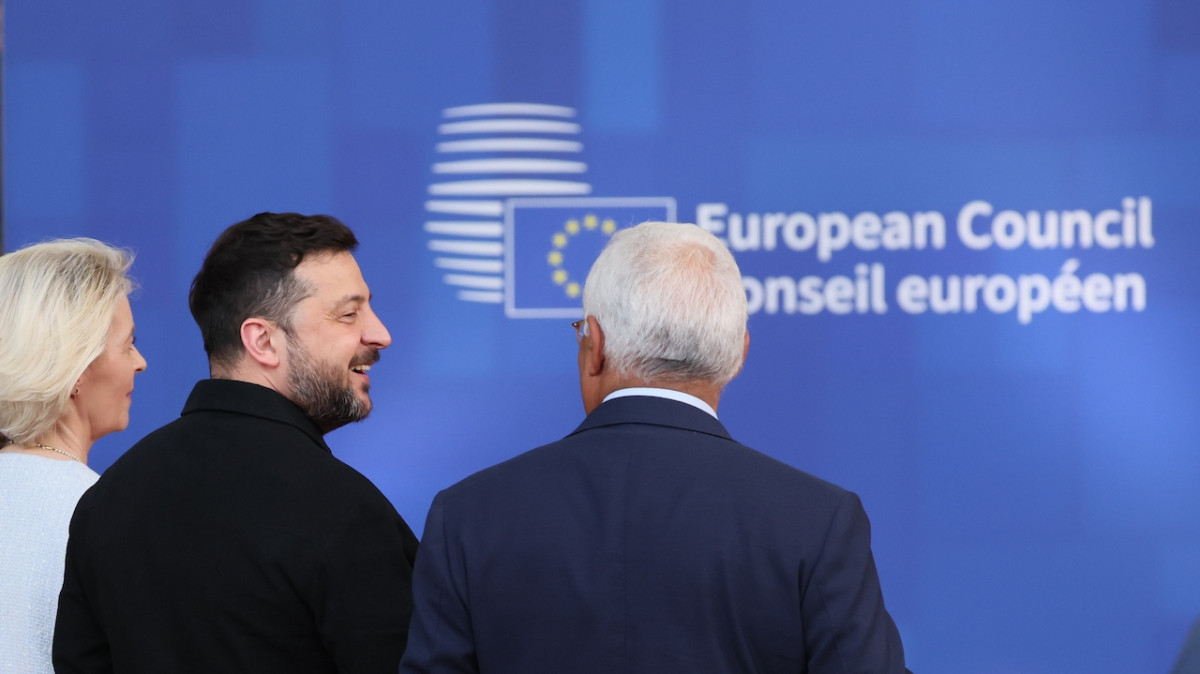
The European summit last Thursday was a demonstration of the tensions between the European Union’s institutional architecture and the continent’s geopolitical reality.
A few days before the gathering of heads of state and government, it emerged that António Costa’s team, the president of the European Council, had opened channels of contact with Russia. Not negotiations or substantive talks, but simply diplomatic channels. The information was confirmed by European sources and also by his chief of staff to the ambassadors—the permanent representatives of the Twenty-Seven to the EU.
The decision has surprised because only a small group of European leaders was informed about the intention to establish that contact. Many other diplomatic sources confirmed that they learned of the matter from the press when Bloomberg broke the exclusive during the G7 summit held last week in Évian (France).
The move by the Portuguese has generated tension in two respects. On the one hand, a group of Nordic and Eastern member states do not share that it is the moment to open up to dialogue with Russia. They are the countries most exposed to Moscow’s threat and the hawks who have led the European pivot toward hard-line positions against the Kremlin during the last four years of war against Ukraine. The Baltic states are especially opposed to contacts with Vladimir Putin’s circle.
“A group of Nordic and Eastern member states do not share that it is the moment to open up to dialogue with Russia”
Some, such as Gitanas Nausėda, president of Lithuania, or the Estonian prime minister, Kristen Michal, oppose this move, as they have done since Volodymyr Zelensky, the Ukrainian president, directly proposed for the first time during a meeting of the European Political Community held in Armenia that Europe should ensure it is in any eventual negotiation with the Kremlin.
The issue has remained on the leaders’ agenda and also on the foreign ministers’, without resolving the lack of European consensus around the strategy to follow.
Other countries have indeed backed Costa’s initiative, even if they had not been informed, as has, for example, Bart De Wever, Belgium’s prime minister. “We’ll send you to Moscow”, the Belgian joked with Costa as they left the European Council building at the end of the first day of the summit.
That tension shows that there is not yet a European consensus on the strategy to follow regarding contacts with the Kremlin and the role that Europe should play in that dialogue. There is also not an absolute divergence. Even those most in favor of opening channels of communication with Moscow share that the role of Europe is not that of a “mediator”. Slovakia, one of the countries with a government close to Moscow, has defended the initiative as a way to “put the ball back in Moscow’s court”.
“There is not yet European consensus on the strategy to follow regarding contacts with the Kremlin and the role Europe should play in that dialogue”
“What I am doing from my office is to establish a diplomatic channel, because we cannot rely solely on others to interpret the Russian messages and we must be able to convey our own messages to Russia directly,” Costa explained, thus following the line set by Ukraine itself.
Geopolitical Tension
Costa has generated a certain tension in another, more institutional sense. The leaders of the so-called “E3”, comprising the major European military powers, namely the United Kingdom, France and Germany, had just stated that these channels of communication with Moscow must be opened.
But London is no longer part of the European Union, so Costa’s role does not cover a key actor in any debate about the future of European security, even though the British are key to any debate on this matter. Norwegians are also examples of such key players.
That shows how the geopolitical dimension stretches the seams of Europe’s institutions to the limit. The EU can try to respond to the call for unity and European coordination, but it will be very difficult to meet the needs that exist. Even Pedro Sánchez, the Spanish prime minister and close ally of Costa, concedes that the limits of any effort by the Portuguese clash with a core issue for a group of countries, some outside the Union, that have pledged to deploy troops on the territory, the so‑called “coalition of volunteers.” No one except the leaders themselves can negotiate something as delicate as putting boots on the ground, even if there is a peace agreement.
“The EU can try to respond to the demand for unity and European coordination, but it will be very difficult to meet the needs that exist”
At the same time, beyond the hawks, there are many small countries that distrust formats in which a group of large member states negotiates bilaterally with Moscow and that do not take their interests into account, and therefore they view favorably Costa, who also answers to them, playing a prominent role.
The President of the European Council has tried to clarify that he does not intend to invade areas outside his competences, and that the spheres of action are differentiated. “To be very clear, I see no contradiction or competition among the different actors and formats. They are complementary. Only Ukraine can negotiate on behalf of Ukraine. Undoubtedly, the Coalition of Volunteers and its leaders will also have to play a role regarding security guarantees, but with regard to the European Union’s interests, these must be defended by the EU institutions in accordance with the Treaties,” Costa explained at the end of the meeting of heads of state and government this past Friday.
