
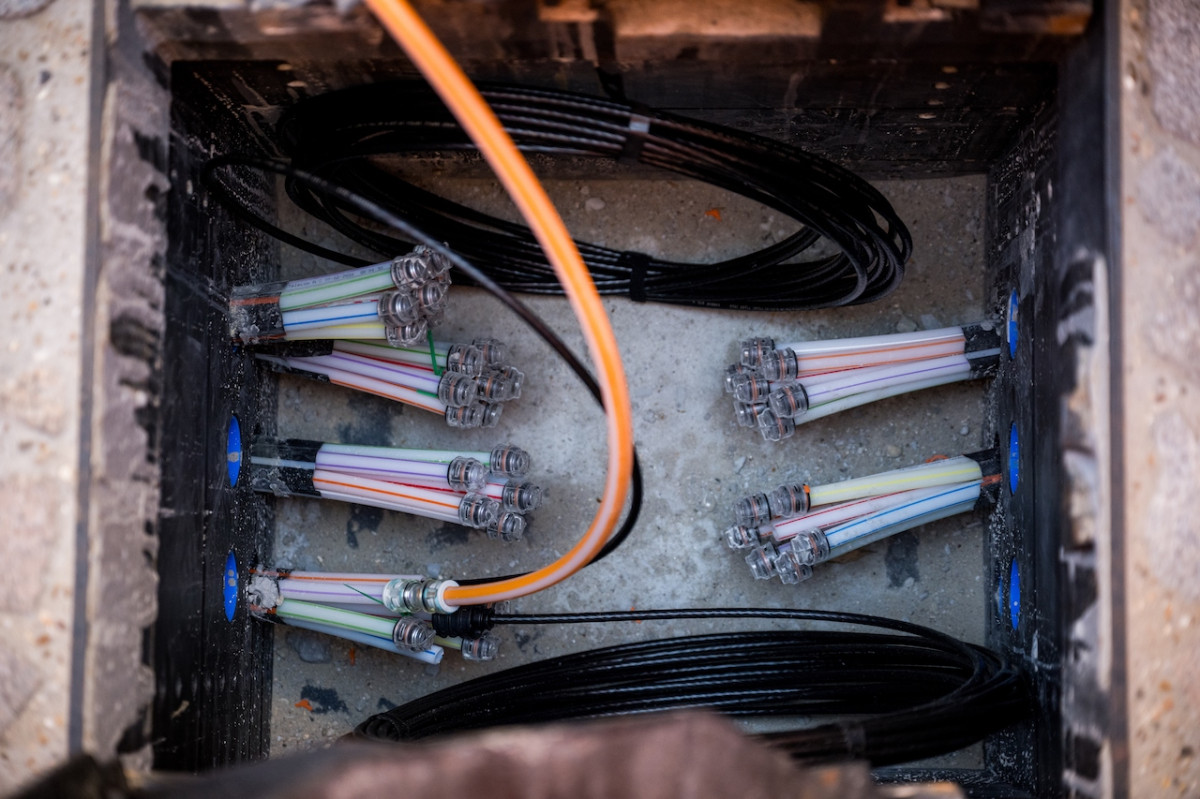
Within Europe’s technology-policy landscape, a number of notable success stories stand out, and one of them is the roll-out of Spain’s fibre-optic network. Today, coverage extends to 96% of households and 99.7% of the population, surpassing the reach seen in major markets like Germany and the United Kingdom.
In the wake of that achievement, however, complex regulatory debates have begun to emerge. From the offices of Spain’s National Commission on Markets and Competition (CNMC) to the corridors of Brussels, attention has shifted from merely connecting more people to ensuring the sustainability of current and, above all, future networks. Central to this discussion is a regulation known as MARCo (Offer of Access to Records and Conduits), which obliges the incumbent operator, Telefónica, to lease its civil infrastructures to rivals at regulated prices.
This measure was introduced in 2009 as an emergency option, intended to prevent needless duplication of trenches and to accelerate competition. Today, it risks turning into a drag on sector investment, prompting a question: Is it prudent to apply the 2009 regulatory logic to one of Europe’s most competitive markets in 2026?
An unrecognizable market and the myth of the “natural monopoly”
When MARCo began to operate, almost twenty years ago, alternative operators scarcely possessed any infrastructure of their own. Regulators’ objective was clear and justified: to facilitate access to existing lines and poles, thereby boosting a market that was stagnant.
That aim was largely achieved. Industry estimates indicate that the use of shared infrastructures yielded substantial savings for competitors, roughly between 60% and 80% of total deployment costs. Thanks to that policy, Spain democratized high-speed connectivity, attracted capital, and dramatically narrowed the digital divide in rural areas.
“Industry estimates indicate that the use of shared infrastructures yielded substantial savings for competitors between 60% and 80%”
Nevertheless, yesterday’s triumph can become today’s burden, and some players in the sector cling to the belief that Spain’s civil infrastructures amount to a “natural monopoly”. In response to that claim, a look at 2026 market data reveals a landscape that is far from what was initially proposed.
Among European countries, Spain arguably counts the most extensive and highest-quality alternative civil infrastructures. A wide range of robust options exists beyond Telefónica’s network:
- Cable networks: older infrastructures from cable operators, now integrated into major groups such as MasOrange and Vodafone, serving more than ten million homes.
- Third-party infrastructures: an extensive network of usable pipelines from other sectors (energy, water, gas) and public civil works, with a reach that rivals that of the historic operator.
It is inappropriate to describe a country with hundreds of networks and record levels of competition as possessing a natural monopoly. And updating MARCo does not imply restricting access, nor undermining competitive guarantees. It can signify a gradual revision of economic conditions to better align with the current costs of operation, maintenance, and investment.
Capital at risk
One of the phrases most often invoked by opponents of updating access prices is that Telefónica’s infrastructures represent a legacy from Spain’s pre-1998 state-monopoly era. Yet this sector has been governed by market dynamics for over a quarter-century.
Since liberalization, Spain’s housing stock has grown by more than 7.5 million new homes. To connect those urban developments and the vast, intricate rural expanses, billions of euros of purely private investment have been necessary. Moreover, the civil network isn’t a static block of concrete: it behaves like a living ecosystem. Over time, wooden posts rot, conduits suffer damage from external forces or collapse, and access points require constant maintenance.
“The civil network isn’t an inert concrete block: it’s more like a living ecosystem”
“You can’t demand massive investment in strategic infrastructure while indefinitely prolonging regulatory schemes designed for a different technological cycle”, EU telecom-investment analysts contend. Maintaining that extensive reach implies rising operating costs. In that sense, the current model sustains an asymmetric transfer of value: the entity that maintains the network bears the risk and the inflationary costs, while third parties exploit that infrastructure at prices kept artificially low by regulation.
The paradox of reciprocity and market prices
That aside, the monopoly narrative falls short. To address the notion of a “fair price,” one must examine the reciprocity within the Spanish market.
Certain alternative operators have persistently warned that any adjustment to MARCo prices by the CNMC would jeopardize their investments. Meanwhile, other ways of thinking about operator relations tell quite a different story. There are instances where the dynamic runs in the opposite direction, with Telefónica needing to rent space from rivals. When that occurs, the tariffs applied aren’t “regulated” at all.
“Certain alternative operators have persistently warned that any adjustment of the MARCo prices by the CNMC would jeopardize their investments”
Market sources indicate that other operators charge Spain’s incumbent company twice, four times, or even ten times what they themselves pay to use the MARCo network. It is hard to argue that a regulated price is “abusive” or harmful to competition when the same players levy markedly higher prices for the identical service.
European sovereignty and resilience enter the debate
The discussion about pipelines in Spain does not dominate the broader strategic framework Europe is shaping. The continent pursues ambitious objectives: strategic autonomy, digital resilience against cyber threats, the essential infrastructure for AI, and the modernization of critical networks. All of these require capital. A substantial amount of capital.
With the recent Gigabit Infrastructure Act, Europe’s legislative direction has already begun to pivot. The Brussels guideline holds that enterprises granting access to their physical infrastructures should have a fair and reasonable chance to recover the costs incurred. In other words, the European regulator understands that imposing excessive burdens on the builder of a network undermines the incentive to keep improving it.
“Updating regulated prices in Spain isn’t equivalent to ‘re-monopolization’, as the alarmists claim”
Viewed this way, updating regulated prices in Spain isn’t the same as “re-monopolization,” as the alarmists claim. No one at any level challenges the right of third parties to access those pipelines, and technical and operational access will remain fully guaranteed. The conversation is moving toward gradual application and adaptation of rates to current economic realities, leaving behind the de facto subsidy that below-cost prices imply.
Adapt or stagnate
Some critics argue that a price rise would halt deployment. The figures tell another story. Data show that renting conduits today represents a marginal slice of the total fibre-deployment costs for any mature operator. The networks are already in place, public deployment funds (like the ÚNICO program) are nearing completion, and the market is highly consolidated.
At this point, one could argue that the legal uncertainty does not stem from changing a price but from keeping a regulatory framework frozen while the economy, inflation, and technology advance. Rate revisions—upward or downward—are a normal and healthy instrument in any market democracy. In fact, CNMC’s own figures indicate that even after adjustments, regulated prices remain below actual costs.
“Maintaining the ecosystem under those same rules in 2026 doesn’t address market failures, but it might be creating some”
Spain achieved fibre leadership through a bold and interventionist regulation in 2009 that addressed a market failure. Keeping those same rules in 2026 doesn’t fix all market shortcomings, but it may be creating new ones. If Europe wants its operators to build the financial strength to compete in the AI era and safeguard their essential infrastructure, it must ensure that regulation continues to provide incentives for those who invest in, maintain, and upgrade these very networks.
The triumph of fibre optics in Spain is now part of history. Now is the moment to begin financing the future.
