
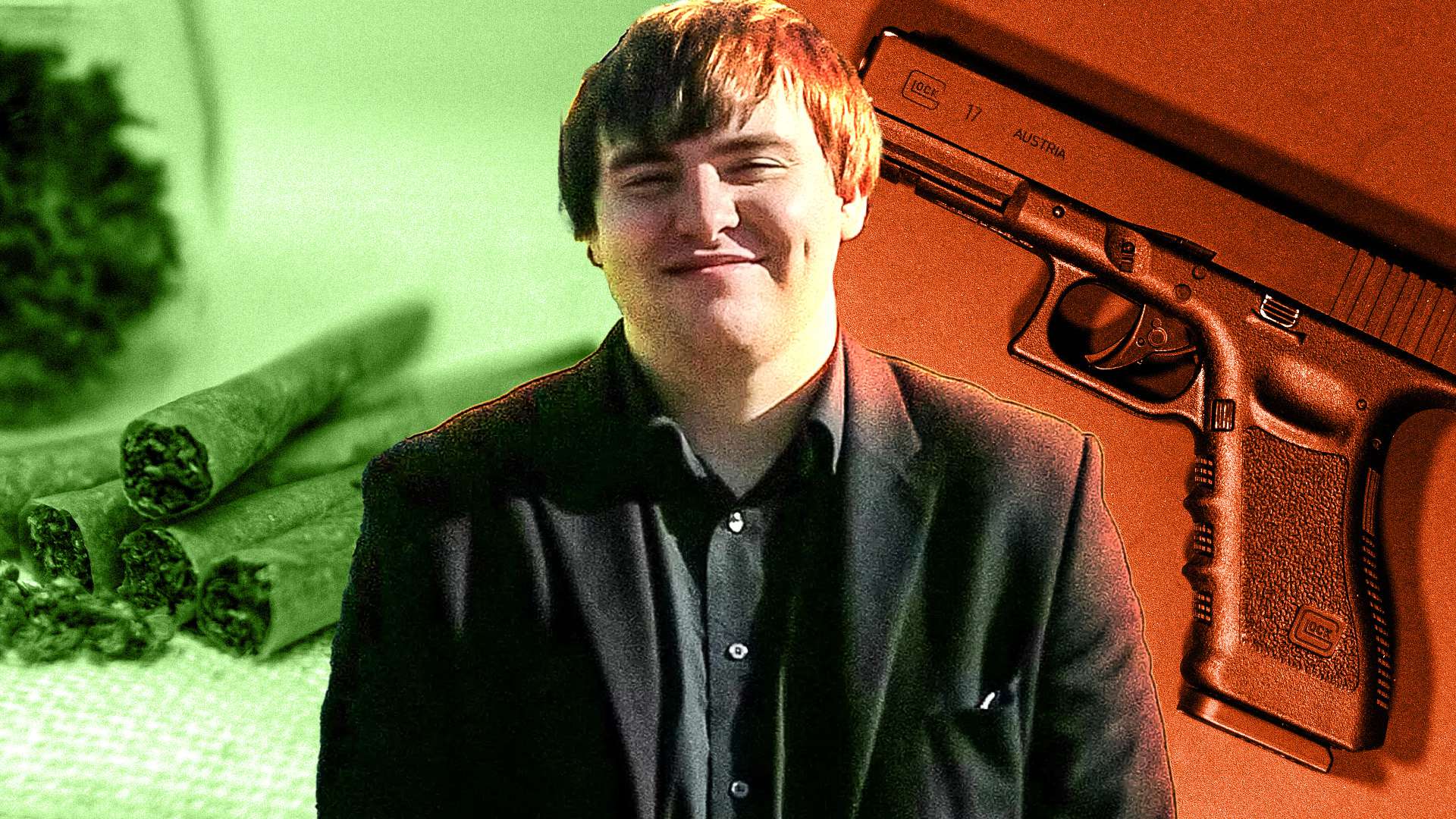
The Supreme Court’s ruling in United States v. Hemani could broaden the path to relief for cannabis users who were convicted of unlawfully possessing a gun.
Last week, in United States v. Hemani, the Supreme Court unanimously held that the government may not strip individuals of their Second Amendment rights or prosecute them for illegal firearm possession merely because they are marijuana consumers. This ruling was welcomed by Alexander Ledvina, an Iowa resident who received a four-year sentence for owning firearms while being a cannabis user.
Ledvina, who was 26 at the time of his June 2023 arrest, has remained in custody since then. In a letter from a federal prison in Memphis—written the same day the Court issued its Hemani decision but before the outcome was known—Ledvina explains that he is slated for release on July 15, six days before his 30th birthday, thanks to the expanded time credits for good conduct and earned time authorized by the FIRST STEP Act of 2018. Hemani therefore will not affect the time he has already served. Nonetheless, the ruling improves his prospects for overturning his conviction, which could restore his Second Amendment rights and erase some of the lifelong consequences that accompany a felony record.
Ledvina’s case illustrates the potential reach of Hemani. The decision not only limits future prosecutions but also opens the possibility of relief for individuals previously convicted under 18 U.S.C. 922(g)(3), which designates it a felony, punishable by up to 15 years in prison, for an “unlawful user” of “any controlled substance” to possess a firearm. Many of those convictions may now be subject to challenge, since the Court stated that Section 922(g)(3) prosecutions are unconstitutional when they rest solely on the statutory elements.
The case before the Court concerned Ali Hemani, a Texas man who admitted to owning a pistol and using marijuana several times a week. Although that admission would normally have sufficed to convict him of violating Section 922(g)(3), the Court held that the Second Amendment requires something more.
Writing for the majority in Hemani, Justice Neil Gorsuch emphasized that the decision leaves room for prosecutors to pursue charges against gun owners who are addicted to any controlled substance, another prohibited category under Section 922(g)(3). He also suggested that authorities could bring a §922(g)(3) case accompanied by individualized proof that the defendant’s marijuana (or other drug) use makes him dangerous to himself or others.
Ledvina’s bench trial resulted in a conviction based on agreed-upon facts that did not include such additional evidence. He acknowledged owning firearms and that he “used marijuana at least five to six times per week” from March 2022 through July 2022. In that sense, his admissions mirrored Hemani’s, though Ledvina was also found guilty of making a false statement during a firearms purchase by denying that he was an “unlawful” drug user—a misrepresentation that is regarded as a separate offense under 18 U.S.C. 924(a)(1)(A).
At sentencing, U.S. District Judge C.J. Williams credited extra allegations, including claims that Ledvina had accidentally fired a gun while under the influence of cocaine with a acquaintance, that he had tried to collect a debt from that person by knocking on his door, and that he had brandished a firearm when confronted by one of that man’s neighbors. Ledvina disputed those assertions, and prosecutors never had to prove them at trial.
Those unproven allegations, however, were factored into Ledvina’s 51-month term, which could have been notably shorter given his relatively clean record. The court noted that his record mostly consisted of “a couple of disorderly conduct incidents when he was 18.” Yet, under the sentencing standard of the preponderance of the evidence, the judge found it more likely than not that the additional allegations were true.
That reasoning stands in stark contrast to the “individualized proof” of dangerousness that Gorsuch said could permit prosecutors to convict someone under Section 922(g)(3). If Ledvina’s case had gone to trial under the constraints of Hemani, prosecutors would have needed to prove beyond a reasonable doubt that Ledvina posed more danger than the typical cannabis consumer.
Ledvina already had some grounds for hope that his conviction might be challenged successfully. In February, the Eighth Circuit ruled that Ledvina should have the opportunity to press an as-applied challenge to Section 922(g)(3). “Beyond that,” Judge Ralph Erickson wrote in United States v. Ledvina, “drug use generally, or marijuana use specifically, does not automatically extinguish a person’s Second Amendment right.” The 8th Circuit vacated Ledvina’s Section 922(g)(3) conviction and remanded the case to Williams’ court for further proceedings to resolve his Second Amendment as-applied challenge. Ledvina states that Williams agreed to defer those proceedings until the Supreme Court issued its Hemani decision.
Even as questions remained about the constitutionality of Ledvina’s prosecution, the 8th Circuit upheld his conviction under 18 U.S.C. 924(a)(1)(A), which rested on the form he completed when purchasing a pistol in July 2022. In addition to that charge, Ledvina could have faced prosecution under 18 U.S.C. 922(a)(6), which criminalizes the same conduct. And due to the Bipartisan Safer Communities Act, effective June 2022, Ledvina could have been charged with another felony—“trafficking in firearms”—a broad provision that Congress extended to cover gun possession by drug users.
These ancillary charges prompt questions about Hemani’s reach. Under the Second Amendment, the Court held that the government cannot disarm a person merely for marijuana use, nor punish him for violating that unconstitutional restriction. Does that mean the government is also barred from punishing him for offenses designed to enforce the general prohibition on firearm possession by “prohibited persons”?
According to the Court, marijuana users generally retain a Second Amendment right to purchase firearms. However, they would still be committing a false statement if they answer “no” to the question, “Are you an unlawful user of, or addicted to, marijuana or any depressant, stimulant, narcotic drug, or any other controlled substance?”
Following Hemani, it remains uncertain whether a cannabis buyer who obtains a gun could be found guilty of “trafficking in firearms.” That offense includes receiving a firearm with knowledge or reasonable belief that such receipt would constitute a felony. But under Hemani, that receipt cannot be deemed a felony unless there is additional proof that the buyer poses a threat.
It would be odd if a marijuana user possessed a constitutional right to bear arms yet could be jailed for answering the form question with a truthful denial of unlawful drug use. It would be even stranger if that person could be punished for “trafficking in firearms” simply for exercising his right to buy a weapon.
How courts resolve these issues will influence Ledvina’s chances of clearing his record. After his release, he will still face three years of supervised release and will continue to carry a felony conviction, which, among other consequences, bars him from exercising the Second Amendment rights recognized in Hemani.
In January, Ledvina earned certification as a paralegal, and he hopes to work at a law firm after his release—even though that may be challenging given his criminal record. “The U.S. Probation Office has approved me to relocate back to my parents’ home,” he explains. “I will then have to rebuild my life from the ground up with the extra difficulty of being a felon.”
Ledvina says he is mourning lost time and the things permanently left behind. While he was incarcerated, his maternal grandfather passed away. “It hit me hard,” Ledvina recalls. “I spent a lot of time with him while growing up, and he was a major reason I got into firearms. He ran a federally licensed gun shop and would often test-fire his stock when I visited. He taught me how to shoot a rifle when I was a child. I dreamed of surprising him by showing up at his house right after I was released. That will never happen now.”
Ledvina included photographs of his dog in the letter, calling her “the closest thing I have to a child.” “Fortunately, she’s still with us, though she’s old and frail,” he writes. “This is truly heartbreaking because she spent most of her life by my side before my arrest. Now she has spent a quarter of hers without me, and she still thinks I’m gone.”
