Europe is at a decisive moment that could redefine its role in security and defense. In a context marked by the war in Ukraine, the uncertainty in the relationship with the United States, and shifts in global geopolitics, the question is no longer whether the European Union should reinforce its strategic capacity, but how to do it and with what instruments.
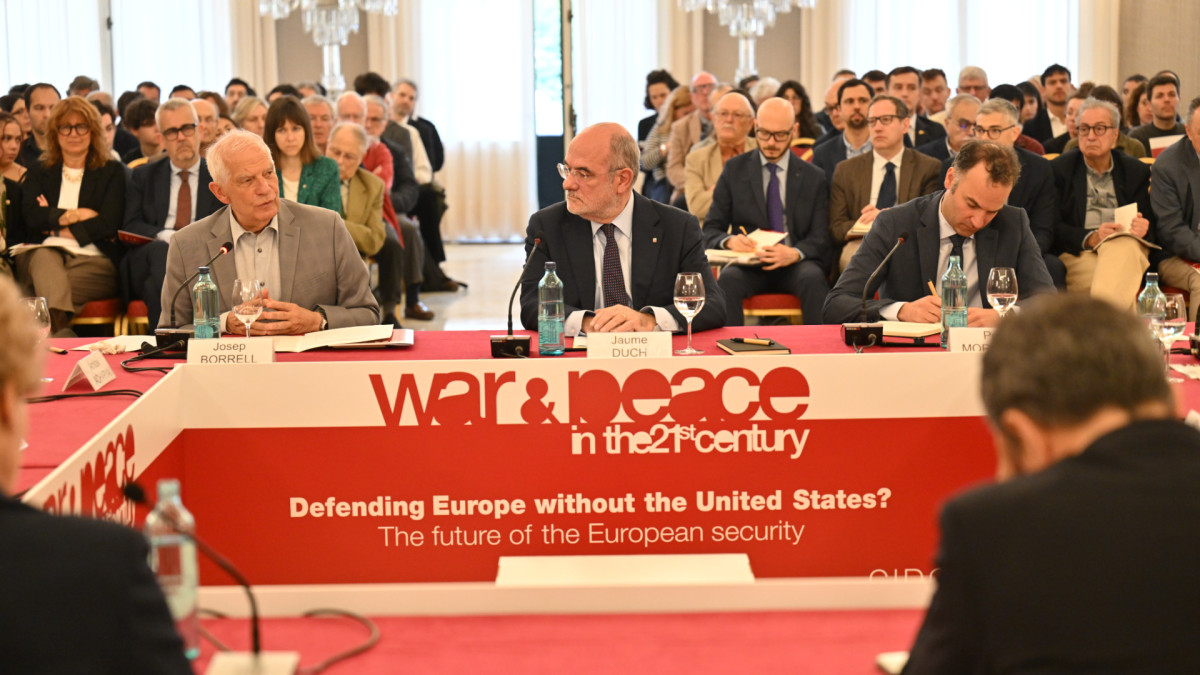
In this context, on April 11, 2026, the Palau de Pedralbes in Barcelona hosted a new edition of the conference War and Peace in the 21st Century, organized by CIDOB under the title Defending Europe without the United States? The future of European security. The meeting brought together political leaders, academics, and experts in international security to discuss the future of European security at a moment when support from the United States can no longer be taken for granted.
The Palau de Pedralbes, once again the meeting point for the international conference. Photo: CIDOB
Defense capabilities and alliance adaptation
The day was structured around two main axes: on the one hand, the development of European defense capabilities; on the other, the adaptation of alliances to an increasingly fragmented international environment.
During the opening, Jaume Duch, Counselor for the European Union and External Action of the Generalitat de Catalunya, stressed that global changes force the European Union to adapt. In this regard, he defended the need to develop an autonomous strategy, with sufficient resources and a greater capacity to respond to current challenges.
Next, Josep Borrell, chairman of CIDOB’s board and former High Representative of the European Union for Foreign Affairs and Security Policy, recalled that the EU was conceived in a more stable context, whereas the current scenario calls for strengthening its strategic autonomy without abandoning its principles or its traditional alliances.
The first session, moderated by María Tadeo, head of EU information and Euronews television correspondent, revolved around a central question: what and who should Europe defend itself against? The moderator actively participated in the debate, raising questions about the real limits of European strategic autonomy.
“Europe faces several simultaneous challenges —Russia, China, and the United States— that require distinct but coherent responses”
According to Steven Everts, director of the European Union Institute for Security Studies (EUISS), Europe faces several simultaneous challenges: the Russian threat, competition with China, and uncertainty about the role of the United States. This context obliges not only to strengthen capabilities, but also to rethink the European strategic approach.
In this line, Kristi Raik, director of the International Centre for Defence and Security (ICDS), focused on Russia as an immediate threat, especially since the preparations for the war in Ukraine in late 2021. In her view, the integration of Ukraine into the European system — including in the defense domain — is not only desirable, but strategic, as it would allow the incorporation of direct military experience into the current conflict context.
From a more structural perspective, Camille Grand, secretary general of the Aerospace, Security and Defence Industries Association of Europe, noted that the current situation is not simply a crisis, but a profound change that requires rethinking European security. In this context, he stressed that European industry already has the capacity to cover roughly 98% of the systems that the United States currently provides. However, the debate itself highlighted important exceptions, as Borrell pointed out: the United States supplies around 90% of the air defense missiles used in Ukraine, especially Patriot systems, in addition to key capabilities such as satellites or cloud computing, which remain difficult to substitute in the short term.
This lack of coordination was also noted by Daniel Fiott, director of the Defence and Statecraft program at the Brussels School of Governance, who highlighted the pressure exerted by major powers such as the United States, China, or Russia on European institutions. Beyond external threats, his intervention pointed to an internal problem: the difficulty for the Union to translate political consensus into operational decisions.
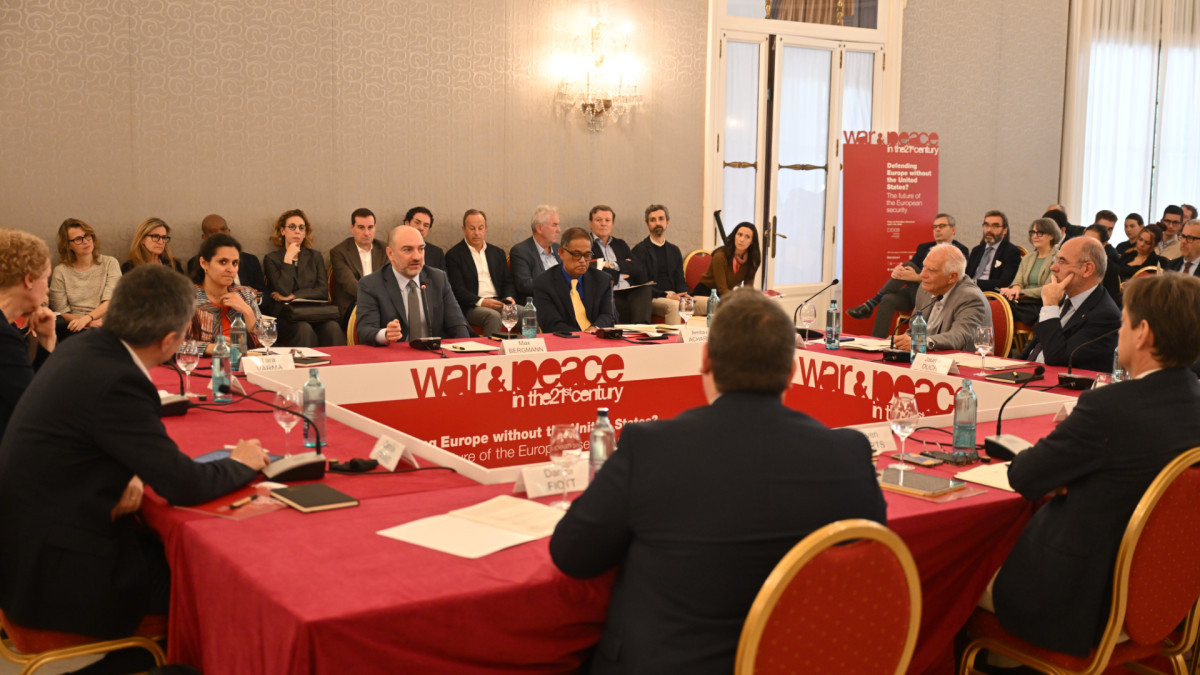
All speakers exchanged viewpoints, from different disciplines, on the risks to European security. Photo: CIDOB
In this vein, several participants warned of an emerging paradox: increasing defense resources do not always translate into greater coordination, as some member states tend to act more autonomously, which can complicate the integration of capabilities at the European level.
Against these tensions, Borrell defended a pragmatic approach, moving away from more ambitious proposals —such as the creation of a European army— and favoring concrete solutions. In this sense, he mentioned initiatives such as the development of a rapid reaction capability of about 5,000 personnel, conceived as a more realistic tool to improve Europe’s response to crises.
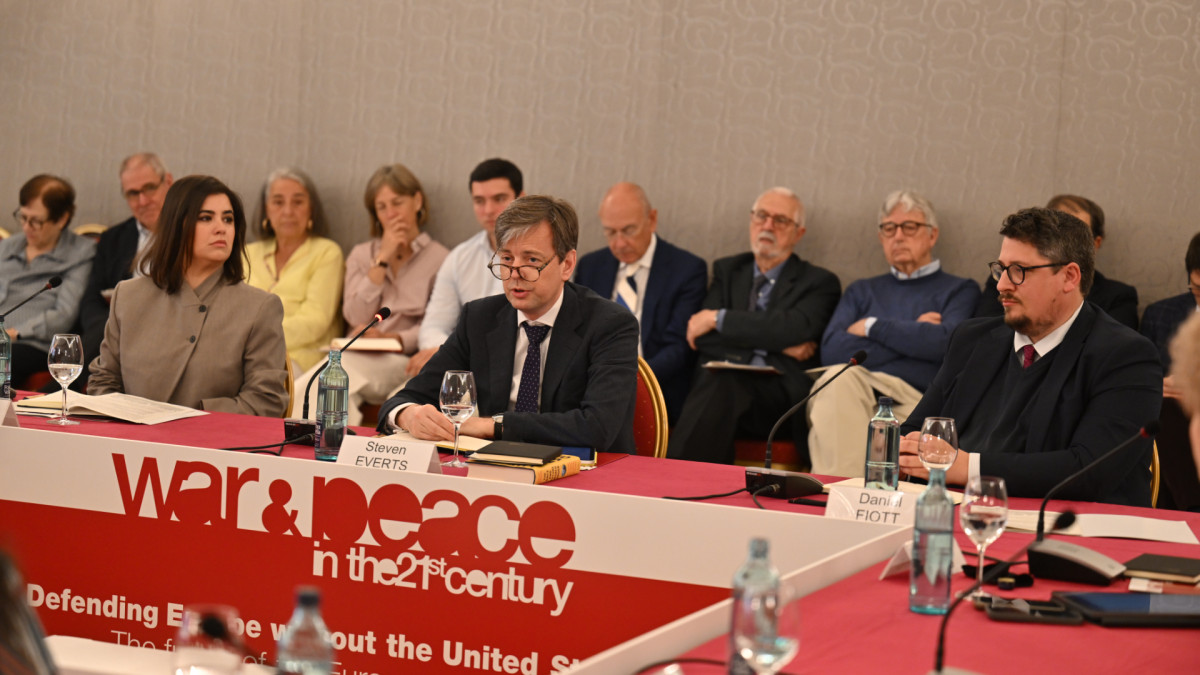
María Tadeo, Steven Everts y Daniel Fiott during their participation in the event. Photo: CIDOB
USA, Russia, and the outer edge of European autonomy
The second part of the day broadened the focus beyond the European framework, incorporating the international dimension of the debate. At this point, one of the most recurring ideas was the need to adjust the European perspective to a global environment increasingly diverse in interests and perceptions.
Amitav Acharya, renowned professor at the School of International Service of American University in Washington, warned that the Global South does not view the Europe-Russia conflict as central. This difference in perception reflects the diversity of approaches to the conflict and underscores the importance of understanding how it is interpreted outside of Europe.
Similarly, Max Bergmann, director of the Europe, Russia and Eurasia program at the Center for Strategic and International Studies (CSIS), noted that the United States does not always consider the EU a top partner, which reinforces the need for Europe to assume greater responsibility for its own security.
In the same vein, Tara Varma, director of the Paris office of the German Marshall Fund of the United States (GMF), stressed the importance of diversifying alliances and adapting to a more complex international environment.
“The question is whether the EU can act as a strategic actor with twenty-seven sovereignties that, in the decisive moment, still think nationally”
Overall, the debate revolved around a shared idea: the need to reinforce the internal unity of the European Union to respond more effectively to the current security and defense challenges. Several participants agreed that military capability strength alone does not guarantee greater political influence if it is not accompanied by greater coherence in decision-making.
As Pol Morillas, director of CIDOB, noted while presenting the conference conclusions, Europe must move toward a true “strategic awakening” that enables it to tackle its own security and defense challenges, strengthening its ability to act and its internal cohesion. In this sense, he stressed that a stronger and more autonomous European Union does not weaken the transatlantic relationship, but helps stabilize it on more balanced grounds, overcoming dynamics of over-dependence and moving toward a more symmetric partnership among allies. As Morillas stated, “despite the challenges, Europe has the capacity to strengthen itself from within,” a sentiment that summarizes the spirit of the gathering.
The conference was closed by Jaume Collboni, Mayor of Barcelona, who highlighted the importance of dialogue and European unity.
In partnership with