
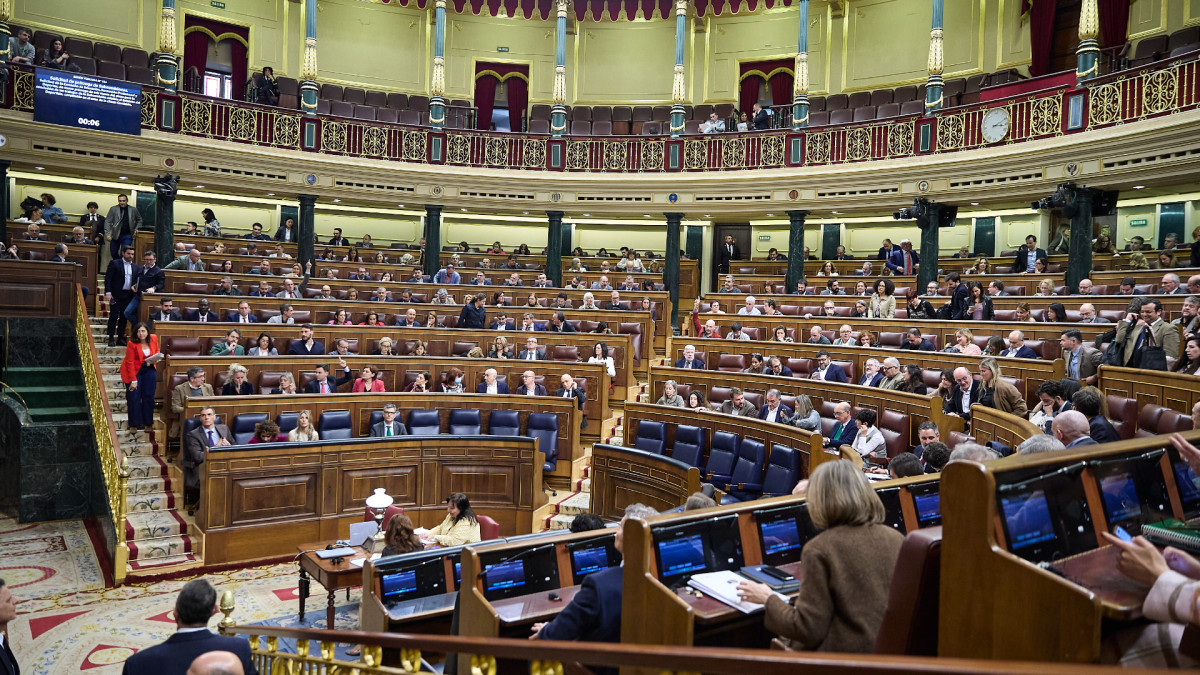
The yesterday morning debate in the San Jerónimo corridor once again proved to be a display of what the British, always precise with their institutional poise, call unparliamentary language (unparliamentary language). Crossed shouts, calculated interruptions, ad hominem insults, and a palpable absence of that ingredient which, although to many it may sound like old-fashioned morality, is the true lubricant of any liberal democracy: respect.
Analysts spend our days dissecting the guts of power, and what we observe in Spanish politics is not an isolated Western phenomenon, but one that has taken on a particularly virulent and sterile hue. The session of the past 24th is not an isolated case. We are witnessing the substitution of public-policy debate with the spectacle of the narrative annihilation of the opponent.
“What we observe in Spanish politics is not an isolated Western phenomenon, but one that has acquired a particularly virulent and sterile hue”
Yet, amid the noise, there remain important aspects being overlooked. Respect in politics goes beyond good manners or protocol. It is the survival mechanism of our institutions. And, paradoxically, it is only through mutual respect that useful disagreement can be exercised. That disagreement that allows citizens to distinguish clearly, with crystal clarity, between competing political projects and opposing country models.
The disappearance of mutual tolerance
To gauge the gravity of what has become routine in our Congress, we can revisit How Democracies Die. In this renowned book, Harvard professors Steven Levitsky and Daniel Ziblatt warned that institutional collapse in the twenty-first century rarely arrives via tanks on the streets or military coups. Instead, it is far more common to witness a silent degradation, which happens when two unwritten democratic norms break down: institutional containment and, crucially, mutual tolerance.
This mutual tolerance is the tacit agreement by which politicians acknowledge their ideological opponents as legitimate rivals, as compatriots who also love their country, and not as existential enemies to be destroyed or expelled from the system. Yesterday, in the chamber, we saw leaders treat each other as threats to the very existence of the nation. If the opponent is dehumanized and labeled as “illegitimate” or “traitor,” the ground is prepared for justifying any excess.
“It is much more common to see a silent degradation, which occurs when two unwritten democratic norms are broken: institutional containment and mutual tolerance”
This incivility has consequences—well-known and dangerous—because it destroys citizens’ trust in the State. Voters observe the row and, exhausted, sink into cynicism, apathy, or throw themselves into anti-system populism. The philosopher Diana C. Mutz believes this process is the great driver of affective polarization. In this sense, we no longer disagree about tax brackets or public-health management; we simply visceral-hate the person who votes for the other party. And the origin of that rupture lies in the incendiary rhetoric of those who should set an example from the speakers’ dais.
The value of dissent: from insult to disagreement
Facing this bleak backdrop, it would be tempting (and dangerous) to fall into the trap of thinking that the panacea is absolute and perpetual consensus. Nothing could be further from the truth. A healthy democracy needs conflict. It requires, in fact, that political projects clash in the public arena and show their differences with absolute clarity. But there is a colossal distance between legitimate disagreement and systematic insult.
Recently, the Next Gen Forum, organized by Agenda Pública, gathered, among others, two rising voices from Spain’s new politics: Enma López of the PSOE and Nacho Catalá of the PP. In a dialogue that should be mandatory viewing for the deputies who were shouting today in the Congress, both demonstrated that it is perfectly possible to hold radically opposing ideological positions without losing sight of the humanity of the interlocutor. As López insightfully noted, disagreement is “super healthy”, but insult for insult, where there is no substantive debate builds nothing but rubble.
That is the core of our current failure, because, in cases where decorum disappears, we see political debate emptied of real content.
“A healthy democracy needs conflict. It requires, in fact, that political projects clash in the public arena and show their differences with absolute clarity”
Another example: if a leader accuses another of being a coup-plotter in the first thirty seconds of his intervention, how can we reach a mature debate about housing or how to structure European funds? Catalá summed it up with unusual maturity in today’s politics: “One can hold hugely divergent positions and, in any case, let the public debate lead you to an agreement or to accepting that the other is there“.
The false comfort of noise
Why have we reached this state of perpetual boiling in Spain? If we look back, during the Transition, the existential threat—the real risk of an authoritarian regression or the collapse of a fragile economy—acted as a cohesion factor. Differences were immense, perhaps larger than today, but the historical urgency forced us to subordinate ideological testosterone to the survival of the State.
Today, with that perception of imminent danger diluted, it seems that the political class, as suggested by the Agenda Pública debate, prefers theatricality: “Perhaps now we can amuse ourselves by insulting each other in Parliament instead of pushing through basic laws to modernize the country,” López pointed out.
But we would be mistaken to think that Europe and Spain do not face vital urgencies today. We are undergoing a technological and digital revolution that will reshape the labor market; we face geopolitical convulsions at the gates of the Union and suffer an incipient internal fracture that threatens to become a generational schism or, stepping into the mud of the material, a chasm between homeowners and non-owners.
“We are mistaken if we think that Europe and Spain do not face vital urgencies today. We are undergoing a technological and digital revolution that will reshape the job market”
To decide how to tackle these challenges, we need to debate green taxation, industrial sovereignty, and the welfare state. And those debates require technical finesse, contrasted data, and a clearly defined clash of models. Noise, on the contrary, deafens the differences. When everything is a theatrical shout, the citizen is unable to discern what the social-democracy truly proposes versus the conservative-liberal alternative. We must champion dissent because it is the nuclear fuel of transformative politics, but we must oppose sterile polarization as merely its toxic smoke.
Governing the future from a moral height
If Spain wants to exercise leadership in the Europe to come, its political class must harden up quickly and abandon the toxic incentives of confrontation for its own sake. The politics of constant grievance, hyperventilated by the social media ecosystem, has only a short tactical shelf life. It can yield ephemeral electoral gains by mobilizing the most hyper-ventilated segments, but it inexorably erodes the foundations of governance.
We routinely see that in other northern European parliaments or in Westminster, maintaining decorum acts as an essential firewall. When the British speaker cries “Order, order!” and forces a retraction of an insult, he does so because he knows that verbal degradation precedes legislative paralysis.
In the Congress of Deputies we have witnessed another episode of low-flying politics. Yet there are reasons to think it could be different. If leaders from different parties are capable of recognizing each other as adversaries worthy of respect—as we saw at the Next Gen Forum—this means that the talent for high politics remains present in the country.
Maintaining respect is not, nor should be, understood as ceding ground to the opponent. In reality, only those who lack tangible arguments need to raise their voices. Let us make deep and rigorous disagreement the norm, not the exception. Because if the seat of national sovereignty renounces being the space where ideas are fought out peacefully, democracy will cease to be the place where citizens find their answers.
A history of our time
Political polarization, electoral fragmentation, perpetual campaigning, social-media dynamics, and the decline of trust in institutions have made political support more volatile and less durable, in the United Kingdom as elsewhere.
