
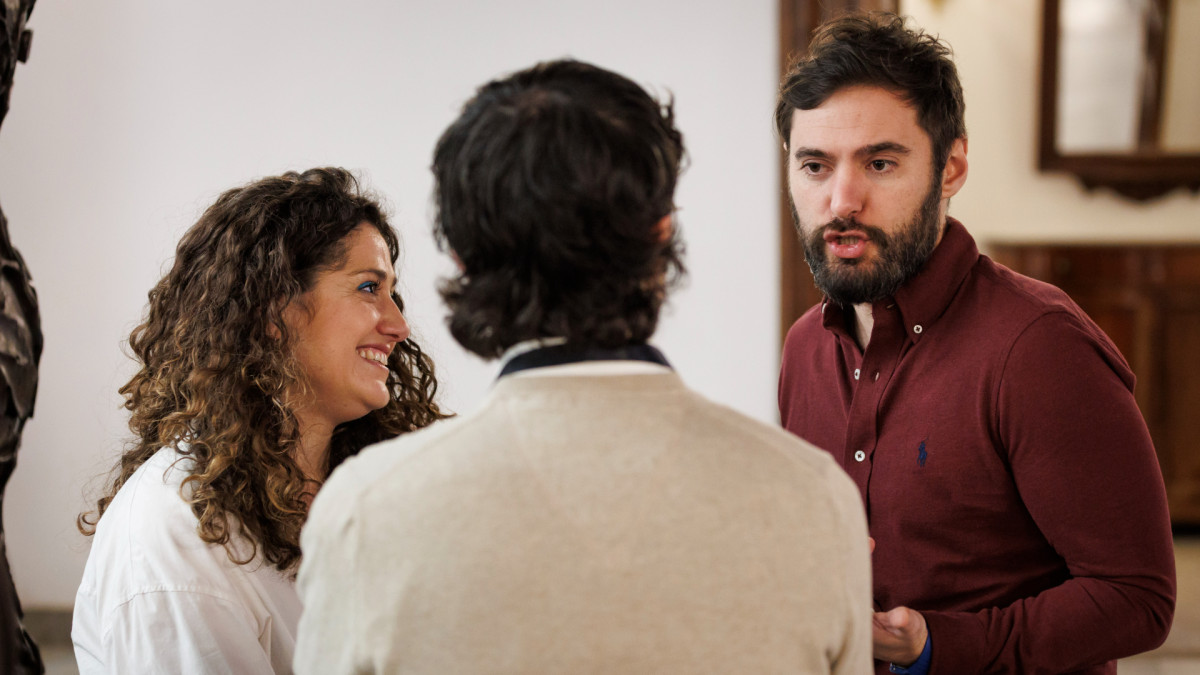
Since the term polarization began to gain traction, politicians and citizens have taken on very similar stances. Although they are fully aware of its drawbacks and of the few virtues in direct and systematic confrontation, the levels of division have only grown. At the Next Gen Forum, the annual gathering of emerging leaders driven by Agenda Pública and TALEÑTO ESPAÑA, one of the main goals was to try to shed light on the reasons and consequences of this dynamic.
To achieve this it is not enough to simply pick politicians from one side and the other to explain their electoral program. It is necessary that they discuss metapolitics: to understand why there exists that gap — legitimate and valuable — which now manifests itself in such virulence. In other words, a discussion about the discussion itself and disagreement, which makes the participants in politics see where the citizens stand and why apathy is beginning to appear.
This was the idea of the conversation they held in Granada, Ignacio Catalá and Enma López. Both, generational leaders. Once their debate — governed by the rules of Chatham House — concluded, they agreed to this special conversation that we share in Agenda Pública.
Besides serving as a deputy in the Assembly, Catalá is the Madrid PP’s Secretary of Transportation. Photo: Agenda Pública / Álex Cámara
How do we face political discussion without hatred but with distance?
The starting point is disagreement. It seems obvious that parties must differentiate themselves, because otherwise one would be facing a mélange of formations offering a similar political package. In Enma López’s words, “it is very healthy” that this distance exists. However, the debate of “dehumanizing the opponent achieves little”, where “insult for insult” is practiced, crosses a boundary and ends up limiting the transformative capacity of politics. In the same vein, Catalá notes that “one can hold positions that are wildly distant”, but even so “the public debate can lead you to an agreement”. “That is what society is,” he emphasizes.
“Polarization is basically insult-for-insult, where there is no substantive debate anymore”
“We must distinguish between disagreement, which I think is very healthy”, López defends, “and then what polarization is, which basically means insult-for-insult, where there is no substantive debate.” A mature democracy needs conflict. What erodes it is dehumanization.
The distinction is crucial because the dominant diagnosis tends to blur everything together. If any intense disagreement is labeled as polarization, the implicit remedy becomes permanent consensus. And permanent consensus, in complex societies, is an illusion. Nacho Catalá agrees with his tablemate, though broadening the focus: “Understand that positions can be enormously far apart and that, in any case, public debate can lead you to an agreement or to accepting that the other is there. It has a majority for a while and then we’ll see,” he asserts. Politics, in this view, is not the abolition of antagonism, but its domestication within institutions.
Both politicians also worry about the quality of the debate because, as López explains, “we are facing tremendous challenges”. Catalá agrees on the importance of the present and regrets that “there is a lack of dialogue” between the two major parties. Nevertheless, the Popular party member positively notes that many topics arise in foreign policy where, in general terms, there has been agreement: with the war in Ukraine or the shift in the Atlantic relationship.
“In any case, the public debate can lead you to an agreement or to accepting that the other is there. It has a majority for a while and then we’ll see”
The problem, however, is that Spain experiences confrontation as permanent. During the Transition —with figures like Adolfo Suárez or Alfonso Guerra at the center of power— disagreement coexisted with a sense of historic urgency. There was a need to design a democratic state, integrate opposing sensitivities, and stabilize a fragile economy. The tension did not disappear, but it was subordinate to a shared objective.
Today, López suggests, the lack of that existential pressure allows Parliament to drift more easily toward gesture and dismissal: “Perhaps now the sense of urgency is lower and we can amuse ourselves with insulting each other in parliament instead of pushing through basic laws to modernize a country”, she argues. Urgency acts as a discipliner. When it fades, the incentive for theatricality increases.
The comparison with the past is tempting. It is also misleading. Catalá recalled that the eighties were not a lull of harmony either —the politics of the “Dober-man,” the “go away”— and warns against catastrophism: “I am not that catastrophist either: we are not in the year 32, nor close to it”.
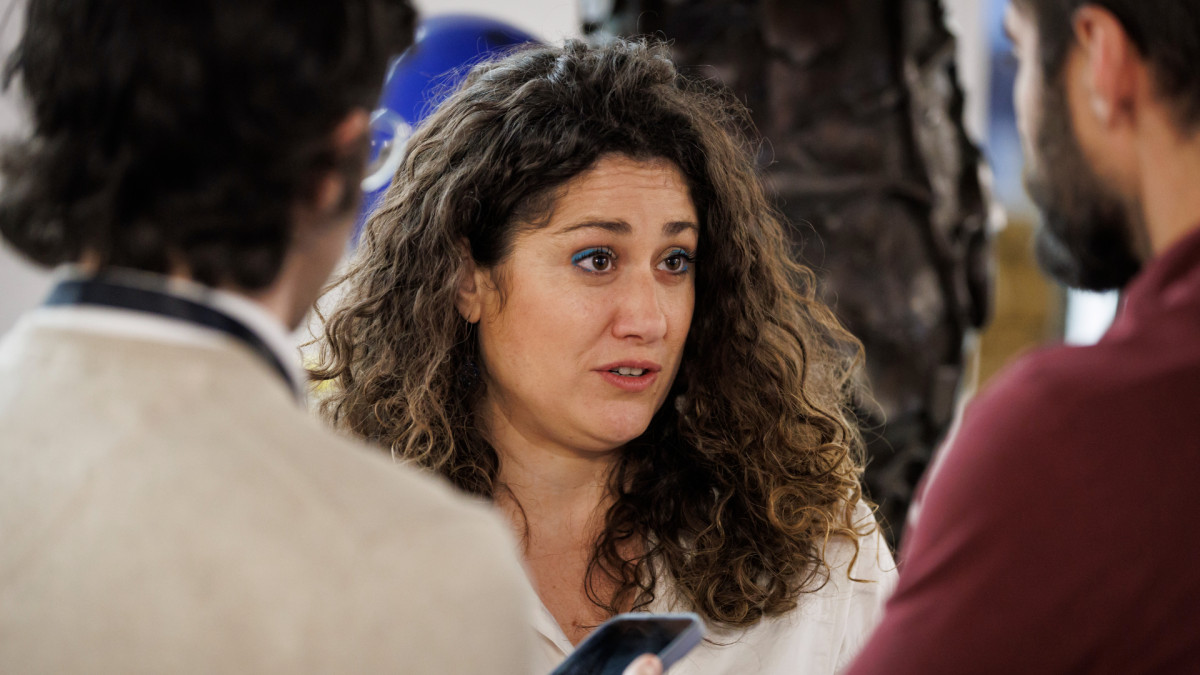
López is the federal secretary of Studies and Programs and a PSOE councilor in the Madrid City Council. Photo: Agenda Pública / Álex Cámara
Acuerdos para combatir los enormes retos del presente
Perhaps the difference is not in intensity but in constancy. The digital ecosystem has turned disagreement into a continuous flow. What used to be episodic campaigns today becomes daily friction, amplified by social networks that reward offense, sharp irony, and instantaneous indignation. Politics has shifted from being experienced in cycles to being consumed in real time.
Yet, the most unsettling debate may be generational. Catalá bluntly puts it: “There could be a generational civil war”. The phrase points to a rift between those who got housing and job stability during the expansion decades and those who today face rents, precarity, and the suspicion that the pensions that sustain them may not exist when they need them.
“I’m very afraid of a generational collapse,” he reiterates. Demography does not favor it. The dependency rate is rising. The housing market pushes young people out of city centers. Social mobility, once the engine of collective optimism, shows signs of exhaustion.
López rejects the strictly age-based frame and repositions it in more classic terms: “It’s not a generational issue, but a class issue that has existed all along: between owners and non-owners”. Not all older people are privileged, she notes, nor are all young people precarious. The real axis runs through the ownership structure.
The discussion is crucial. If the conflict is defined as a generational war, the solution will tend toward intergenerational redistribution. If it is defined as patrimonial inequality, the answer will involve taxation, housing, and market regulation. Changing the frame changes public policy.
“Economic history shows that technological transitions tend to concentrate rents in the initial phases. Policy decides whether that concentration becomes entrenched or corrected”
Both agreed, however, that the upcoming challenges may be more disruptive than those of the actual Transition. Digitalization and artificial intelligence present themselves as true forces reconfiguring production. “The issue of digitalization will lead our country to challenges perhaps even larger than those we faced during the Transition.”
The issue is not whether there will be growth, but who will capture its benefits. “We face the challenge of redistributing those benefits”, he continues, “because if, in the end, it ends up making the already rich much richer and everyone else much poorer, I don’t think that’s acceptable.” Economic history shows that technological transitions tend to concentrate rents at the outset. Policy decides whether that concentration becomes entrenched or corrected.
Catalá adds another important nuance: the continuity of the State beyond the noise. He notes that, despite the lack of substantial agreements between the Government and opposition in recent years, “the country will continue to move forward”. Perhaps the problem is not the existence of conflict but its perpetual framing as an existential crisis. A democracy is not measured by a lack of disagreement. It is measured by its ability to process it without breaking. Spain has endured greater tensions —economic, territorial, institutional— and has emerged from them with gradual adjustments that avoided collapse.
López offers a clear metaphor in this regard: “The talk shows that work are those where the participants know, respect, and appreciate each other regardless of their disagreements. Respect does not erase disagreement; it makes it productive. Without mutual recognition, any negotiation becomes a zero-sum game.
The final lesson is less dramatic than the noise would suggest. Spain does not suffer from debating too much. It suffers when it confuses confrontation with demolition. Disagreement is the fuel of politics. Sterile polarization is its smoke. Consensus is not the absence of conflict, but the agreement on the rules to manage it.
The risk is not that there are two poles. The risk is that the shared space where those poles can talk without denying each other’s legitimacy disappears. If that space is preserved, disagreement will be a sign of democratic vitality.
“To govern that future, it is urgent to abandon the noise along with the toxic incentive of ‘free insults’ “
There is a certain level of optimism in the air. Debates, accompanied by disagreements but also with respect and conversations that continue beyond the stage, are proof that there is a desire to do better. The leaders called to push forward tomorrow show they are up to the task and that, in contexts like the Next Gen Forum, agreements, or constructive disagreements, can emerge for the good of the country. “Here we are talking about the future of the country and not only our own country,” López concludes, also thinking about the European dimension. To govern that future, it is urgent to abandon the noise along with the toxic incentive of the ‘free insult’ and finally enter into debate and solve the problems of a historic moment that no one now doubts.
As much as it is necessary that there be disagreements between the parties, so too is it essential to detect what is failing or where emphasis is needed. It is the preliminary step to any transformative public policy. From this exchange, Enma López ensures that she comes out “more connected,” both with the different parties and with “the world of business,” also present at the meeting. “Either we go hand in hand with a country-wide consensus, or we go nowhere,” the socialist asserts. Nacho Catalá, for his part, also values the ability to “de-dramatize” the debate: “We’ve had a heated conversation, but we’ve been at it for a day and a half and we’ve talked for hours, also about other things. We’re not people who kill each other,” he adds.

Natalie Foster
I’m a political writer focused on making complex issues clear, accessible, and worth engaging with. From local dynamics to national debates, I aim to connect facts with context so readers can form their own informed views. I believe strong journalism should challenge, question, and open space for thoughtful discussion rather than amplify noise.