
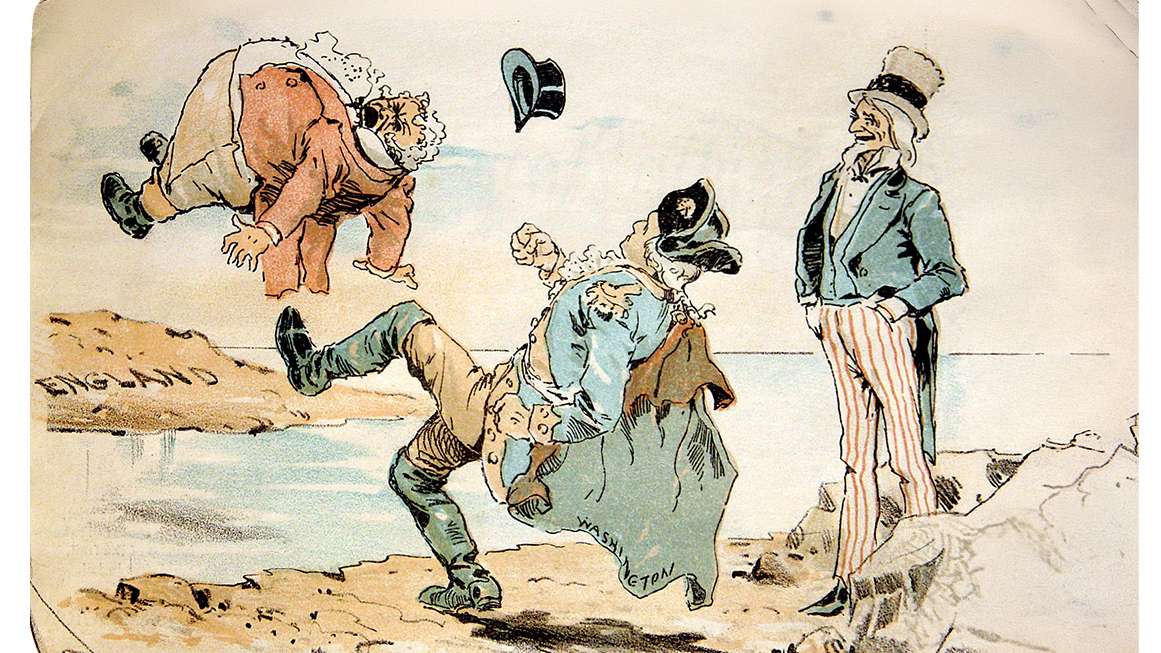
When you push him too far, the boar will turn on the hunters, warned Edmund Burke to Parliament. What would have happened if the British government had taken his counsel?
In a commemorative issue marking America’s 250th anniversary, Reason revisits the figures and ideas central to the nation’s founding. Read more here.

In 1790, the British statesman Edmund Burke published the work that would define his career. Part critique and part manifesto, Reflections on the Revolution in France condemned that upheaval not only for its blunt and violent experiments with liberty but also for its talk of the rights of man. Appalled by what he termed the “tyranny and cruelty employed to bring about and uphold this revolution,” Burke argued for a government “directed by laws, held in check and balanced by the nation’s great hereditary wealth and dignity; and again restrained by a prudent check from the reason and feeling of the people at large acting through a steady and permanent organ.” The book’s rapid reception solidified Burke’s reputation as the leading defender of traditional values and the established social order.
It also provoked the fury of Burke’s more radical peers. Mary Wollstonecraft, a pioneering feminist and liberal voice whose daughter Mary Shelley would later gain fame as the author of Frankenstein, charged that Burke was no champion of liberty. In her critique A Vindication of the Rights of Men, she argued that if there is any real argument in Burke’s wild denunciation, it is a case for venerating the rust of antiquity and branding as wisdom the unnatural practices that ignorance and selfishness have built up—the fruit of experience, she claimed, not its guide.
The celebrated American revolutionary Thomas Paine, who had become a fervent supporter of the French cause, likewise recoiled from Burke’s stance. In The Rights of Man, Paine contended that he defended the rights of the living against being surrendered to or controlled by the supposed authority of the dead, writing that Burke was championing the authority of the dead over the freedoms of the living.
Yet when it came to the cause of American liberty, Burke’s stance aligned more closely with Paine’s than with King George III. Even as the British monarch and his ministers considered harsher punishments for the rebellious colonists, Burke used his position in Parliament to advocate for peace, accommodation, and a restrained approach that would restore the era of “wise and salutary neglect” that had once defined relations between the colonies and the Crown.
Why did the famously hardline opponent of the French Revolution adopt a markedly softer posture toward the rebelling Americans?
The More You Tighten Your Grip
In 1774, a few months after the Boston Tea Party, Burke rose in Parliament to call for the repeal of the tea tax itself. He also used the moment to blame Britain’s leadership for pushing the colonies toward a breaking point.
“Let America, if she has taxable matters within her borders, manage them herself,” Burke urged. “When you press him hard, the boar will surely turn on the hunters. If sovereignty and liberty cannot be reconciled, which path will they take? They will fling your sovereignty back in your face. No one can be argued into slavery.”
A year later, Burke delivered what some scholars regard as his most impressive address, a plea for Parliament to seek reconciliation with the colonies before it was too late to mend the rift.
“This fierce spirit of Liberty is probably stronger in the English Colonies than in any other people on earth,” Burke asserted. He warned his colleagues that the enduring American vitality, whether they liked it or not, had left the Crown with only one viable option going forward.
The British government could try to extinguish the American liberty by “removing the causes” or by prosecuting that very spirit as criminal, he argued. But such repression would backfire: “Will it not teach them that the Government, against which a claim of Liberty is tantamount to high treason, is a Government to which submission means enslavement?” Burke quipped that it was not always prudent to impress dependent communities with such a notion.
A similar sentiment had already been voiced by a fictional rebel leader, Leia Organa. “The tighter you grip, the more star systems slip from your grasp,” she warned a galactic tyrant in a distant galaxy.
A Necessary Evil
For Burke, the spirit of American liberty was an undeniable fact that the British government had to acknowledge. Attempts to shelve or undermine it only magnified the problem. “To prove that the Americans ought not to be free,” Burke observed, “we must undermine the very value of Freedom itself.”
Thus, if the Americans could not be persuaded away from their principles and if their freedom could not be crushed by force, the only viable option might be to “conform to the American Spirit as necessary; or, if you prefer, to submit to it as an inevitable Evil.” They had asserted that they were taxed in a Parliament where they were not represented; so be it. “If you intend to satisfy them at all,” he declared, “you must address this grievance.” Otherwise, the king risked losing control over the colonies for good.
Strikingly, this is where the Burke of 1775 resembles the Burke of 1790 most closely. The latter opposed the French Revolution for its destabilizing impact on the established order; the former opposed Britain’s clampdown on American liberty for reasons that echoed the same concern. “We never seem to gain a mere advantage over them in debate,” Burke noted, “without attacking some of the principles, or deriding some of the sentiments, for which our ancestors shed their blood.”
In effect, Burke believed it wiser for Britain to retreat and grant broader freedoms to the Americans, lest any attempt to “cure” them of their dissent prove deadlier than the disease itself. With the French Revolution, Burke judged the outbreak already widespread, and he acted accordingly.
What If?
What if the British government had adopted Burke’s counsel in 1775? Could the American Revolution have been avoided? Might we today inhabit a Burkean America that still clings to some formal loyalty to the Crown?
Burke’s own assessment suggests the answer would likely be no. As he had warned Parliament, the American colonies were already on a path toward independent self-rule by 1775. “Until very lately, all authority in America appeared to emanate from British power,” Burke argued. “We believed, sir, that the furthest the discontented Colonists might do was to disturb authority; we never imagined they could supply it themselves.”
And supply it they did. In 1774 the first Continental Congress began meeting in Philadelphia, formed by members who stated they had assembled to secure a form of government in which religion, laws, and liberties would not be overturned.
Burke correctly perceived this development as a watershed toward independence. “The colonists, having discovered the possibility of enjoying order amid the struggle for liberty,” he observed, “will not view these conflicts with the same fear they once did.”
In short, Burke’s speech may have arrived too late even if his advice had been followed. For a growing number of Americans in the mid-1770s, the chance of turning back had nearly vanished. The road to independence would be long, winding, and bloody, but the journey had already begun.
