
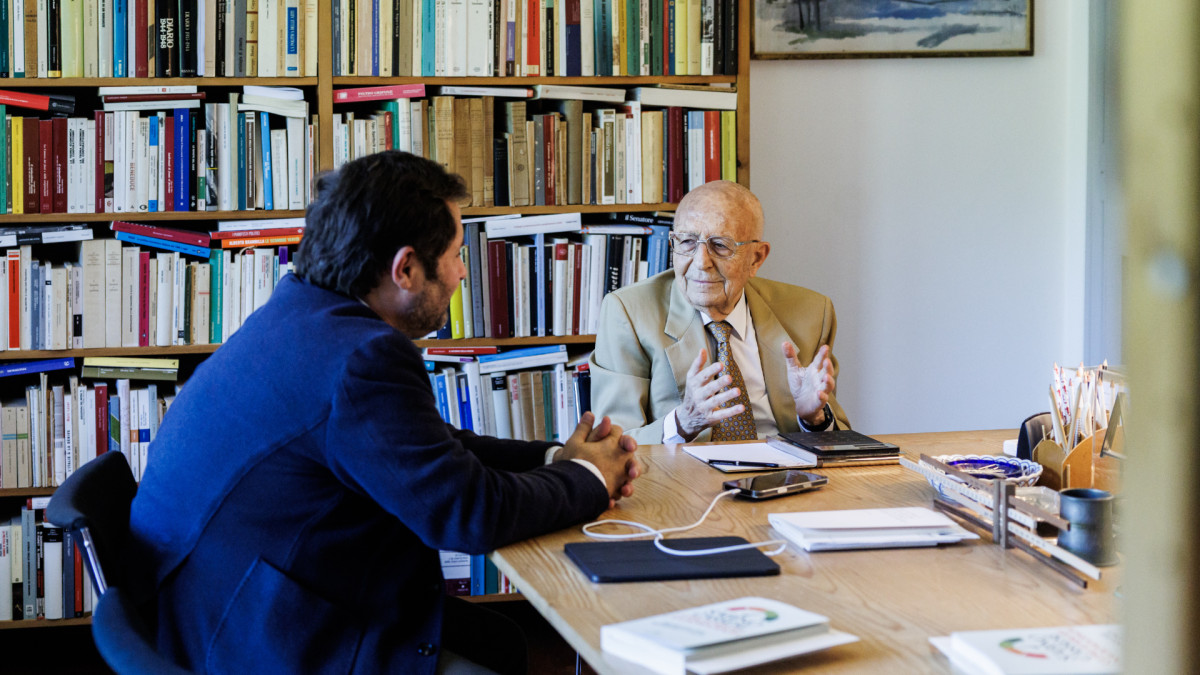
At ninety years old, Sabino Cassese (Atripalda, 1935) remains remarkably fit. The former judge of the Italian Constitutional Court and emeritus professor at the Scuola Normale Superiore in Pisa welcomed me again in Rome nearly a year after our initial encounter. Since then, a great many things have shifted, yet Cassese continues to draw on his experience with clarity and to interpret current events with precision.
Today, the dynamic between politics and justice is undergoing a volatile and precarious phase, both in Italy and in Spain. In this regard, Cassese, who also has political experience after having served as minister in the Government of Carlo Azeglio Ciampi, contends that “if the judiciary develops a predominantly anti-government orientation, it ends up becoming an obstacle to government action”.
Regarding the judicialisation of politics and the politicisation of justice, he emphasizes that “there is an influence between the two spheres”, but “this influence should be ten, and today it becomes one hundred”. In this sense, when asked about popular prosecution —so widely debated in Spain, but non-existent in Italy—, he is unequivocal: “In a sense, it amounts to a call for judges to do politics. From my point of view, that is a significant flaw in the system”.
The respected legal scholar Sabino Cassese has been awarded the Order of Merit of the Italian Republic. Photo: Agenda Pública / Francesco Fotia
We are living in a historical moment in which investigating someone —for example, a former prime minister— has immediate consequences. When it is announced that someone is under investigation, the media and social networks render that person guilty in the eyes of many people.
In my view, the answer requires us to distinguish three aspects. The first is the “whether,” the second is the “how,” and the third is the “how often”.
The “whether” is straightforward. Naturally, judges have the authority to interpret rules and must apply the law. If they believe there is sufficient evidence —as in the case of criminal judges, for instance, of corruption or other offenses— they must intervene.
“Judges have the power to interpret rules and must apply the law. If they believe there is sufficient evidence […] they must intervene”
The “how” is the crucial dimension. In Italy, and I think also in Spain, investigations involving politicians often unfold through the immediate publication of accusations in the media. In this way, the accusation becomes the judgment. Yet an accusation is not a judgment.
The accused person appears in the newspapers as a corrupt individual or as someone responsible for a crime. Moreover, wiretaps are published out of context. Wiretapping has become the usual method of gathering evidence. This is a fundamental part of the “how”.
There are numerous investigative tools, but in general the preferred method of Italian prosecutors — virtually the only one — is wiretapping. A person can be subjected to it without knowing, without even realizing that they are under investigation and that their privacy has been violated.
The “how,” therefore, concerns two issues: what kinds of evidence are used and how they are employed. There are other tools, such as police surveillance, banking investigations or the analysis of financial documents. But, among the entire spectrum of evidentiary tools, the primary resource tends to be wiretapping.
“Wiretapping has become the usual way of gathering evidence. This is a fundamental part of the «how»”
There is also a second aspect of the “how”: the accusation and the evidence are made public immediately. In this way, a person who has not yet been tried is subjected to the judgment of public opinion. I have written on occasion that this is what Max Weber would have called Kadi justice.
And then there is the “how often.” That is, how many times a particular person or a particular matter becomes the target of an investigation. When this is repeated systematically, it can amount to genuine persecution.
So, in the Italian experience of the past thirty years, the problem has not been so much the “whether,” but rather the “how” and the “how often.”
I believe that the dividing line is very clear in most cases, probably around 80%, 90% or even 95%.
Problems arise when matters have strong political consequences. In those cases, even before a final decision has been reached, merely opening an investigation already has significant political repercussions.
And that is even more true today than in the past, because politics moves faster, becomes more personalized and concentrates on leadership. Personalisation requires projecting strength and makes it difficult to endure a condition of perpetual suspicion.
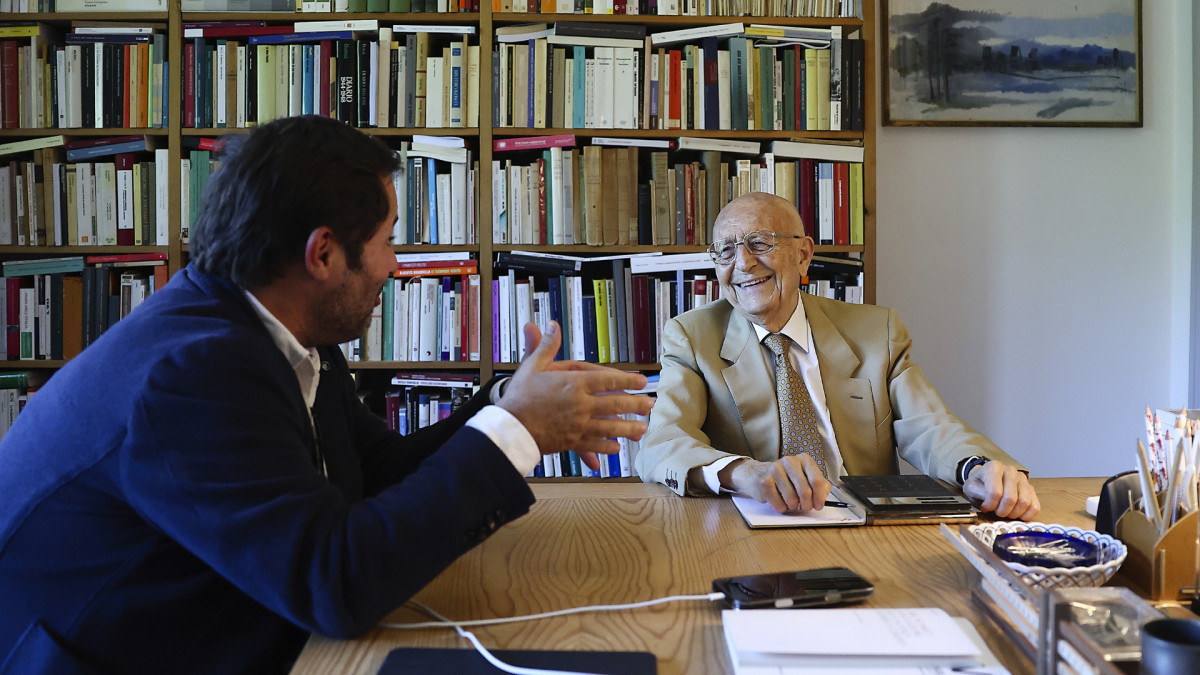
Cassese analyzes how an accusation can become a public judgment before a ruling. Photo: Agenda Pública / Francesco Fotia
In this context, is it easier for judges to have the ability to interrupt or influence political processes?
That depends on the domain we are discussing. Take immigration, for example. Italian prosecutors have conducted numerous investigations related to immigration. The judiciary contends that this occurs to safeguard human rights. Politicians respond that this is not the case, that the government’s stance — for instance, the one advocated by Salvini — is to limit irregular migration and that certain investigations end up targeting policies promoted by the government itself.
It is a difficult issue to pin down. In any case, the problem of quantity recurs. The issue becomes salient when a prosecutor’s office concentrates a very large portion of its investigative activity on areas especially sensitive to government action.
The Italian judiciary often defends itself by citing a constitutional article that enshrines mandatory prosecution. In my view, that is a rather weak defense.
Because what exactly does mandatory prosecution mean? In theory, it implies that if a prosecutor reads a newspaper item and believes a crime may have been committed, they are obliged to act. Or that if they receive a complaint, they must open proceedings.
But that explanation is insufficient. In many countries there are priority scales. In the United States, for example, prosecutors set enforcement priorities: certain offenses receive more attention than others.
“In theory, if a prosecutor reads a news item in the newspaper and believes that a crime may have been committed, they are obliged to act”
If prosecution is mandatory for any offense, and news about possible offenses can reach prosecutors through thousands of channels — and can even be sought by prosecutors themselves — then in practice this grants broad discretion to decide what to investigate.
That is why, in addition to my three criteria — the “whether,” the “how” and the “how often” — a fourth could be added: the “what.” In other words, what matters are the actions chosen for pursuit. And that is politically consequential.
Imagine a prosecutor’s office that concentrates its activity mainly on a particular category of offenses or a particular class of people. It is clear that such focus amounts to a deliberate selection with potential political consequences.
In Italy, it is hard to know exhaustively all the investigations opened by a prosecutor’s office because much of that information remains non-public. Yet your question matters because it touches on the possible overlap between government priorities and the judiciary’s priorities.
If the judiciary develops a predominantly anti-government orientation, it ends up obstructing government action.
How should we define today the responsibility when judges decide to open an investigation? Many argue that anyone should have the right to be investigated if there is enough evidence. I agree. But I also wonder whether a judge should reflect especially carefully when opening an investigation into someone who has held the office of head of government. How should we understand that judicial responsibility?
It is a very difficult issue. I think it should be part of the professional culture of judges and prosecutors to recognize that when a person who has held significant public responsibilities is investigated, they must act with particular care and with respect for the office they have occupied.
Permit me a personal example. During my time at the Constitutional Court, I served as rapporteur in several cases involving Berlusconi. In one of them, the decision had to be made a few months before a general election.
I spoke with the Court’s president and with colleagues to suggest resolving the matter after the election. Not because we had decided the outcome, but because any decision would inevitably carry political consequences.
I am therefore convinced that judges and prosecutors must possess a certain political sensitivity. That does not mean they should engage in politics. It means they must grasp the context in which they operate. They must know —and they know very well— what impact their decisions can have when they become public. In fact, their decisions always become public.
“Judges and prosecutors must have a certain political sensitivity. That does not mean that they should engage in politics”
They must be mindful of their effects. Because under certain circumstances they can tilt an election. And this happens whether the investigation helps or harms a candidate. If it harms them, they bear the stain of the accusation. If they are ultimately exonerated, they may present themselves as victims of an unjustified investigation.
That is why I believe that the ability to distinguish between legal action and its political consequences should form part of the training and professional education of those who exercise these functions.

The jurist reflects on the responsibility of judges and prosecutors when decisions have political effects. Photo: Agenda Pública / Francesco Fotia
And then there is the question of effectiveness. If we consider Mani Pulite, for instance, a large number of investigations were opened. An entire political system collapsed. Yet, when we look at the final results, the number of convictions or individuals who ended up in prison was far lower than one might have expected at the time. How should we evaluate the effectiveness of those investigations? Should accountability be recognized in such cases?
I do think there was a disproportion between the media and political impact of those investigations and their strictly legal outcomes. That seems fairly evident. That said, it is also true that if the political system could not withstand that impact, there were likely weaknesses within the political system itself.
Not everything can be attributed to the actions of magistrates. Many factors played a role. The attitudes of certain leaders, the political system’s reaction, and other circumstances all contributed to the final result.
Undoubtedly, there is some share of responsibility attributable to the Mani Pulite team. The challenge lies in measuring it. Because the problem exists, but there is no simple solution.
Judicial independence remains a fundamental value. The key is to understand clearly what independence entails.
When a person who is not a judge wants to approach the High Council of the Judiciary to complain about a judge’s conduct, I wonder: what happens to those complaints? How does it work?
I understand the question, but I would have serious doubts about allowing the High Council of the Judiciary to meddle in specific judicial decisions.
“Judicial independence remains a fundamental value. The important thing is to understand correctly what independence means”
The function of the High Council of the Judiciary is to ensure that judges and prosecutors are capable, independent, balanced individuals, and that they also exercise self-restraint. But it should not intervene in decisions taken by individual judges.
The fundamental problem is to guarantee ex ante the quality and independence of those who perform judicial functions.
If the Council intervenes in specific decisions, it ceases to be a governing body of the judiciary and becomes a court itself. And the High Council of the Judiciary should not be a court.
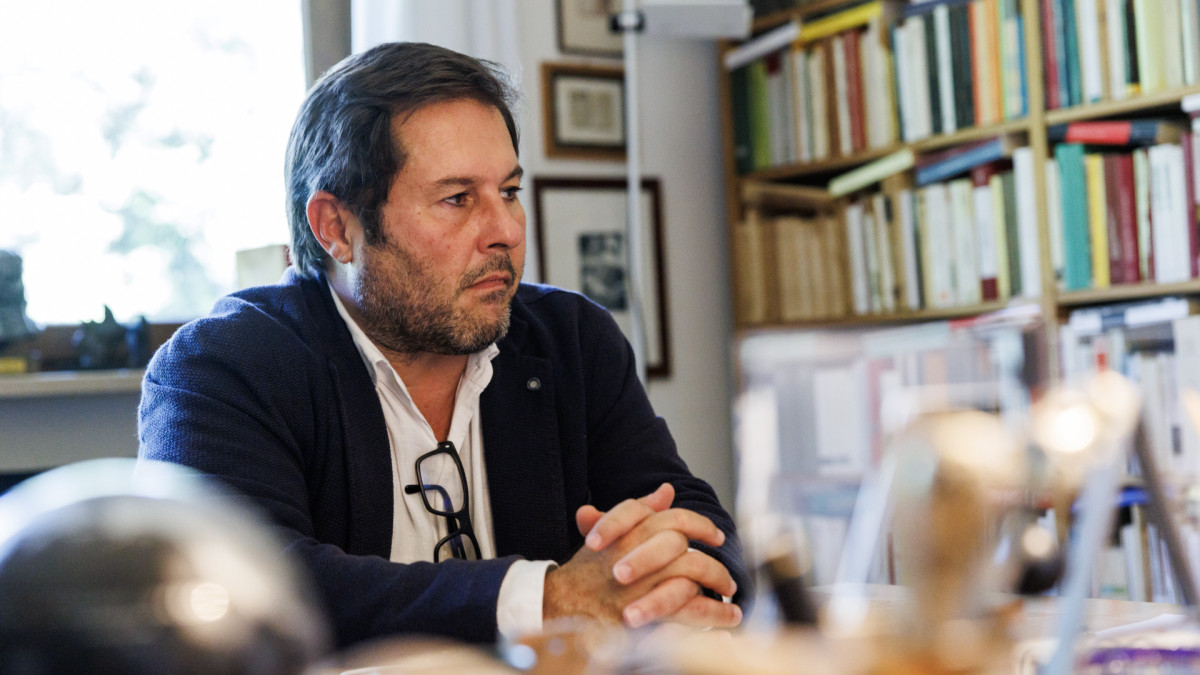
Marc López Plana asks about the legitimacy and representativeness of judicial elites. Photo: Agenda Pública / Francesco Fotia
I am interested in the representativeness of those who govern the judiciary. For a long time, the judiciary has been understood as a counter-majoritarian institution, tasked with curbing political majorities. Yet today citizens demand greater legitimacy from non-elective institutions as well. Is there a problem of political or ideological underrepresentation among judicial elites when they decide on politically sensitive issues?
What you raise touches a fundamental question. If one reads Democracy in America, Alexis de Tocqueville notes that American democracy rested largely on the election of judges.
Although, that represents a major difference between the United States and Europe.
In the United States, many state judges are elected, but federal judges are appointed by the president and serve for life. It is not necessarily an ideal model.
The important point is that the American democratic tradition preserves a direct form of popular participation in the judicial function. Judges are elected and juries are chosen from among citizens. In this way, the judicial function remains, to a degree, linked to popular sovereignty.
“The legitimacy of judges rests precisely on merit: they are selected and promoted according to meritocratic criteria”
We have abandoned that model. We place greater trust in a professional judiciary that acts as a counter-power. Our systems have evolved toward a counter-majoritarian structure built on merit-based selection. The legitimacy of judges rests precisely on merit: they are selected and promoted according to meritocratic criteria. That is the foundation that allows us to entrust them with a checks-and-balances role.
When we discuss these issues, we often present them as affecting the entire judiciary. They do not. First, we are mainly talking about the criminal judiciary, not the civil one. And the criminal judiciary represents a relatively small portion of the Italian judiciary as a whole.
Second, we are mostly considering activist magistrates. Well, most magistrates are not activists. The aim remains the same: to preserve a merit-based system while preventing it from turning into a closed clique.
We constantly discuss the judicialisation of politics and the politicisation of justice. How would you account for these phenomena?
The function of justice is to resolve specific cases. The function of politics is to address matters of collective interest. Justice protects rights in particular situations. Politics operates at a broader level. If we allow confusion between the two spheres, we end up mixing two completely different functions.
Take a concrete example. I am a judge and must decide on fifteen migrants who are in irregular status and could be sent back. You are a parliamentarian and must decide whether irregular immigration should be opposed, tolerated, or regulated in a particular manner.
“The function of politics is to address matters of collective interest. Justice protects rights in specific situations”
These are two completely different decisions. The first is a case-by-case determination. The second is a general policy decision. Naturally, the two spheres influence one another, but they are not the same thing.
But when a ruling on immigration is issued, public interpretation is usually immediate: “the government has won” or “the government has lost.” The media frame the news in that way. And when a headline proclaims that the government has lost, the politician immediately feels pressure to respond because it affects their public image, electoral prospects and citizens’ perceptions. That is why it is hard to claim that the two spheres remain entirely separate.
I understand perfectly what you are saying. And I agree that there is an influence between the two spheres.
What changes is the magnitude: the influence should be ten, but today it feels like one hundred. The difference lies in how it is interpreted. The problem is not the act itself, but how it is read.
If you asked me for a solution, I would half-jest that every television host, radio presenter and journalist should undergo a five-year training course to teach them what a judicial ruling really means.
Because a ruling on fifteen migrants is not a ruling on a country’s overall migration policy. Yet the media often present it as if it were. And that is where the influence grows from ten to one hundred.
“All television presenters, radio hosts and journalists should be made to take a five-year training course to teach them what a judicial ruling really means”
Let me offer a concrete example. The government most critical of immigration in Italy is likely Meloni’s. And yet do you know which government has allowed the largest number of regular migrants to enter? Meloni has amplified her political advantage by projecting a tough stance on irregular immigration. At the same time, she has responded to the real needs of the Italian economy, since there will soon be shortages of plumbers, carpenters, construction workers and agricultural laborers.

Cassese addresses popular prosecution and the risks of confusing the political arena with the judicial arena. Photo: Agenda Pública / Francesco Fotia
I wanted to ask you about popular prosecution.
It does not exist in Italy.
In Spain, a trade union, a private association or a political party can participate in judicial proceedings through popular prosecution. Even organisations with a clear ideological identity.
In Italy, a complaint can be filed. If a person has knowledge of facts that they consider criminal, they can go to the prosecutor’s office and report them. But that is not popular prosecution. It is an individual complaint. It must be signed by a specific person. It cannot be filed collectively or turned into an initiative promoted by organisations.
In Spain, popular prosecution can not only be present at the start of a case, but those who exercise it can become actors within the proceedings themselves.
That is very striking. And precisely there we see a very clear case of intersection between a political process and a judicial process. Because those who intervene are associations, trade unions or political parties.
One could even say that there is a perversion of the original idea. The initial intention was to allow citizens or associations to defend general interests. But in practice the result may be different. It can lead to an extension of political struggle into the judicial sphere.
“The government that has criticised immigration most in Italy is probably Meloni’s government. And yet, do you know which government has allowed the largest number of regular migrants to enter?”
That is the right word: an extension. Or, even better, a confusion between two different arenas. One is the political arena. The other is the judicial arena. And what is dangerous is precisely confusing the two. The proper setting for politics is Parliament, the government, the parties. The judicial setting is different. That is why I consider it a problematic institution. Because it creates a short circuit. It invites judges to perform functions that belong to politics. And, in a sense, it amounts to a call for judges to do politics. From my point of view, that is a significant flaw in the system.
You spoke earlier about the judicialisation of politics and the politicisation of justice, but you have not yet explained exactly what those concepts mean to you.
First, that decisions relating to specific cases come to be transformed into decisions of general scope. And, second, that decisions of a general nature end up being triggered by issues relating to specific cases.
There is a confusion between completely different actors. The actors of politics cannot be the same as the actors of justice.
Think of a concrete example. In Italy there is currently a magistrate who even hosts a television programme. He expresses opinions regularly, every week. If I am a citizen and one day I have to appear before that magistrate, how can I fully trust his impartiality?
Allow me to give a personal example. During the 1970s I wrote regularly in newspapers, as well as publishing academic work. However, when I joined the Constitutional Court, where I remained from 2005 to 2014, I stopped writing newspaper articles. And, from an academic point of view, I confined myself to writing about globalization, precisely in order to keep away from any debate related to Italian domestic law.
I considered it an elementary rule. If one exercises jurisdictional functions, one should not express public opinions on matters on which one may have to rule in the future.
“In Italy there is currently a magistrate who even hosts a television programme. He expresses opinions regularly, every week […] how can I fully trust his impartiality?”
Because I may write about a topic today and, three years later, be obliged to decide on it judicially. Then my opinion would already be known in advance. It would not be assessed solely by the evidence in the specific case.
That is why the English use a very fitting term: self-restraint.
I did not even speak to journalists. Many called me, and I always gave them the same answer: “I cannot reveal what I think.” In my view, that is a fundamental rule if we want to avoid certain problems.
And I sincerely believe that the High Council of the Judiciary should lay down much clearer criteria on this matter.
Public statements by judges should be severely limited. A judge must judge. A judge must be impartial and independent. And, in addition, a judge must appear impartial and independent. Because there is an important distinction between being impartial and appearing to be so.
Citizens must not perceive the judge as just another participant in the conflict. They must see the judge as someone who stands above the parties.
The moment a judge appears as a political or ideological actor, that perception disappears. And when the perception of impartiality fades, public trust in justice also deteriorates.

Cassese defends judicial self-restraint and the need to preserve the appearance of impartiality. Photo: Agenda Pública / Francesco Fotia
Today we know that when a judge or a prosecutor makes a decision, sometimes even before formally making it, information appears in the newspapers. Investigations, leaks, phone taps… Everything ends up being published. How can citizens’ trust in judicial independence be maintained when decisions, or even the content of investigations, constantly appear in the media? How can a fair trial be guaranteed? How can a properly informed public opinion be built under these circumstances?
The answer is already in the Italian Constitution. Article 111 establishes that the accused must be informed of the accusation confidentially. The key word is precisely that: confidentially.
If the accused must be informed confidentially, that means they cannot learn about it simultaneously with millions of others through television or newspapers. And yet that often happens.
“A judge must judge. A judge must be impartial and independent. And, in addition, a judge must appear impartial and independent”
There is therefore an evident conflict between the constitutional principle and certain real practices. Moreover, I must say something that may sound delicate. The current Italian government has spoken a great deal about this problem but has done relatively little to solve it.
Because the term “confidentially” should be translated into precise legislation that establishes concrete mechanisms to protect confidentiality.
Thank you very much.
