
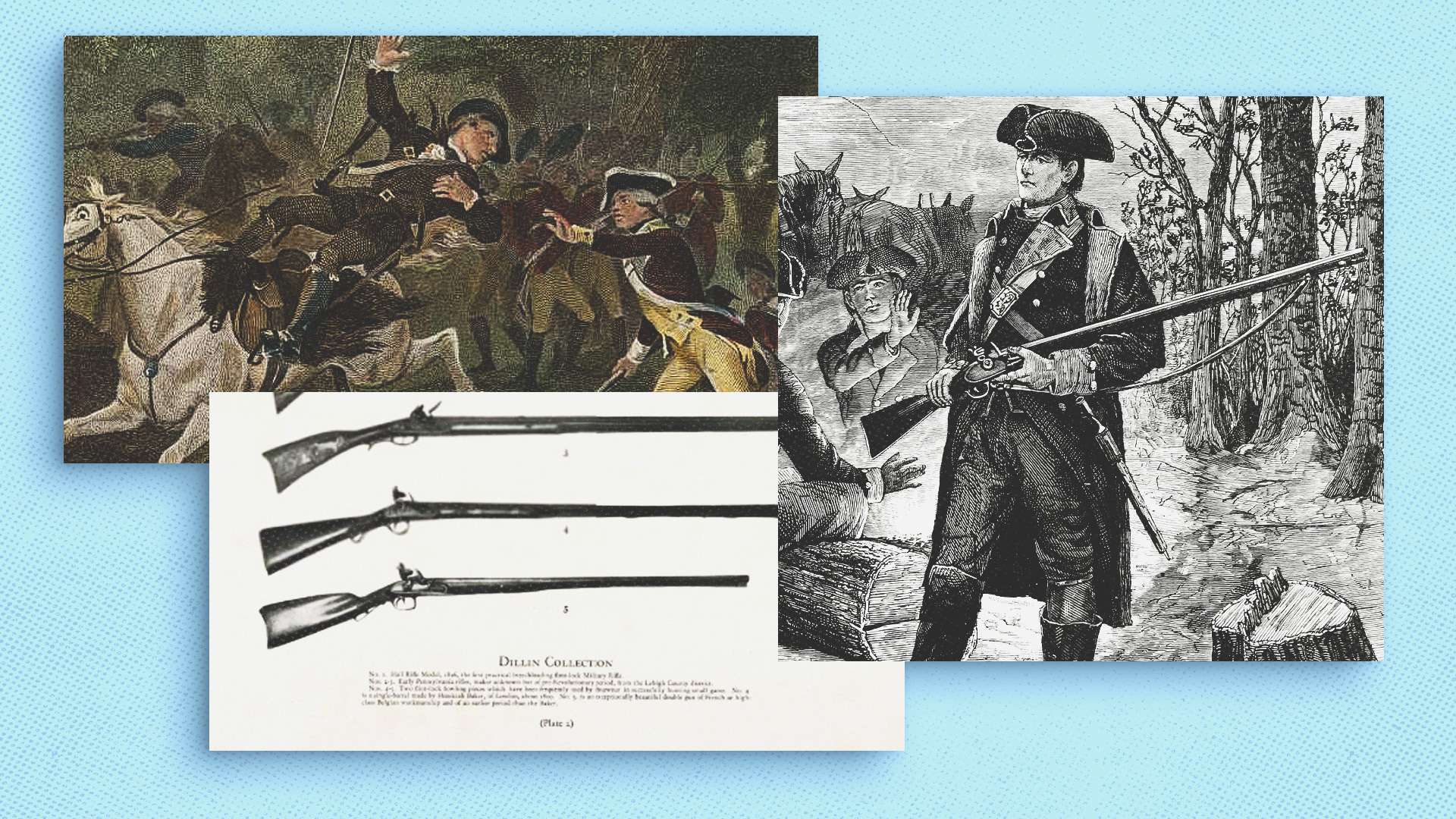
The American Long Rifle demonstrated precision at great distances, far surpassing the British smoothbores.
In a special America 250 issue, Reason looks back at the people and ideas that formed our nation. Read more here.
History remembers the tiny James Madison as “no bigger than half a bar of soap,” and at 5 feet 4 inches, he would become the shortest president in American history. Yet when it came to firearms, size mattered less than aim and training, and in June 1775, two months after the Revolution began, Madison believed he and the Virginians could silence British redcoats.
In a note to Rhode Island patriot William Bradford, Madison argued that the strength of their colony would lie mainly with riflemen from the upland counties, a large and capable contingent. He suggested you would be astonished by how far this craft had refined itself. He claimed that even the most unskilled shooters could often strike a head at 100 yards, while many Virginia riflemen could drop enemy officers before they reached 150 or 200 yards. He added that there were men among them who could regularly hit such a target at 250 yards, and that shortages of powder were their only real concern—because a little powder could go a long way when used with rifles.
Madison’s prediction proved prescient. The civilian skill with the iconic American Long Rifle would alter the course of the Revolution and help forge a nation stretching all the way to the Mississippi River. Long after, as president, Madison would witness American marksmen wielding these same rifles to deliver a decisive victory over the British at the 1815 Battle of New Orleans.
God and Guns
It fits the symmetry that the First and Second Amendments touch on related freedoms: both protect inherent rights, and each shield the other. So the origin of America’s finest firearm naturally overlaps with religious liberty.
Pennsylvania, founded in 1681 by the affluent English Quaker William Penn, stood apart from most colonies: there was no established church funded by taxes or required attendance. Instead, religious liberty was guaranteed for “all persons living in this province, who confess and acknowledge the one Almighty and eternal God.” So long as people lived peacefully and justly within civil society, they would enjoy unlimited freedom “in matters of faith and worship,” without coercion of any sort.
Across the Atlantic, skilled artisans—immigrants escaping political and religious restraints—sought opportunities to build their own livelihoods and prosper outside the heavy hand of guilds and state control. For Central Europeans whose faith did not align with the Church of England or the local Congregationalist offshoots, Pennsylvania became especially appealing. When George Louis of Hanover ascended to the British throne as King George I in 1714, many German-speaking gunsmiths chose to migrate to America, clustering around Lancaster, Pennsylvania. There they introduced a different kind of firearm to British North America.
From the earliest days of English settlement, most American guns were smoothbores—the interior of the barrel was smooth. Today, smoothbores are most commonly associated with shotguns. While smoothbores excel at bird hunting, they fall short in long-range accuracy.
By contrast, the German newcomers were accustomed to making rifles. In a rifle, the bore is rifled with spiral grooves, imparting a stabilizing spin to the bullet. This spin yields superior stability in flight, making rifles far better for long-range shots. The practice of rifling had long been established in southern Germany and northern Switzerland since the late 15th century, but rifles had not caught on in Britain or its colonies.
The Pennsylvania gunmakers initially produced the Jaeger, a Central European design, but it proved heavy, with large, slow bullets and a rear sight that needed adjustment for different ranges.
Americans wanted a firearm tailored for a purpose unfamiliar to Europe: long hunting expeditions. The earliest long hunters in the colonies included 17th-century Finnish settlers of New Sweden along the Delaware River, later imitated by Scotch-Irish and German immigrants. Whether alone or in groups, long hunters spent days, weeks, or even months within densely wooded interior regions, hunting for themselves and trading furs with Indigenous peoples, then returning home with pelts for transatlantic markets. These expeditions also charted new lands for future settlements.
While the colonies began as narrow coastal settlements, long hunting spearheaded westward expansion toward the Appalachians and beyond.
The Impossible Rifle
As historian Robert Held notes in his book The Age of Firearms, Americans asked their gunsmiths for something that seemed almost impossible: a rifle weighing ten pounds or less, capable of carrying a month’s worth of ammunition weighing 1–3 pounds, using relatively small quantities of powder, easy to load, and with such velocity and flat trajectories that a single rear sight would suffice from fifty yards to three hundred—where only the adjustment in elevation would be needed from experience.
By roughly 1735, Held observes, that “impossible” design had taken concrete form with the birth of a new rifle type.
Some called it the “Pennsylvania rifle” because it originated there; others the “Kentucky rifle” because Kentuckians became its most famous early users (the term “Kentucky” referred to a region stretching from present-day southern Ohio and Indiana into northern Tennessee).
Throughout the 1700s, riflemaking knowledge spread across the country as apprentices trained in Pennsylvania moved south and west. Today, these guns are known as the American Long Rifle.
The American Long Rifle featured a longer barrel than the Central European Jaeger, a design choice that improved balance and allowed a shooter to sight distant targets more accurately.
Where European rifles tended to have calibers around .60 or .75 inches, Americans favored smaller calibers—typically in the .40 to .46 range, occasionally as small as .32. A smaller caliber meant smaller bullets, enabling a hunter on a lengthy expedition to carry more ammo: one pound of lead yields 16 bullets for a .70 caliber rifle, but 46 bullets for a .45 caliber rifle. With less weight per bullet, a hunter could bring more rounds along for months of travel.
The American Long Rifle, the most accurate firearm in the world until the early 19th century and not surpassed until the 1840s, proved ideal for hunting mammals and for the irregular warfare on the frontier. Indigenous fighters also favored the rifle for its forest-friendly profile.
Whether on hunts or in frontier cabins, shooters meticulously measured the powder needed for each shot so nothing went to waste. They adjusted loads for longer shots and participated in long-distance shooting contests that were central events in rural communities. Precision shooting in the American mind was not merely a matter of prestige; it was a practical necessity for sustenance. A precise hit to a small target, such as the center of a squirrel’s body, could dramatically affect the meat yield. Hence Americans developed a “bark” technique: a shot just under a squirrel’s tail would cause it to drop from a branch and fall to the ground unharmed. The American Long Rifle helped foster what Alexander Rose would later describe as the American “cult of accuracy.”
Even so, the American Long Rifle did not dominate the scene on the eve of the Revolution. Smoothbore muskets, simpler and cheaper to produce, quicker to reload, and sturdier, remained far more common. American muskets were often derived from British or French military patterns, adapted for American needs with features such as lighter weights for easier hunting utility.
Although riflemen were spread across the Middle and Southern colonies, they remained relatively scarce in New England—until the Revolution blossomed.
Rifles of the Revolution
On April 19, 1775, British troops in Boston attempted to seize American arms at Lexington and Concord. On their retreat to Boston, they narrowly escaped being overwhelmed by a swarm of American defenders. The British then found themselves besieged by New England militiamen.
The Second Continental Congress, meeting in Philadelphia, established the Continental Army on June 14, 1775, a date now celebrated as the birth of the U.S. Army. The army began with New Englanders encircling Boston and was augmented by ten companies of “expert riflemen”—six from Pennsylvania and two each from Maryland and Virginia. These riflemen impressed their New England counterparts by picking off British officers, sentries, and other troops at distances beyond 200 yards. The effect lifted American morale while demoralizing the British forces.
During the Revolutionary War, rifles mattered less than muskets for several reasons. All firearms of the era were muzzleloaders: the shooter inserted a round bullet into the muzzle and used a ramrod to push it to the powder charge at the breech. Rifle bullets required a precise fit to engage the rifling grooves, so loading a rifle took longer.
Moreover, battles often ended with close-quarters combat. Soldiers would bayonet or club each other, and rifles were comparatively delicate in such encounters. While riflemen often carried tomahawks or hatchets, adversaries armed with bayonets could reach farther with muskets than with rifles.
Nevertheless, rifles altered the war’s trajectory. The most decisive shot came on October 7, 1777, at the Second Battle of Saratoga, a turning point in the conflict. British forces advancing along the Hudson River were disrupted when an American rifleman delivered a shot from at least 300 yards, felling Brig. Gen. Simon Fraser on his horse. The disruption sent the British into a panic, disrupted their offensive momentum, and helped secure American success that day. Lt. Gen. John Burgoyne—trying to lead a retreat—could not escape. Ten days later, the entire British army surrendered on the field for the first time in history.
News of Saratoga prompted France to begin Franco-American negotiations, leading to France’s entry into the war on the American side through Franklin’s diplomacy.
Later, the British shifted to a southern strategy, hoping Loyalists would rise in support. On October 7, 1780, patriots with American Long Rifles crushed a large Loyalist militia near Kings Mountain, on the border of North and South Carolina. In the wooded terrain, Loyalist muskets could not reach the backwoods riflemen, whose shots from 200 yards or more decimated Loyalist forces and undermined Loyalist recruitment.
A few months later, in 1781, victory at Cowpens, South Carolina, helped pave the path to Yorktown. Brig. Gen. Daniel Morgan deployed 150 riflemen on the front line. As British forces approached, riflemen aimed at officers from beyond 200 yards, then withdrew, drawing the British in pursuit into a trap laid by hidden American units.
For years, the British had been willing to concede independence, but only for lands up to the Appalachians. The Americans demanded more: control of territory all the way to the Mississippi River. Across the interior, patriots and allied tribes used their rifles to push back British claims, a reality that forced Britain to relinquish its interior ambitions in the 1783 Treaty of Paris.
The Battle of New Orleans
The War of 1812, sometimes called the Second War of Independence, culminated for Americans at the Battle of New Orleans on January 8, 1815. The British forces at New Orleans were considered the world’s best, fresh from defeating Napoleon’s forces in the Iberian Peninsula.
Even though the war had technically ended with the December 24, 1814, Treaty of Ghent, news traveled slowly in the Western Hemisphere. If the British had captured New Orleans, they could have choked Western American commerce, just as they had earlier occupied forts without proper authorization. General Edward Pakenham commanded British troops with promises of “beauty and booty”—a vow of plunder and brutality.
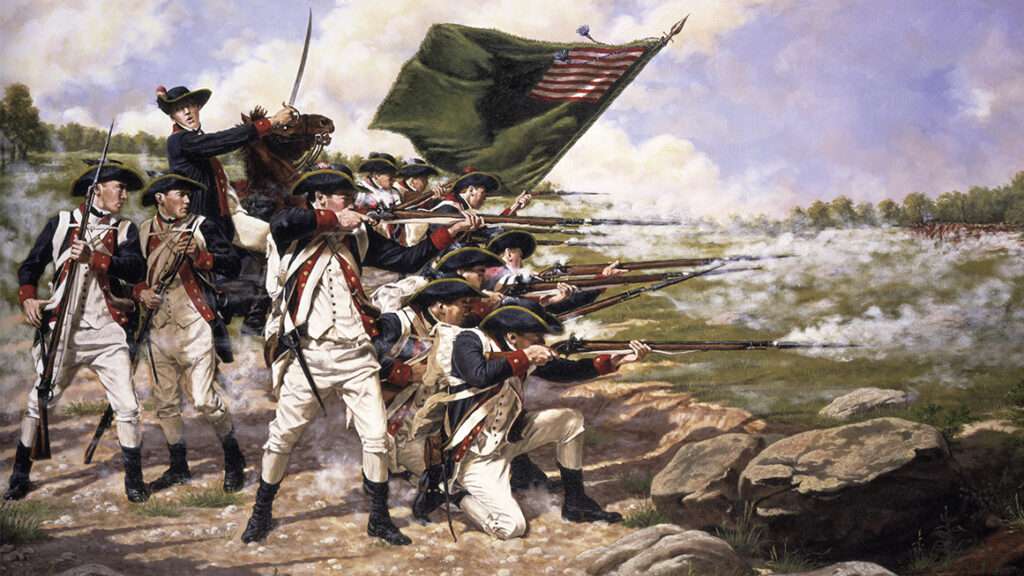
Leading American forces were a diverse coalition under General Andrew Jackson—professional soldiers, militia, irregulars, free Black people, whites from various backgrounds, Creoles, Cajuns, Spaniards, French, Portuguese, Germans, Italians, Native Americans, lawyers, privateers, farmers, and shopkeepers. They faced a numerically superior force but fought with the rifles that many Americans had brought themselves, since the federal government could not supply standardized weapons.
Despite being outnumbered, the Americans were seasoned hunters and skilled marksmen. From improvised defensive positions, they fired their American Long Rifles with deadly effectiveness, inflicting heavy casualties while suffering relatively few losses themselves.
Victory at New Orleans became a centerpiece of American patriotism and remained celebrated up to the Civil War era. Although artillery and muskets played significant roles, the rifle took pride of place. The anthem-like refrain “The Hunters of Kentucky” captured the mood: “For Jackson he was alert, unafraid of trifles; he knew well what aim we’d take with our Kentucky rifles.” Americans credited their freedom in large measure to their prowess with marksmanship.
From Our Cold, Dead Hands
When the American frontier pushed beyond the Mississippi, the traditional long rifle did not accompany every trek. The demands of the plains required a shorter arm to ride on horseback and a larger bullet for bison and other big game.
Yet the American Long Rifle never vanished from American manufacture. In 1924, John G.W. Dillin published The Kentucky Rifle, describing Appalachian gunsmiths still producing Kentucky rifles by hand. He recalled a time when a Pennsylvania gunsmith could craft a rifle from a maple tree and two bars of pig iron, the expectation around Bunker Hill era still echoing in the trade.
In 1954, Dixie Gun Works launched home-building kits for modern replicas of Kentucky rifles and other muzzleloaders; other firms followed. Because muzzleloading firearms were not covered by the 1968 Gun Control Act, makers could sell or gift these guns freely. This began a revival of muzzleloading, and many states now offer special early hunting seasons for muzzleloaders.
In 1955, Ohio gunsmith Cecil Brooks began a half-century tradition. At the National Rifle Association (NRA) Annual Members Banquet, he presented the guest of honor with a hand-built American Long Rifle that had taken hundreds of hours to complete. Recipients included President Ronald Reagan, Vice President Dick Cheney, Sen. Barry Goldwater (R–Ariz.)—and, most famously, actor and future NRA President Charlton Heston.
Pro-gun bumper stickers long proclaimed, “You can have my gun when you pry it from my cold, dead hands.” After receiving the rifle at the conclusion of his speech, Heston raised the weapon overhead and declared, “I have only one more comment to make: from my cold, dead hands.” The crowd responded with a roaring, sustained ovation.
Today, the Pennsylvania Long Rifle is recognized as the official firearm of the Commonwealth, while the Kentucky Long Rifle holds similar status in that state. For all Americans, the American Long Rifle stands as a cornerstone of our shared heritage of ingenuity aligned with the defense of human rights.
Born of immigrant ambitions for religious liberty, the American Long Rifle helped secure independence and helped shape a nation. A feat of engineering once deemed impossible, the rifle reigned as the world’s most accurate firearm for a century. A versatile instrument for hunting, personal protection, and community defense, it helped cultivate a gun culture that made Americans among the most adept weapons users on Earth. Through modern replicas, the American Long Rifle remains a common presence, an enduring emblem of American self-reliance and freedom.
