
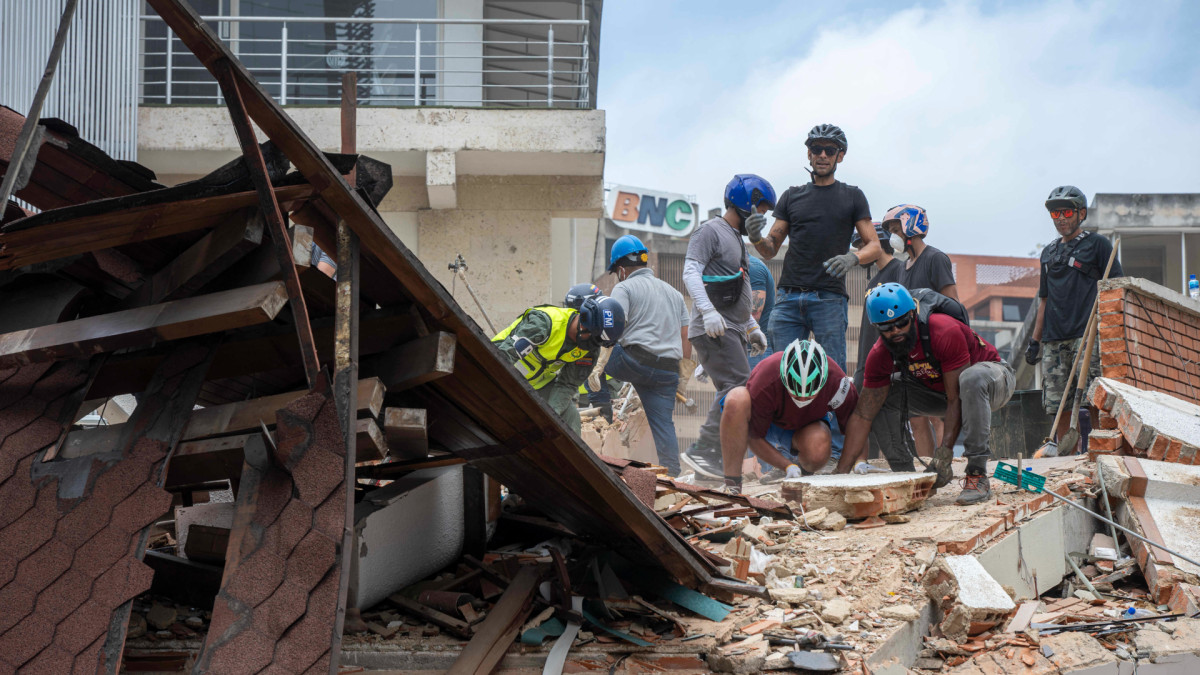
The tremor I felt in downtown Caracas during the twin earthquakes of magnitudes 7.2 and 7.5 was terrifying. The initial uncertainty, as seconds stretched slowly, dissipated when we understood the threat: it was shaking. People looked upward, seeking to protect themselves or preparing to run in the face of the structural breaks of buildings struggling to stay upright.
The effects of seismic amplification beneath their columns are the proof of an urbanism built on the margins of geological reality and the permits required. While the affected areas, mainly Caracas and La Guaira, continue tallying the damages and trying to save lives, the institutions are collapsing and we are witnessing the collapse of a system that has prioritized inaction.
The memory of the ground as a warning
The vulnerability of the present arises from a persistent geological memory. The hydrometeorological disaster of 1999 in La Guaira, which left an official death toll of hundreds and thousands missing, with unofficial estimates exceeding 10,000 dead, left a landscape of unstable sediments and slopes that never recovered. Today, the 2026 earthquakes strike that already known fragility. The seismic acceleration has exposed the proliferation of buildings erected outside the Venezuelan Standard COVENIN 1756 (Seismorresistant Buildings), which has enabled a high-risk urbanism: construction has taken place on subsidence zones and un-stabilized slopes, ignoring that the soil, when saturated with water and subjected to a seismic impact, loses all firmness and becomes an unstable mass.
“The effects of seismic amplification are the proof of an urbanism built on the margins of geological reality and the permissions necessary”
This phenomenon of the “twin seismic event” — two consecutive earthquakes that transfer stresses onto already weakened structures — is a warning documented by FUNVISIS studies for years without the State incorporating this information into a binding territorial planning policy.
From legal shielding to emergency governance
Our regulatory framework remains anchored in the premise of “stationarity”, as if nature followed unchanging patterns. A prime example of this outdated legal shield is the invocation of the legal construct of “force majeure” to exempt the State from its responsibility.
“Construction has taken place on subsidence zones and un-stabilized slopes, ignoring that the soil, when saturated with water and subjected to a seismic impact, loses all firmness”
Europe has developed a different response, supported by foresight and financial solidarity. The European Union has gone beyond mere reaction with instruments such as the EU Solidarity Fund and the European Social Fund, designed to act as financial safety nets in the face of disasters. European regulation, through the Floods Directive, requires states to map extreme event scenarios, subordinating management to the Charter of Fundamental Rights.
After the catastrophe of the Ahr Valley (2021), Germany enacted the Federal Climate Adaptation Act (KAnG). This law requires the creation of binding risk plans for municipalities and, moreover, ensures that aid funds reach directly those rebuilding in a resilient way, prohibiting negligent reconstruction in high-risk areas.
Spain, following the Valencia DANA events (2024), demonstrated that emergency management requires a legal framework capable of rapid activation. Through real decrees, the State could shield, in real time, the productive fabric and family assets, understanding that the State is not a spectator, but the final financial guarantor before catastrophe.
While Europe consolidates resilience funds, the abolition of mechanisms such as Mexico’s Natural Disaster Trust Fund (FONDEN) left a lethal vacuum and returned public response to a discretionary aid model. Venezuela must learn. A national contingency fund, transparent and auditable is needed to guarantee reconstruction in the face of events that, by their recurrent nature, can no longer be considered unexpected.
The obsolescence of the “force majeure”
The Venezuelan State has historically invoked “force majeure” to elude its responsibility. But, in accordance with Inter-American Court of Human Rights Advisory Opinion 32 on Climate Emergency and Human Rights, if the risk is known by science, inaction is not misfortune: it is a juridical omission.
“If the risk is known by science, inaction is not misfortune: it is a juridical omission”
This stance contravenes Article 55 of our Constitution, which imposes on the State the duty of guarantee in the face of threats and risks. If the State possesses the risk atlas and knows seismic danger, but chooses not to stabilize slopes or sanction noncompliance with the COVENIN 1756 Standard, it is a co-author of vulnerability.
Some technical proposals to develop future capacities
To move from negligence to accountability, actions such as the following must be implemented:
- Territorial risk audit: update risk atlases by integrating historical data with current seismicity. Prohibit, through binding ordinances, any new construction in zones identified as “absolute vulnerability” by technical bodies.
- Automated response system: implement a strategic logistical reserve (RescEU-style) that acts at “minute zero”, avoiding bureaucratic bottlenecks that today paralyze aid.
- National inspectorate of seismic resistance: raise the enforceability of the COVENIN 1756. Create an inspectorate with authority to criminally sanction officials who authorize licenses in contravention of scientific evidence.
- Financial shield: build a legal framework with automatic financial deployments, shielded against political discretion to guarantee resilient reconstruction.
Conclusions
Governing “with one’s back to science” must translate into effective administrative and criminal responsibilities. The climate and geological emergency obliges updating the law: preparation and adaptation to meteorological and seismic phenomena are no longer a suggestion, but a human rights obligation, autonomous and enforceable. While the law cannot stop an earthquake, it can build a normative shield that protects human life. Therefore, the “force majeure” is dead. It is time to establish full state accountability.
