
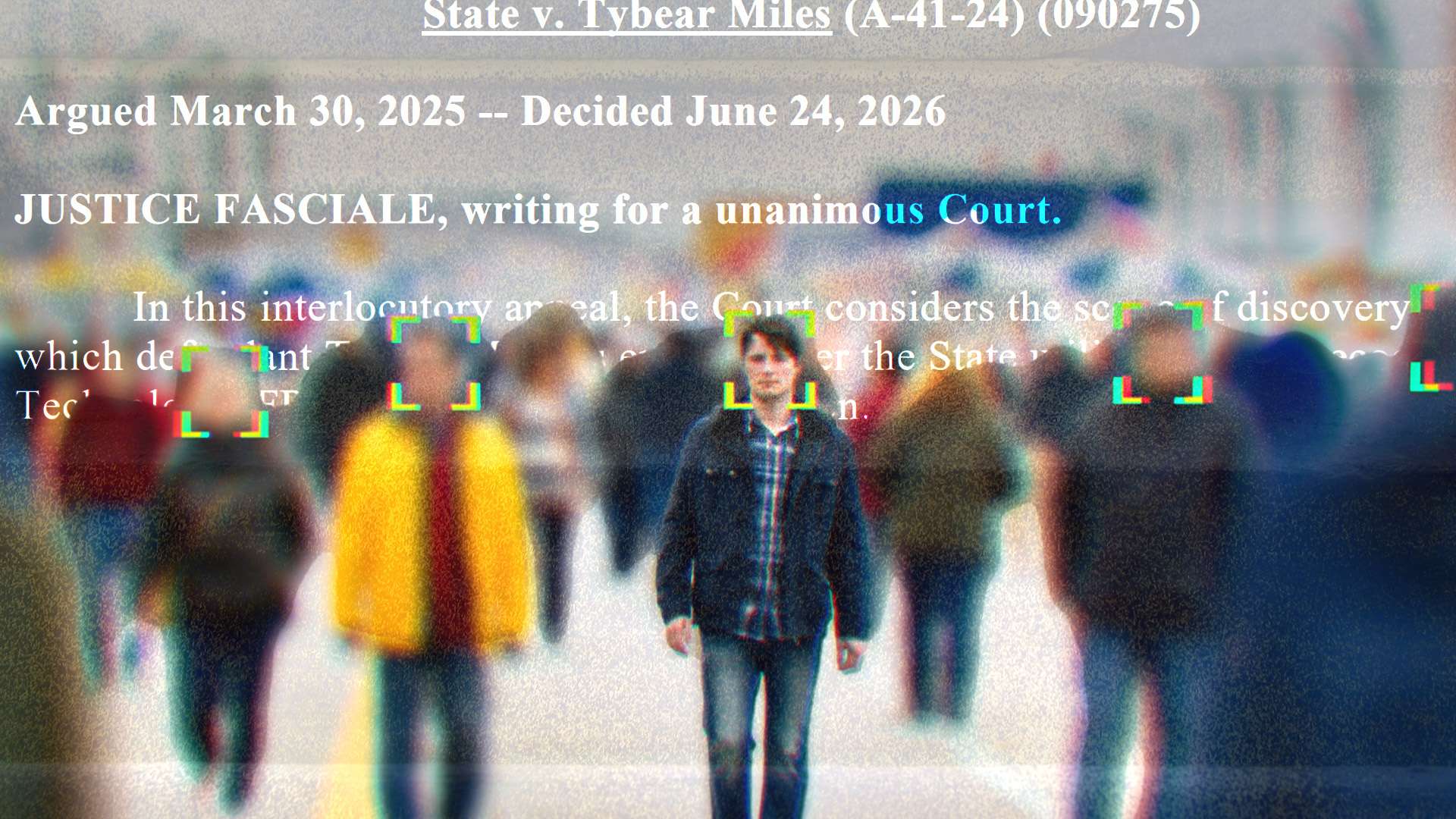
Prosecutors in New Jersey must reveal how the technology is used in criminal cases, the state’s Supreme Court ruled.
The New Jersey Supreme Court has determined that prosecutors are obliged to disclose the manner in which facial recognition technology is employed during criminal investigations and prosecutions.
Just as people can misidentify faces, facial recognition technology (FRT) is imperfect and can err. Numerous defendants have pointed to the technology as a factor in wrongful arrests, as law enforcement agencies increasingly depend on it to pinpoint suspects. Yet, the rules governing its use vary widely by state and locality.
A recent ruling in a murder-related case in New Jersey mandates that law enforcement reveal how this technology is employed in state investigations.
State v. Tybear Miles, the New Jersey Supreme Court held that prosecutors must disclose how FRT was used to identify the defendant, Tybear Miles, who faced charges of “first-degree murder and weapons offenses.”
The facts trace back to a fatal shooting in Jersey City in 2021. The day after the incident, officers, using footage from a nearby CCTV camera, showed a confidential informant—who did not witness the shooting—the video from the scene. The informant identified two male individuals by their street names and Instagram handles, according to the ruling. After labeling one of the individuals as “Fat Daddy,” police processed an image from “Fat Daddy’s” Instagram account through a facial recognition module, which produced a potential match to Miles.
The ruling notes that the state furnished Miles with two separate FRT searches during discovery. One search produced a list of ten possible “matches” to the probe image, with Miles ranked as the eighth entry on the list. A separate search yielded another list of ten potential matches, with five different images of Miles appearing in the top five positions.
Miles’s sister and ex-girlfriend each identified Miles using videos and still shots from other nearby surveillance footage, according to the ruling. It also states that no witness personally identified the defendant as the shooter; several people were near the victim when the shooting occurred, and all police interviews relied on video footage and still images taken roughly ninety minutes prior to the murder and seven minutes before it.
Miles’s defense team sought specifics about how FRT was used in the case, and the trial court ordered prosecutors to produce thirteen items, referring to prior case law that required the disclosure of FRT discovery materials, the New Jersey Monitor reported.
In the Wednesday ruling, the New Jersey Supreme Court partially affirmed the lower court’s order. Justice Douglas Fasciale wrote that the state must provide discovery identifying the FRT tools and materials employed in the investigation, including the software’s name and manufacturer and publicly available information about its error rates. The state must also turn over items such as the original photograph used in the probe. However, the court did not require the state to disclose the algorithm’s source code or other proprietary information; if warranted, a defendant may pursue a separate discovery request for such confidential data.
“The right to a fair trial is guaranteed under the Federal and State Constitutions, and due process compels the State to disclose evidence favorable to an accused,” the ruling states.
The New Jersey Chapter of the American Civil Liberties Union, which filed an amicus brief in the case, praised the decision, with one attorney calling it a “major victory for civil liberties” and noting it as “one of the first state high court rulings of its kind.” While some states—such as Maryland, Montana, and Washington—already require agencies to inform defendants about FRT use before trial, clearer guidance remains scarce nationwide about how the technology is integrated into the criminal justice process. Regardless of Miles’s guilt or innocence, the ruling signals a growing expectation that transparency around facial recognition technology will accompany the expanding role of such tools in tracking and identifying suspects by law enforcement.
