
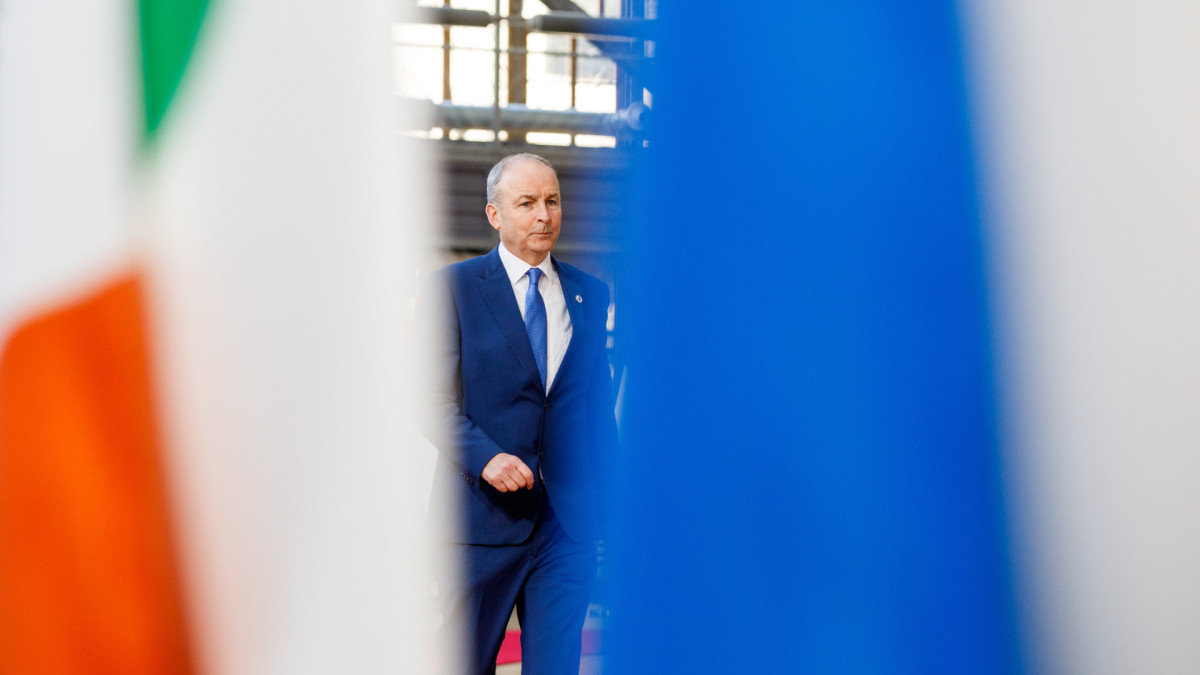
This week the Republic of Ireland assumes the rotating presidency of the Council of the European Union, and will steer the institution that brings together all member states until the end of the year. This is a pivotal six months, with three major dossiers in which Dublin will have to play a very active role and that will largely determine the success or failure of the current term.
“Ireland will take the helm of the institution that unites all member states until the end of the year”
On one hand, there is the negotiation of the next multiannual financial framework (MFF) for the period 2028-2034. António Costa, president of the European Council, aims to reach an agreement before the year ends. That means the Irish have a central role in securing a final pact. A diplomatic source explains that negotiations are still at a “hard, tactical” stage, with many frontal refusals. Ireland will have to ease tensions and pave the way for three summits that will be crucial.
The first will be the October summit, when Costa’s team has signaled that Dublin will present a new negotiation box or negobox, replacing the one put forward by the Cypriot presidency and immediately torn apart by capitals in a near ruthless fashion. As it must be, explains another source. It is the fate of the first negotiation boxes: to be publicly loathed. Ireland has the job of uniting positions. Cuts are unacceptable: too small in the eyes of the frugals, the wealthy northern countries, who criticize that the Cypriot presidency has cut only 2% from the Commission’s initial proposal.
Dublin knows it must navigate carefully among the current opposition. Cutting more to win over the north could provoke the firm opposition of the bloc’s largest group, the so-called “friends of cohesion,” who defend the classic MFF allocations and are fairly cohesive and organized. Several diplomatic sources point to the fact that the only viable solution is to present at that October summit a new own-resources proposal, i.e., European taxes that go directly to financing the MFF. A Swedish source has already shown more than skeptical about whether that can resolve the current clash.
“Cutting more to win over the north could lead to the firm opposition of the largest bloc of member states, the so-called ‘friends of cohesion’ “
The budget proposed by the Commission is much larger than the current one if the economic impact of the Recovery Fund created during the coronavirus pandemic is not taken into account, and if debt interest payments on the funds raised to finance that Fund are not considered. Excluding that debt service, the future MFF is only 0.02% higher than the current one. However, solving this equation is extremely difficult.
Beyond October, the Irish presidency will have two more attempts: an informal meeting of heads of state and government to be held on the island in early November and the formal European Council at the end of December, the key date.
Economic Reforms
The other area where the Irish presidency has a lot of work to do is capital markets reform, with added pressure from the E6 group of major European economies, namely Germany, France, Italy, Spain, the Netherlands, and Poland, which have a clear roadmap and demand progress on reforms. Last week, in an interview with the Financial Times, Micheál Martin, the Irish prime minister, stated that there is 80% agreement regarding the E6 plans. But the remaining 20% is what has justified the bloc’s blockade for many years.
In fact, and although Martin has explained that there are “ways to land” the agreement, Dublin has played a very active role in blocking any agreement on the Union of Capital Markets, now renamed the Union of Savings and Investments (SIU), which, as a test case, would centralize supervision in the hands of ESMA in Paris, something Ireland has never wanted for fear of losing control and not being able to continue to be a genuine magnet for foreign financial investment.
“Micheál Martin, the Irish prime minister, said there is 80% agreement regarding the E6 plans”
Dublin has offered an agile, flexible, and fast regulator, and very low taxes. The SIU would eliminate one of the pillars of its business model. It has not been only a problem for Ireland: many other small member states believe that, if they do not have the capacity to attract clients through their regulator, they will lose potential customers to the larger economies of the European Union.
Expansion, Energy, and Immigration
Beyond the economic dossier, the Irish presidency also aims to reach agreements in other important areas. For example, in energy, it aims to conclude negotiations on the European Networks Package, an ambitious reform of the Union’s energy infrastructures, for which Brussels and Dublin want to have an agreement before the end of the year.
The Irish presidency will also play an active role in the dynamic debate on enlargement, where many things are happening: negotiations have already opened with Ukraine and Moldova, while Montenegro is practically at the doors of the club. Meanwhile, ideas are piling up to make enlargement politically more viable for the habitual enlargement-skeptics, those member states less enthusiastic about expanding the EU. For example, the German government has proposed a special observer role for Ukraine, while progress is also being made on ideas such as a transitional period in which new members do not have veto power in some areas requiring unanimity, such as, for example, foreign and security policy.
“The entire system rests on mutual trust between member states that was broken during the migrant crisis of 2015 and 2016”
Finally, Dublin will preside over the first months of the implementation of the Migration and Asylum Pact, which analysts and involved sources identify as a key stage. The whole system, which was agreed during the Spanish presidency in 2023, rests on mutual trust between member states that was broken during the migrant crisis of 2015 and 2016. To ensure the proper functioning of the new Pact, it is essential to maintain loyal cooperation between capitals, a task in which the Irish presidency will have to apply itself fully while governments are split by the corrosive debate about deportation centers outside Community territory and the intention of nineteen member states that the initiative be financed with European funds.
