
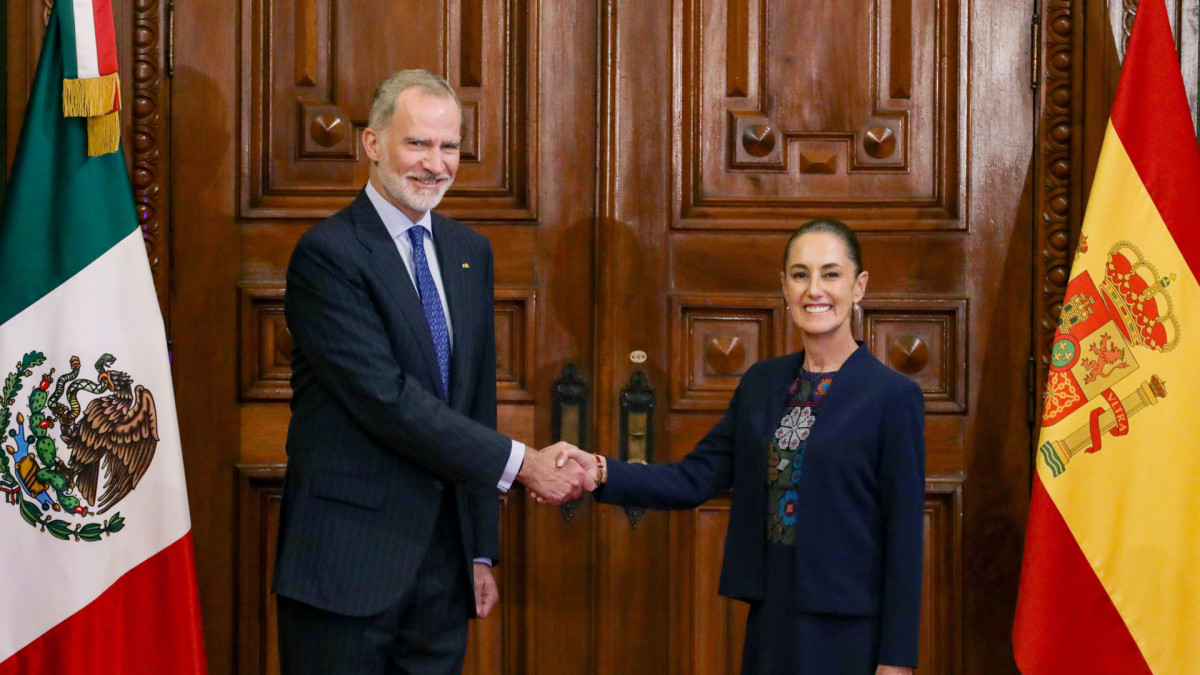
The motive, apparently, was a sports encounter: Spain was playing against Uruguay. It wasn’t just any match; it was one in the FIFA World Cup. And the host could not go unnoticed: Mexico, the Mexico of Claudia Sheinbaum and the Fourth Transformation. But behind the sports pretext lay another motive: the reconciliation of two countries after eight years of distance, a diplomatic pause, awkward silences.
Felipe VI, as usual, arrived in Mexico with the discretion and authority of someone who knows that his presence is, in formal terms, a symbol. He attended the match in Guadalajara, yes, but for diplomatic purposes and resetting relations, what truly mattered was the appointment at the National Palace. There Sheinbaum awaited, with the aim of closing a cycle of estrangements and misunderstandings, started with her predecessor, López Obrador, due to the questionable ways in which he chose to demand apologies for the Conquest, something that led to an extended tension in cooperation.
“Sheinbaum esparaba a Felipe VI con la intención de cerrar un ciclo de desencuentros y malentendidos, iniciado con su antecesor, López Obrador”
A ceremonial and symbolic act. The meeting between Felipe VI and the Mexican president was brief, ceremonial, but laden with significance. The anthems, the photos, the measured words, a stroll befitting a good host for a guest of honor: everything functioned like a ritual of normalization, of mending good treatment and distinction. The leader spoke of the importance of the indigenous peoples of her country—and gave that matter an indisputable priority over the rest of the issues to be discussed—, as well as cultural cooperation, and the upcoming Ibero-American Summit —which will be held in November, in Madrid, and in which she highlighted a working table on the topic of indigenous peoples and their recognition—, to which she accepted the invitation. But, above all, there was talk of turning the page on a tension that, in light of the current volatile geopolitical landscape, is both useless and unnecessary. In short, in politics, as in football, there are gestures that are necessary to imagine that meetings, regardless of differences, are part of the same celebration.
“Sheinbaum esparaba a Felipe VI con la intención de cerrar un ciclo de desencuentros y malentendidos, iniciado con su antecesor, López Obrador”
What that act symbolized was the end of the pause, of the distancing (it should be noted that relations between Mexico and Spain were never officially broken, nor were the embassies withdrawn; they only passed through a phase of awkward speeches, untimely and ill-timed requests, and misunderstandings). For decades, both countries showed the world that the relationship between their governments was only the product of the sisterhood of two peoples that have been building it together for more than five centuries, and, as an example, one only has to mention the name of former Mexican president Lázaro Cárdenas (who welcomed the exile of the Second Republic, recognizing its government and its currency, to save the lives of all those threatened during Franco’s regime).
In the same vein, it is worth noting the figure of Íñigo Noriega: an Asturian who, like thousands of other Spaniards, found in Mexico a land and an opportunity to reinvent himself after fleeing the harsh conditions in his homeland at the end of the 19th and early 20th centuries. He became one of the wealthiest men on the continent, but he was not the only one who found in American lands the chance to make a fortune: between 1876 and 1910, large migratory waves arrived in the Aztec country, and the Spanish colony there lived a “golden age.” It was a time of intense commercial and financial exchanges, as well as cultural and joint development.
Then came the Spanish Civil War and relations were broken. However, during Francoism, although the diplomatic link did not exist, the large Galician, Asturian, and Catalan communities in Mexico did gradually restore, little by little, the bridge with the peoples, cities, universities and companies of origin in Spain. And it was so until, after the death of Francisco Franco, diplomatic relations were restored and Spain and Mexico entered more than four decades of intense relations and effective cooperation. Nevertheless, in 2018, Andrés Manuel López Obrador came to power and, a couple of months after starting his Fourth Transformation project, took the first step for relations with Spain to enter an uncomfortable stage. Later, a couple of years afterward, controversy arose over the former governor of Sinaloa who was named ambassador, and a list of statements from López Obrador’s government strained the relationship on both sides of the Atlantic.
“Durante el franquismo, aunque el vínculo diplomático no existía, las grandes comunidades gallegas, asturianas y catalanas en México sí que fueron restableciendo, poco a poco, el puente”
But in the nearly two years since his successor has led the Mexican government, the situation has radically changed. As we already reported in Agenda Pública, the visit of Sheinbaum to Barcelona in April, on the occasion of the IV Summit for Democracy, and her rapprochement with Pedro Sánchez marked a radical shift in a relationship previously tinged with discomfort eight years earlier. Months later, the king had already acknowledged the abuses of the Conquest in an exhibition in Madrid, and his presence, now, in Mexico as one of the venues of the FIFA World Cup, and the meeting with Sheinbaum at the Palacio Nacional open a new diplomatic path between the two nations. Undoubtedly, the gestures mentioned above represent a before-and-after in the bilateral relationship.
In the end, the match between Spain and Uruguay was merely an excuse. The real game was played in the halls of the Mexican government headquarters: there it was decided that distance had ended, that diplomacy would once again be a bridge and not a wall. Football provided the pretext, politics gave the meaning. And the handshake between the two heads of state ended a distance, an unease, that had lasted too long.
Now, what challenges does the Mexico-Spain relationship face in this new phase?
Ayuso and the Other Diplomacy
As we have discussed in this outlet, weeks ago, today we see that in Spain there are two diplomatic currents that mark, particularly, the relationship with Mexico: the official one —of course, the Government’s— and the one unilaterally exercised by Isabel Díaz Ayuso from the Community of Madrid.
The bungled trip of the Madrid president to Mexico exposed more the weaknesses of the bridges she tried to build with business groups and leaders of the opposition to Claudia Sheinbaum’s government. One of the hypotheses of the journalist who writes these lines is that Ayuso’s bet on forging ties based on a revisionist history was too risky, since the Conquest issue remains extremely delicate, one that, even the most renowned scholars on both shores handle with extreme care.
The motive, according to the Madrid government, was an institutional trip: “Madrid goes to Mexico” was the pretext. But what was really at stake on that visit was a game of another diplomacy: Ayuso’s diplomacy, which wanted to present herself as an emissary not of Spain, but of her own community turned into economic liberalism, as if she could open a parallel channel to the Moncloa, as if the “Villa y Corte” could speak for itself.
“La apuesta de Ayuso por trazar vínculos con base en la revisión histórica fue demasiado arriesgada, ya que el tema de la Conquista sigue siendo extremadamente delicado”
Ayuso did not come to Mexico to strengthen the bilateral relationship in official terms; she did so to dispute it: to show that there are other forms of diplomacy, ones that are more personal, more of patronage and business contacts, more ideological and more risky. In her speeches, as we noted earlier, she championed the reclamation of mestizaje and of the Hispano heritage as bonds of unity, but she forgot that this topic (which in Spain hardly leaves the offices of academics and popular folklore) in Mexico is thorny and continues to open wounds that are very difficult to cauterize.
In that sense, Spain and Mexico are not immune to the extreme polarization that traverses the geopolitical map. On both shores there are two camps: those who bet on official channels and those who seek to dismantle them. However, the only certainty is that, in this relationship, the bridge that Claudia Sheinbaum’s government is constructing with Pedro Sánchez’s government and with Felipe VI has far stronger foundations than the alternative projects between private individuals and local governments, such as the previous visit of the Madrid president to Mexico.
