
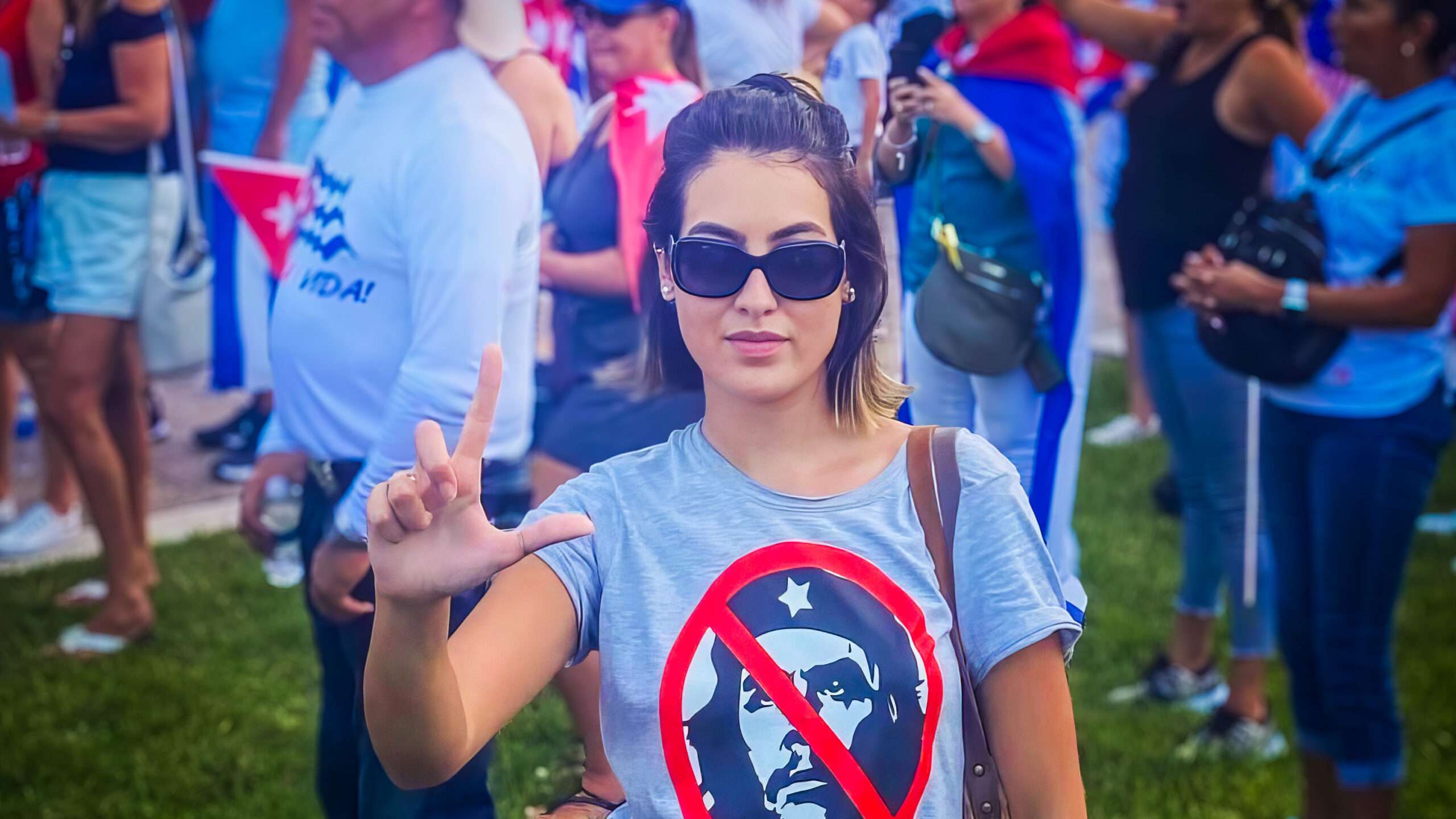
In 2005, at eleven years old, my mother and I fled Venezuela after the regime moved to detain her for her reporting. She stood among the earliest investigative journalists to document how President Hugo Chávez and his socialist party were tightening their grip on the judiciary and integrating Cuban operatives into the military and security apparatus. She exposed how Chávez and his allies were siphoning oil revenue for personal gain, helping to shape what would come to be known as one of the largest corruption networks in recent history. To quiet her, the regime concocted charges that she had masterminded the murder of a corrupt prosecutor and issued an arrest warrant against her.
My mother’s escape from Venezuela unfolded like a cinematic thriller. She hid in safe houses, rode in the trunk of a car concealed by trash bags, and ultimately slipped out of the country on a small boat. A family friend guided me to Miami to join her a few days later.
Our family had already endured the violence of “Chavismo.” Police raided our home, our car was shot at, and our family bodyguard, Germán Delgado, was abducted and killed by state security operatives. My grandfather faced bogus charges because of his journalism. He was arrested under Interpol’s direction by Italian authorities, and he eventually joined us in exile. The socialist regime shut down the newspaper and the magazine he owned by blocking paper imports needed to run their presses. Relatives fled one after another, including my grandmother, who spent her final years aching to see her Caracas home one last time before she died.
A radical leftist government uprooted my family and shattered my homeland. Yet, after I arrived at New York University as a freshman in 2013, I became a leftist myself.
How NYU’s Groupthink Turned Me Into a Leftist
It was all about fitting in.
When we first relocated to Miami, I yearned for Venezuela. In school we saluted the Star-Spangled Banner at dawn, and I refused to place my hand over my heart. “That isn’t my anthem,” I told my mother. But I quickly picked up English and befriended native-born peers. By adolescence, I longed to be the quintessential All-American girl, which meant concealing my Venezuelan origins.
Initially I aligned with a moderate liberal Democrat stance, campaigning for Barack Obama’s re-election in high school. Then I arrived in New York and confronted NYU’s intensely progressive campus culture. Like many classmates, I became fixated on social justice. I majored in journalism and political science, and I tackled courses such as “The Politics of Inequality,” “LGBT Politics,” and “Latina Feminist Studies.” My instructors included ardent leftists, a Catalan independence advocate who rejected the establishment, and a pro-Palestine activist who assigned a text edited by the Marxist historian Vijay Prashad—who advocates for Chávez, Nicolás Maduro, and their socialist regimes.
Chávez died in that first year, and Maduro took his place, continuing to erode Venezuela’s democratic institutions and doubling down on Chávez’s socialist policies. I was still a freshman in 2014 when the country erupted in daily protests, with millions marching in streets across the nation—an anger and desperation that my NYU classmates could hardly imagine.
I knew Chávez and Maduro were socialists, but I wasn’t focused on their economic plans. I concluded that the core issue was their authoritarianism and the suppression of civil liberties.
In the typical immigrant arc, the protagonist yearns to be authentically American, only to reconnect with her past through nostalgia or duty to family. I felt both forces, yet my transformation stemmed from a deep intellectual dissonance: I could not reconcile what happened to my family with what I was being taught in my Latin American studies classes.
I was taught that poverty in the region was a direct result of U.S. and European colonialism and imperialism. I was being conditioned into a doctrine of “tercermundismo”—the Third Worldism that Vladimir Lenin had reinterpreted after the failure of a proletarian revolution. According to this view, the true victims of capitalism were the untainted peoples of the Global South, whose lands had been plundered by colonial powers. They would rise up to overthrow the rich nations, not the workers of those nations. I was assigned Eduardo Galeano’s Open Veins of Latin America, a foundational text of Latin American studies and a manifesto of Third World victimhood. Chávez publicly presented it to Obama at the 2009 Summit of the Americas. It chronicles how European colonizers and American imperialists impoverished Latin America by extracting its resources. But in Venezuela, the 1976 oil nationalization had marked the end of the country’s most prosperous era, and Chávez dismantled the oil industry’s autonomy, diverting its revenues into his personal coffers. He neglected the oil sector’s infrastructure and seized the assets of foreign operators. In short, the government itself was making us poorer.
When Campus Politics Collided With My Family’s Story
At NYU, we argued that unfettered capitalism and “trickle-down” economics caused inequality, and that our moral duty was to resist by promoting social justice and progressive values. We learned about the Iraq War, the Abu Ghraib scandals, and the idea that the United States bore responsibility for the recent right-wing dictatorships in Argentina and Chile.
Yet this narrative clashed with what I knew about Venezuela’s recent history. In 2002 the military briefly ousted Chávez; I was taught at NYU that the U.S. government helped arrange the coup out of fear Chávez would sever oil access. But my mother had been in the room when Venezuelan media discussed the possibility of removing Chávez, and the U.S. ambassador told everyone present that “the Americans wouldn’t back a coup.” Maybe Latin American history wasn’t as simple as I had been taught.
I soon noticed how many of my NYU peers prioritized race and identity politics and believed silencing opponents trumped protecting free speech. It reminded me of how Chávez had shut down the free press (with support from the American and European left) by labeling it a propaganda tool of the oligarchy.
My NYU classmates often treated those who disagreed as though they belonged outside polite society. They shouted down conservative speakers, ostracized Republicans or anyone associated with them, and I met well-off students who called themselves “antifa.” I heard chants like, “How do you spell racist? NYU!” As a Venezuelan in exile, I could see a contrast: American democracy, capitalism, and the rule of law had provided unimaginable wealth and security, freedom I could scarcely have imagined in my homeland.
I felt a spark of hope when a professor invited our class to attend a lecture by Alejandro Velasco, an NYU colleague who grew up in Caracas. I was crushed to learn Velasco had become an apologist for the regime. In a 2019 In These Times piece, he characterized Chávez’s opposition as “the middle-class and elite sectors.” While acknowledging Maduro’s authoritarianism, Velasco urged progressives “to resist a growing narrative that uses the last five years of economic crisis in Venezuela to retroactively cast the entire chavista project—even socialism itself—as an unmitigated failure.”
Velasco’s spin did not square with my own memories or my mother’s reporting. Socialism, I felt, had been an unmitigated failure.
You will rarely meet a Venezuelan in the United States who supports Chávez—except in academia. The same holds for Cubans. In my senior year, while studying abroad in Madrid, I enrolled in a class with NYU’s Cuban-born anthropologist Aida Esther Bueno Sarduy, who remains the sole leftist Cuban I’ve encountered.
I wrote a paper for Bueno Sarduy pointing out the irony that Podemos, a Spanish left-wing party then gaining sway, had shown support for the Venezuelan dictatorship, and its policies were driving Venezuelans to migrate to Spain, fueling a backlash of nativism. When it came time to discuss my paper, Bueno Sarduy explained that she had lowered my grade from an A to an A- because I had included “false information” about Podemos.
For years afterward I sent her citations illustrating the direct ties between Podemos and Chávez’s circle. She shifted her stance, saying there was nothing “illegal” about those connections and pointing out that Spain’s conservative party, Partido Popular, was implicated in financial crimes. It was a rhetorical move I heard again and again at NYU: bring up leftist authoritarianism, and you’d be flooded with the evils of U.S. imperialism.
I Voted for Bernie Sanders Anyway
By my junior year I was still striving to fit in. On April 13, 2016, Senator Bernie Sanders (I-Vt.) held a massive rally in New York’s Washington Square Park, attracting roughly 27,000 people. I walked through the crowd, trying to ignore the imagery of communism and the Che Guevara shirts. Yet Sanders defined himself as a “democratic socialist.” He imagined making the United States resemble Norway or Sweden, a vision that seemed far removed from Fidel Castro or Hugo Chávez.
Five weeks before that Washington Square Park gathering, Sanders had taken part in a Democratic presidential primary debate in Miami, where he faced questions about his past praise for Castro and Nicaragua’s Daniel Ortega. “The Cubans are sending doctors all over the world,” he asserted onstage, arguing they had made progress in education. I had met Cuban doctors who said they were coerced into service and paid meager wages; Castro’s so‑called medical missions felt like a modern version of servitude.
An accompanying video featured on the event page only deepened my doubt.
Sanders would later defend his claim about Cuba’s “progress in education” in a 60 Minutes interview: “When Fidel Castro came into office, he implemented a massive literacy program. Is that a bad thing?” That literacy drive was a tool of socialist indoctrination, and its tangible achievements were largely questionable.
In their debate, Clinton and Sanders pivoted around Ortega, with Sanders redirecting to U.S. culpability—citing the Reagan era’s support for the Contras and the 1954 Guatemala upheaval. “The United States was wrong to attempt an invasion of Cuba,” Sanders stated, and it was wrong to back endeavors to topple the Nicaraguan government. He also argued against the 1954 Guatemalan overthrow. This tactic recurred: when confronted with leftist dictators, he redirected to U.S. policy and embargoes, avoiding acknowledgment of the crimes committed by socialist regimes in Latin America.
Sanders had once praised the Cuban Revolution in 1985 and visited Cuba in 1989, hoping to meet Castro. The Soviet Union was on the verge of collapse then, and its support for the Castro regime would soon wane. In 2000, Chávez arrived in Cuba with billions of dollars in regular oil shipments. In exchange, Castro aided Venezuela in establishing a network of spies to root out dissent within the military and sent the doctors who had previously inspired admiration in Sanders.
Growing up in Miami, I had met Cubans whose immigration stories mirrored my own: a charismatic leader who promised to revive precolonial values and communal bonds. Once in power, however, Castro imprisoned dissent, silenced the free press, nationalized industries, collapsed the productive economy, and enriched himself and his family, much like Chávez had done.
How I Finally Broke With the Left
Admitting it, I’m ashamed to say I voted for Sanders again after his remarks defending the Cuban and Nicaraguan regimes in 2016.
My break from the left did not occur until my senior year, when I began speaking with relatives and other survivors of socialist dictatorships. By then, Venezuela was enduring the worst peacetime economic collapse in modern history, and millions were fleeing. When we left in 2005, you would hardly hear Venezuelan accents in Miami; by the time I graduated, Venezuelans were moving to the city in large numbers—Doral earned the nickname “Doralzuela.”
After graduation, when I was farther from NYU’s left-leaning milieu, I learned about trips organized by the Democratic Socialists of America to Cuba and Venezuela, where participants visited staged communities and absorbed socialist propaganda. I discovered that Norway and other Scandinavian nations were far more capitalist in many respects than the United States. I also realized that the Democratic Socialists of America aligned more closely with the repressive forces that had devastated my homeland than I had been willing to admit.
Sanders advocated for a universal healthcare system in the United States; Venezuela already had a universal system that rendered hospitals into infection-prone death traps. Curable cancers became terminal for most, unless one had special government connections to cut ahead in line.
True universal healthcare would require the government to seize private providers and take control of their businesses, echoing Chávez’s expropriation of private property in Venezuela. In 2010 Chávez even proclaimed on television, “Expropriate that!” while pointing to stores in a Caracas square. He justified seizing private enterprises by arguing that capitalism was theft.
I remembered Chávez’s dismantling of Venezuela’s oldest beloved television station, Radio Caracas Televisión, transforming it into another state-run channel for propaganda. I recalled how, after my father passed away, his home was invaded by regime‑sanctioned squatters. I remembered Franklin Brito, who went on a hunger strike after Chávez authorized the seizure of his family farm; Brito starved to death in 2010. I realized that property rights and human rights are inseparable.
Spreading the Truth About Socialism
When I finally admitted I was done with the left, I felt nothing but shame. In my bid to assimilate, I had buried the truth about what had happened to my country in order to be accepted into a culture of upper-middle-class privilege. I had been uprooted by the evils of Castro-Chavismo, and I had done nothing to counter the ignorance of my NYU classmates.
I resolved to dedicate myself to conveying what happened in Venezuela so that well-intentioned peers could grasp the realities of socialism and learn to see beyond their own considerable privileges. If I could fall for socialist propaganda, anyone could.
I became a vocal critic of Venezuela on social media to counter the tide of misinformation online. Through Twitter, I connected with a community of survivors of anti-Western tyranny and met refugees of socialism—not only Venezuelans—who were adept at explaining how the First World misreads our histories and endorses policies that would replicate these tragedies.
Some American and European progressives have accused me of being a CIA agent. Others have labeled me a gusana, a Spanish term meaning “worm” popularized by Castro and his circle to describe Cubans who opposed the 1959 revolution. They questioned my cultural identity, arguing that I’m “white” and not truly Venezuelan because I speak flawless English and oppose Chavismo.
The Venezuelans I met online urged me to read Carlos Rangel’s 1976 classic From the Noble Savage to the Noble Revolutionary, which serves as a counterpoint to Galeano’s book. It helped me deprogram the NYU-era propaganda. The book functions as a guide to understanding leftist ideology, challenging the myth of victimhood and the claim that Latin Americans descend from one-dimensional noble savages. It explains why Latin American culture and history have left the region especially vulnerable to populist tyrants, who are the real culprits behind social and economic stagnation.
I can’t undo my Bernie Sanders vote, and I still feel a sting of shame for the years I spent defending democratic socialism. I’m choosing to honor my heritage by dedicating the rest of my life to spreading the truth about an ideology that ruined Venezuela and caused so much suffering. Socialism transformed the wealthiest nation in Latin America into the site of the worst peacetime tragedy in modern history. We honor its victims by ensuring it cannot happen again.
