
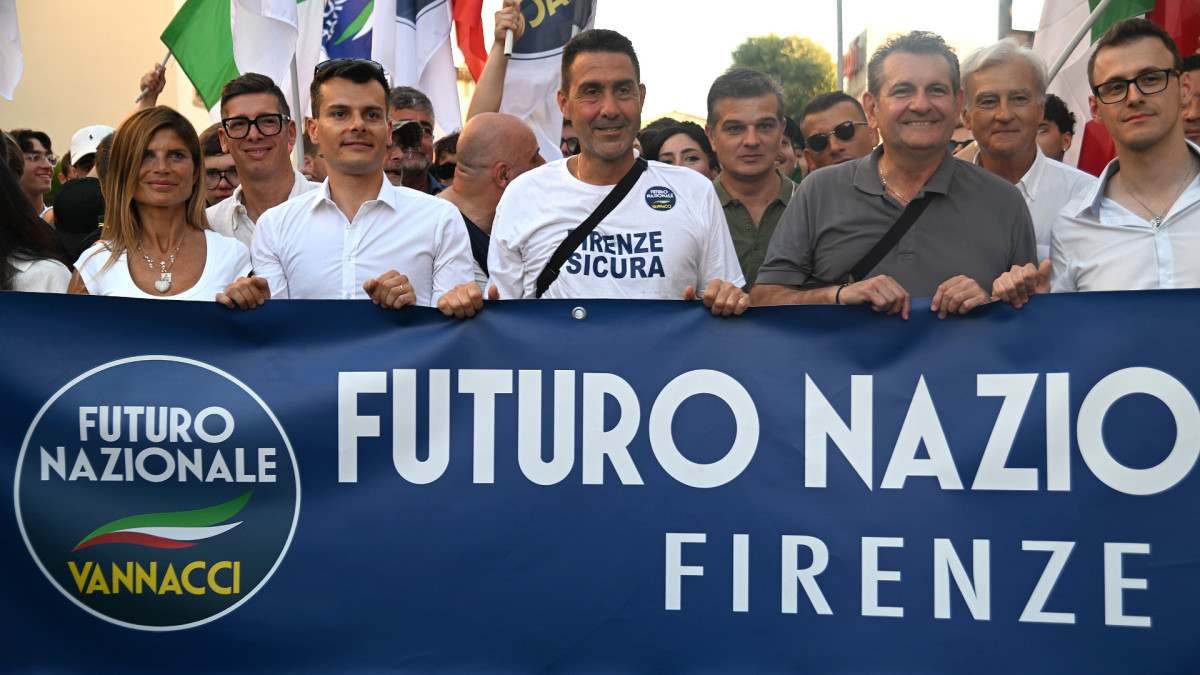
The emergence of a third far-right party into Italy’s political system (Futuro Nazionale/FN, led by Roberto Vannacci) raises the question of whether there is enough electoral space for all three to compete alongside Giorgia Meloni’s Fratelli d’Italia (FdI) and Matteo Salvini’s Lega. For now, Vannacci is effectively contesting Salvini for the runner-up spot, and if those three camps eventually consolidate, Italy will once again prove to be an “anomaly” and a political “laboratory.” This also means that the country already hosts all three strands of Europe’s radical-right in the European Parliament: FdI within the European Conservatives and Reformists, Lega within Patriots for Europe, and FN within Europe of the Nations and Sovereign States, the most far-right of the trio, led by Alternative for Germany, represented by Alice Weidel and Tino Chrupalla.
The new party founded by Vannacci has split from the Lega to avoid having to concede or compromise, and it is riding the crest of Salvini’s leadership crisis, who now regrets having recruited him in the first place (he has described himself as disillusioned and annoyed). The polling dead heat between FN and the Lega is catastrophic for Salvini, who is already facing internal doubts (the regional president of Veneto, Luca Zaia, emblematic of the old northern bloc’s spirit). Salvini warns Vannacci that he could end up like Gianfranco Fini, but the reality is that FN’s ascent is tapping into the vote bleed from Salvini’s leadership, which he has been unable to stem in the polls.
“A man who has broken away from the Lega to avoid concessions and commitments is profiting from Salvini’s leadership crisis,” reads one of the analyses.
Although FN’s strongest electoral impact harms Lega and only marginally FdI, for Meloni the rise of this new party poses a problem because it complicates the majority alliance. On one hand, Meloni’s relative pragmatism leaves room to her right for more radical strands such as FN, and on the other hand, it is a challenge for her, since it disrupts the balance of power within the conservative coalition and complicates a new government.
For this reason, the Financial Times has noted that Vannacci poses a significant challenge to Meloni, because to absorb him she would need to harden her policies, something that would clash with reservations from Forza Italia and Noi Moderati. In sum, FN’s consolidation proves awkward for Meloni, as she will have to deal with one more ally farther to her right, complicating negotiations over policy programs and portfolios.
In the YouTrend poll (June 2026), FN overtakes Lega for the first time by the narrowest margin (5.9% to 5.8%), a symbolic moment. Meanwhile the SWG poll (June 2026) places them equal at 5.3% each. While Lega is a party with a solid organizational structure, FN is a “personal” party built around Vannacci’s leadership, which recently held its first congress to formalize a minimal program and ratify its statutes. Although Forza Nuova, a small far-right party, briefly explored recruiting Vannacci, he ultimately chose to launch his own organization. Regarding its name, the preference for the word futuro (future) among Italian radical-right formations is striking: from the futurist movement of Filippo Tommaso Marinetti (which later embraced Mussolini’s fascism) to Fini’s brief personal party, Futuro e Libertà per l’Italia, when Berlusconi broke with him. There is also a think tank called Nazione Futura (close to FdI), whose logo closely resembles the one approved by FN, which has led to a pending civil action for misappropriation.
“Just as the Lega is a party with a solid structure, FN is a personal party explained by Vannacci’s absolute leadership”
FN presents itself as the true right, which is fairly novel because this kind of debate has traditionally been the preserve of the left, in pursuit of ideological purity, but is rare on the right that is more often driven by interests than doctrinal definitions. Vannacci aims to build a competitive radical-right party, positioned to the right of both FdI and Lega, to capture the segment of voters most dissatisfied with Meloni and Salvini’s practical “moderation.” In that sense, he is proving adept at his anti-system campaign. Vannacci embodies the latest pledge of the political neoclassical reformulation, though his message remains as antiquated and reactionary as it gets. Besides, this new entrant has already faced investigations for financial irregularities, racial hatred, and defamation, all dated and well behind him. Although he does not have a parliamentary group in Italy, he has attracted eight defectors from Lega (including Rossano Sasso, Edoardo Ziello, and especially Laura Ravetto, who has a long political career).
Vannacci is a former general (having participated in several international military missions) who served in Lega from 2024 to 2026 as a member of the European Parliament, where he rose to vice-president of the group Patriots for Europe. After tensions with Salvini, he was expelled from the group and spent a period as non-attached before finally joining the more radical European group, Europe of the Nations and Sovereign States. The truth is that in the 2024 European elections Vannacci was the candidate with the highest personal support after Meloni in all the major constituencies used for these elections. His program centers on his pamphlet Il mondo al contrario, which became a best-seller. In it he rails against political correctness, woke culture, and progressivism, presenting himself as the great defender of national identity, traditions, and punitive security. Indeed, the main themes of his platform align with the three pillars that define Europe’s far-right: ethno-national chauvinism, anti-immigrant xenophobia, and anti-establishment populism. Vannacci refuses to call himself antifascist, arguing that Fascism as a historical phenomenon no longer exists, while insisting that Mussolini was a statesman who did things that benefited Italy.
FN’s program is a catalog of reactionary slogans organized under the acronym VITAL (Virtue, Identity, Tradition, Love, Liberty, Excellence, and Enthusiasm), and its core points are sovereignty, ethnic purity, and opposition to feminism and LGBT rights. Sovereignty is partial because it supports NATO under the leadership of the United States of Donald Trump and does not address energy, food, or digital sovereignty, which means the attribute is almost reserved for<|> expelling irregular migrants. This is the real obsession of Europe’s reactionary right and of their ideological allies (including some social-democratic parties), hence Vannacci has embraced the xenophobic thesis of re-migration and the establishment of strict reception caps.
“All of Vannacci’s ideology is governed by an exclusionary ethno-nationalist and supremacist concept of Italy”
All of Vannacci’s ideology is governed by an exclusionary ethno-nationalist and supremacist concept of Italy that must always prioritize compatriots and encourage native birth rates. His ultraconservatism leads him to glorify the traditional family and Christian roots and reject abortion, while denying femicides and gender-based violence (similar to Vox, he champions the notion of “domestic violence”). Finally, and this is a matter that will complicate Meloni’s coalition, it is worth noting that Vannacci is a staunch supporter of Vladimir Putin and is also a radical eurosceptic (these two positions align with Salvini’s), which stands in tension with the pro-Atlanticist and pro-European tilt that the prime minister is pursuing.
