
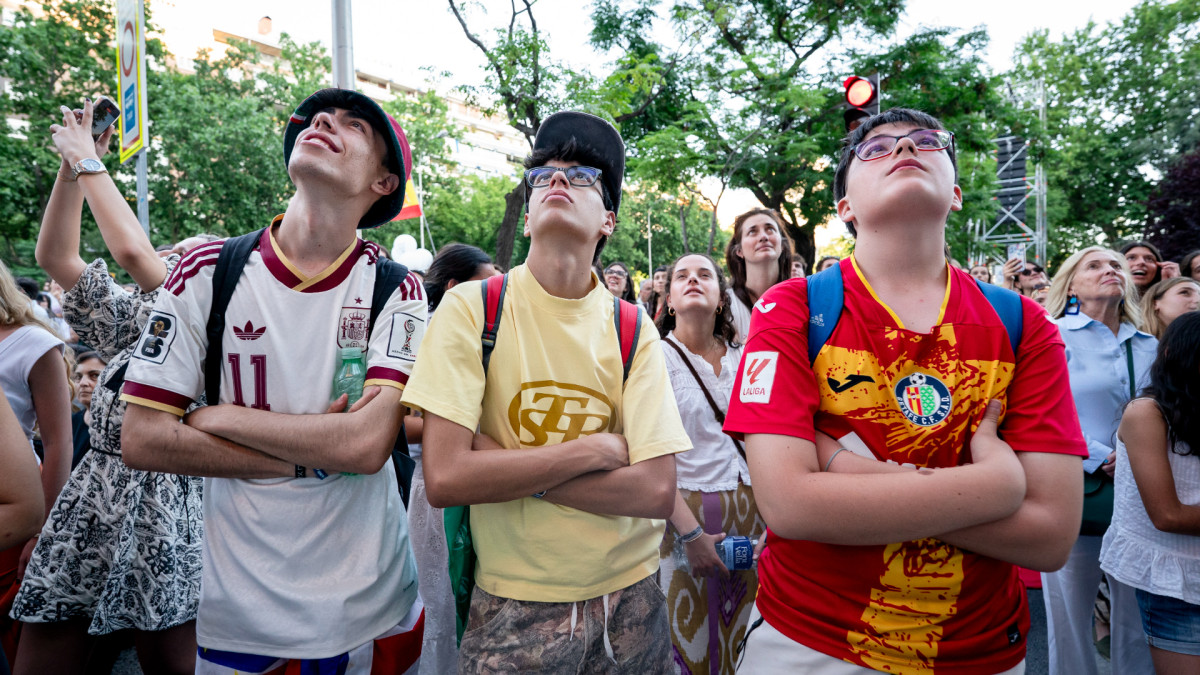
It seems we are living immersed in a generational battle. We hear arguments about how other generations behave constantly. These criticisms are mainly aimed at Generation Z, people born between 1997 and 2012. The reader will notice the difficulties of analyzing a generational group as diverse as those born across fifteen years. Some lived the economic and representation crisis at a certain age, while others had not yet been born. Some spent the pandemic at their parents’ home, some abroad, and some were not ten years old.
This generational battle recalls a sketch from José Mota’s New Year’s Eve show in which the father scolds his son and that same father received the scolding when he was a son, and this goes back to a troglodyte relationship between father and son.
Thanks to the collaboration of Palumba and Cotec, we could investigate and gather everything we knew about the participation of Generation Z in politics in Spain, trying to escape those age-related aspects and focus on what is happening specifically in Generation Z.
Young people participate less electorally, it is true, but it is also true that it has always been so: the very generations that came before, when they were young, participated less electorally. It is a life-cycle effect. It has been modulated according to context, but it is common for young people to participate less in elections than older generations. Confidence in their opinions could be a key factor in participation. Palumba’s data emphasize the general trend: the youngest have lower confidence. In fact, these differences are similar to those in other European countries. It is thought that the acquisition of one’s own habit or some life events (employment, home ownership, or marriage) could be related to electoral participation. Surely, the delay of these events may also be affecting electoral participation.
“Young people participate less electorally, it’s true, but it’s also true that it has always been so: it is a life-cycle effect”
If we adopt a broader view of political participation, it may be that the forms of participation have changed more than participation itself. Social networks and technological changes have conditioned the way they participate, both in spaces of participation themselves —where debate, discussion, and opinion occur— and through mechanisms to coordinate in-person participation. There are also spaces for collective organization. The study phase has a strong impact on non-institutional participation. But they gather more signatures, send more messages to politicians online, and participate more in demonstrations than other age groups.
One of the first factors to analyze to understand political participation in Generation Z is relative deprivation: the gap between expectations and capacity, and the amount of resources they have access to. Young people have access to knowledge and organizational resources that surely have no precedents. However, there is a sense of generational grievance in which factors such as housing prices make them feel that their capacity does not match their expectations.
“There is a sense of generational grievance in which factors such as housing prices make them feel that their capacity does not match their expectations”
Relative deprivation helps explain the sense of grievance and part of the political mobilization of this generation, but it does not by itself determine the channels through which they participate. There, the second great crisis experienced by Generation Z, COVID-19, played a fundamental role. Its psychological impact and the digital framework in which it developed conditioned the forms of political participation of this generation in years especially relevant to their political socialization.
One thing that seems relatively clear is the generational gender gap with respect to political participation. Young men tend to participate less in almost all forms of political participation despite having greater interest. They only participate more than women in illegal protests and online political debates. They also participate more in those activities related to political parties. The curious thing is that between fifteen and twenty-four there are relatively few gender differences in the interest in politics. In electoral participation, especially when asked about general elections, the differences are also minimal or directly do not appear among the young groups. Time will tell whether this marks the start of the end of the gender gap in interest in politics or, again, a gap triggered by life events. In that sense, it seems that among the youth there is also a smaller gender gap with respect to political knowledge. The feminist movement has undeniably shaped the gender gap in participation. Women participate more than men in mobilizations of a feminist nature, though also in those related to climate change. These two issues have occupied a significant portion of mobilizations in recent years, showing a higher degree of participation by Gen Z women in demonstrations. Moreover, the gender gap regarding feminism seems to be widening among the younger members of Generation Z.
Generation Z has lived a series of unique and unrepeatable events in its early years, which condition its political socialization. As a generation, it has its own characteristics; however, one cannot claim that it is a generation particularly unparticipatory. Another thing is that the forms of participation are changing, because the world is changing.
