
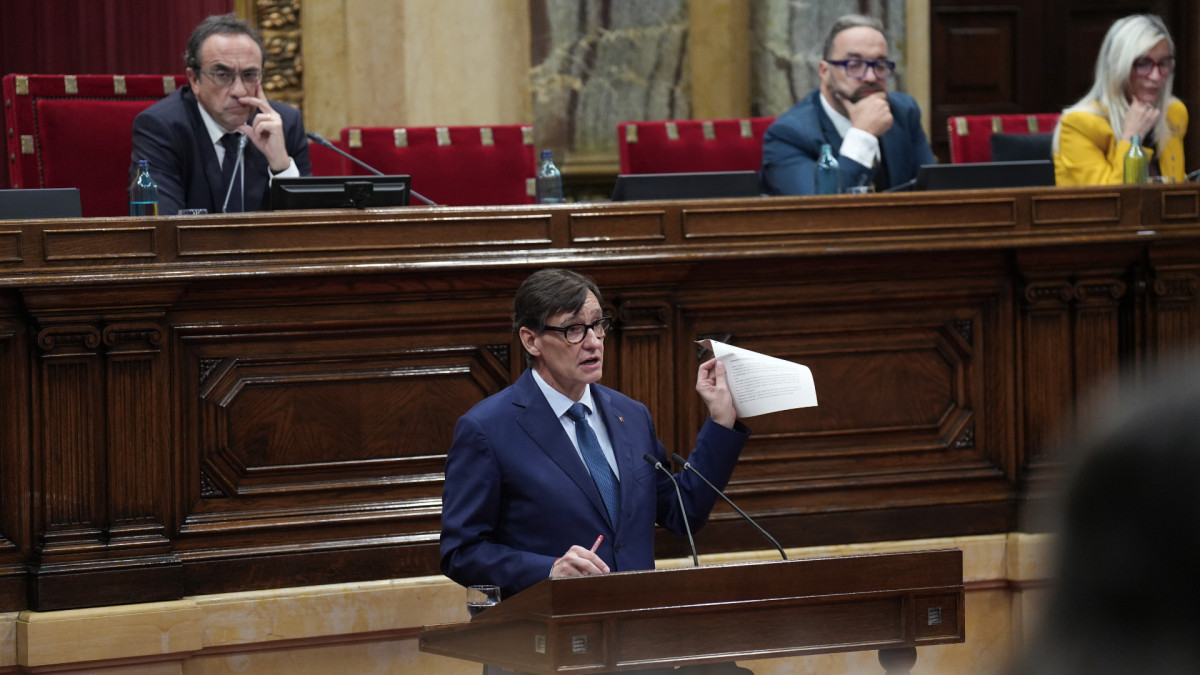
Since the 1-O referendum and the application of Article 155, the tone of Catalan politics has changed. The pro-independence and anti-independence parties remain at odds, but they have also had to negotiate investitures, budgets, or laws. Has the way they speak about each other also changed?
Salvador Illa was sworn in as President of the Generalitat on August 8, 2024 thanks to the support of Esquerra Republicana de Catalunya (ERC) and the Comuns. It seems clear that the tone of political debate in Catalonia is not the same as it was in 2017. The way parties from the different blocs confront, negotiate, or relate to one another has changed.
Has the vision they project of the other bloc improved? Between whom? Why might these improvements occur?
With these questions, we began a research process in which we analyze hundreds of messages posted by political parties in Catalonia on the social network X during the post-referendum period.
To do so, we used two methods of analyzing the messages seen on this social network: on the one hand, an analysis of the tone of the messages (positive, negative, or neutral) and, on the other, the Thomas-Kilmann Conflict Management Model, which allowed us to classify them into five categories: competition, commitment, collaboration, avoidance, and accommodation.
The events that occurred in Catalonia between 2012 and 2017 are unprecedented and, therefore, so are their consequences. Our objective was to analyze whether there had been a discursively de-escalation during the early years of the party-political debate in Catalonia.
“It is difficult to expect a radical change in how parties view the national question or how they see their political opponents”
We know that national positions and party ideologies are relatively stable: changes occur slowly and tend to be very limited, usually for strategic reasons. It is hard to expect a radical shift in parties’ views on the national question or on how they view their political opponents. The national dimension is a central axis that structures political competition and the party system in Catalonia.
The first thing we observed is that visions remain predominantly negative. That leads us to refute a hypothesis we had: we thought that the winning side (understood as the non-independence parties, since they managed to preserve territorial unity) could experience a sustained improvement in its visions of the other side, since, once the conflict ended, there would be no incentive to keep fueling it.
Even so, there have been episodes of more positive or less competitive visions, but these have not occurred in a sustained manner; they appeared sporadically.
These occasional improvements in the other bloc’s visions have been driven by PSC, ERC, and the Comuns. In contrast, actors such as Vox, CUP, Ciudadanos, or the PP have not altered their negative views of the other bloc at all.
“The improvement in tone between PSC, ERC, and the Comuns has occurred, in part, because they negotiated investitures, budgets, or laws in which they needed one another”
Of these three actors, the PSC has shown the greatest improvement in its tone toward parties in the other bloc. Its evolution over these years has been irregular, mainly in relation to ERC. What is striking is that this improvement has not been sustained, but rather occurred sporadically. It is surprising that in 2018 and 2019 the tone improved, in 2020, 2021, and 2022 it became completely negative again, and in 2023 it improved once more.
The Pace of Catalan Political Debate Is Set by Institutional Incentives
The conclusion we reach is that these changes have a reason: institutional incentives. In other words, the improvement of the tone between PSC, ERC, and the Comuns has occurred, in part, because they negotiated investitures, budgets, or laws in which they depended on one another.
We also analyze civil society organizations closely tied to this issue, such as Societat Civil Catalana, Òmnium, and the Assemblea Nacional Catalana, which have not modified their view of the other bloc. This leads us to a conclusion in the same vein: party incentives are key to understanding changes in discourse. In this sense, organizations such as Òmnium, the ANC, or SCC have not much reason to alter their tone toward the opposite bloc, since they do not need to reach agreements with it.
“Pedro Sánchez has needed ERC consistently in recent years to form majorities in Congress; with more or less agreement, but he has needed their support”
To be more specific, we have identified three events that substantially mark these changes: the motion of censure and the consequent investiture of Pedro Sánchez in 2018, the negotiations for Sánchez’s investiture in 2019, and the approval of budgets in Catalunya in 2023. In all three moments, PSC and ERC, and also the Comuns —although they did not start from the same position— found important incentives to cooperate. Pedro Sánchez has consistently needed ERC to form majorities in Congress in recent years; with more or less agreement, but he has needed their support. On the other hand, with Junts leaving the government, ERC needed to find new allies in the Parliament to pass the budgets, and here there was an approach with the PSC, which explains some messages with a less negative tone.
That also gives us a forward-looking reading: we do not know to what extent the disappearance of these incentives could again condition the discourse of the parties. That is, if the tone improved because there were shared interests, it is possible that the disappearance of those incentives would once again deteriorate the way these actors talk about the other bloc.
In conclusion, the national conflict has not disappeared from the political discourse in Catalonia. It colors the visions about the parties and conditions the tone in which they address their rivals. However, our data show that institutional incentives (investitures, budgets, or parliamentary agreements) can generate episodic de-escalation in rhetoric. The de-escalation exists, but it does not reflect a deep change: it is, above all, a strategy when governing requires finding common ground.
To access the full open-access publication: Words After the Storm: Elite Rhetoric and the Limits of De-Escalation in Postreferendum Catalonia, published in the journal Nations and Nationalism.
