
A lawyer’s—and former trial judge’s—perspective.
(Note: For those unfortunate few who hate soccer, you can just skip to the next post—and you are missing one of the world’s greatest sporting events.)
Like more than 30 million other Americans, last night I watched the U.S. Men’s National Team (USMNT) defeat Bosnia and Herzegovina 2-0 at the FIFA World Cup.™ The loudest topic after the match was whether the “straight” (i.e., immediate) red card shown to the American striker, Folarin Balogun, was warranted. As a long-time supporter of the U.S. men’s team (and of the women’s team, see, e.g. my post here), it may not surprise you that I disagree with the decision. And I concede that I lack formal training in the World Cup’s official rules. But as a lawyer and former trial judge, I do have training and experience in applying rules to concrete fact patterns. That background prompts me to question the decision last night. It seems worthwhile to consider how legal rules function in this setting, so I thought a brief, timely post would be appropriate.
To recap the situation briefly: around the 63rd minute of the game, the USMNT was leading Bosnia and Herzegovina 1-0. Then American striker Balogun and Bosnian defender Tarik Muharemovic collided as they both contested a ball high in the air. You can view video of the incident here. As Balogun descended, the studs on his boot—specifically his right cleat—made contact with the defender’s ankle. The on-field referee did not call a foul. But after the Video Assistant Referee (VAR) reviewed the incident in slow motion, the referee was summoned to reassess the footage. Following the slow-motion review, the referee changed course and issued Balogun a red card for “serious foul play.” This red card ejects Balogun from the match—and it will prevent him from playing in the U.S. squad’s upcoming game against Belgium on Monday.
From a lawyer’s standpoint, four concerns come quickly to mind:
The “Time Framing” Problem
In legal reasoning, one often must decide the appropriate window of time for evaluating a disputed action. In criminal law, for instance, a defendant’s conduct might appear culpable if only a narrow instant is considered. Yet taking a wider view can reframe the conduct entirely. A simple illustration is a shooter who might be charged with murder if you look only at the moment the trigger is pulled. If you step back and learn that a short time earlier the person who was shot had made a serious and plausible deadly threat toward the shooter, the act could reasonably be understood as self-defense. Choosing the correct time frame is essential.
Applied to Balogun’s case, the critical question is whether to judge the red card’s propriety by focusing on the moment he landed on the defender’s ankle—or on what occurred earlier. By definition, the assessment should encompass a broader period than the landing itself. To offer a simple hypothetical: suppose Balogun leapt straight up in an effort to win the ball, and the defender purposely extended his leg to anchor Balogun to draw a red card. If one only examines the landing, the impression could be distorted.
Here, the issue of whether Balogun engaged in serious foul play appears to depend on when he initiated his jump. After that moment, his ability to alter his trajectory would be limited. Yet, according to the American television broadcast, the VAR officials and the on-field referee seemed to concentrate on the moment of Balogun’s landing.
The time-framing issue becomes even more pronounced when we consider what happened after Balogun took off and during his flight. As the image below indicates, the defender’s arm is extended into Balogun, clearly influencing the trajectory of his jump.
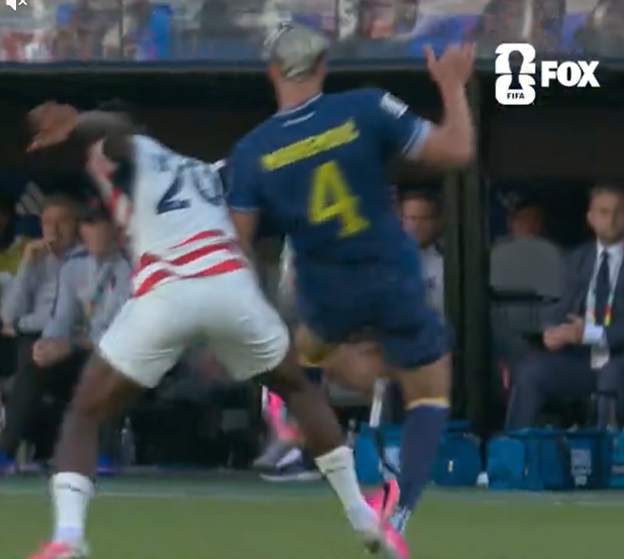
Of course, if Balogun was knocked off balance by the Bosnian player, that would seem to paint the incident in a different light.
But the commentary I’ve seen on the incident hasn’t focused on this aspect. It is also notable that the laws of soccer (promulgated by the International Football Association Board or IFAB) permit shoulder-to-shoulder challenges, and explicitly limit use of the arms. SeeIFAB Rule 12 (“A player may shield the ball by taking a position between an opponent and the ball if the ball is within playing distance and the opponent is not held off with the arms of body.”) Given this reality—that the Bosnian defender’s arm contact preceded Balogun’s boot to the ankle—it alters the dynamic, because Balogun could not reasonably have anticipated being pushed in that manner.
Mens rea or intent
That observation naturally leads to another question: what was Balogun’s intent? In criminal law, the Latin phrase often used is “mens rea,” roughly translated as a guilty mind. The applicable provision (Rule 12) from the IFAB Rules of Soccer provides:
“Any player who lunges at an opponent in challenging for the ball from the front, from the side or from behind using one or both legs, with excessive force or endangers the safety of an opponent is guilty of serious foul play.”
In criminal jurisprudence, a common interpretive issue when examining provisions like this is whether they require some mental element—intent, knowledge, or recklessness. The usual view is that the defendant must have some mens rea related to the action; strict liability situations are rare. The serious foul play rule, as drafted, appears to contemplate the possibility that intent might be irrelevant. In particular, the phrase “endangers the safety of an opponent” could be read as creating liability merely for a dangerous situation created in a neutral sense. But the surrounding context matters in interpreting the term “endangers.” For example, imagine a player leaping to head the ball and being shoved from behind by the opposing team as he comes down, resulting in him landing on top of and thereby endangering an opponent. In that scenario, there might be no red card, because the player is not in control through no fault of his own. It would be hard to describe simply leaping into an opponent’s area as constituting endangerment.
This nuance is implicit in the IFAB rules, but it is clarified in other regulatory interpretations. For instance, the English Premier League (widely regarded as the premier soccer league globally) explicitly identifies five factors in deciding a red card for “serious foul play”:
- Speed
- Intensity
- Force
- Degree of control
- Point and extent of contact (full/limited)
Therefore, a player who makes a controlled challenge that inadvertently and unexpectedly endangers an opponent may not receive a red card.
Likewise, common sense dictates that the level of endangerment owed into the calculation must be weighed when issuing a red card. Anyone competing for balls on a field will, to some degree, risk harming an opponent. The critical factor is the extent of that risk, and a person who intentionally aims to harm an opponent would presumably be more likely to cross that boundary.
This conclusion is reinforced by other moments in the World Cup, such as an earlier incident involving the world’s most famous footballer, Lionel Messi. That moment clearly endangered an opponent’s safety but did not warrant a red card (or even a foul). The image below depicts the event:
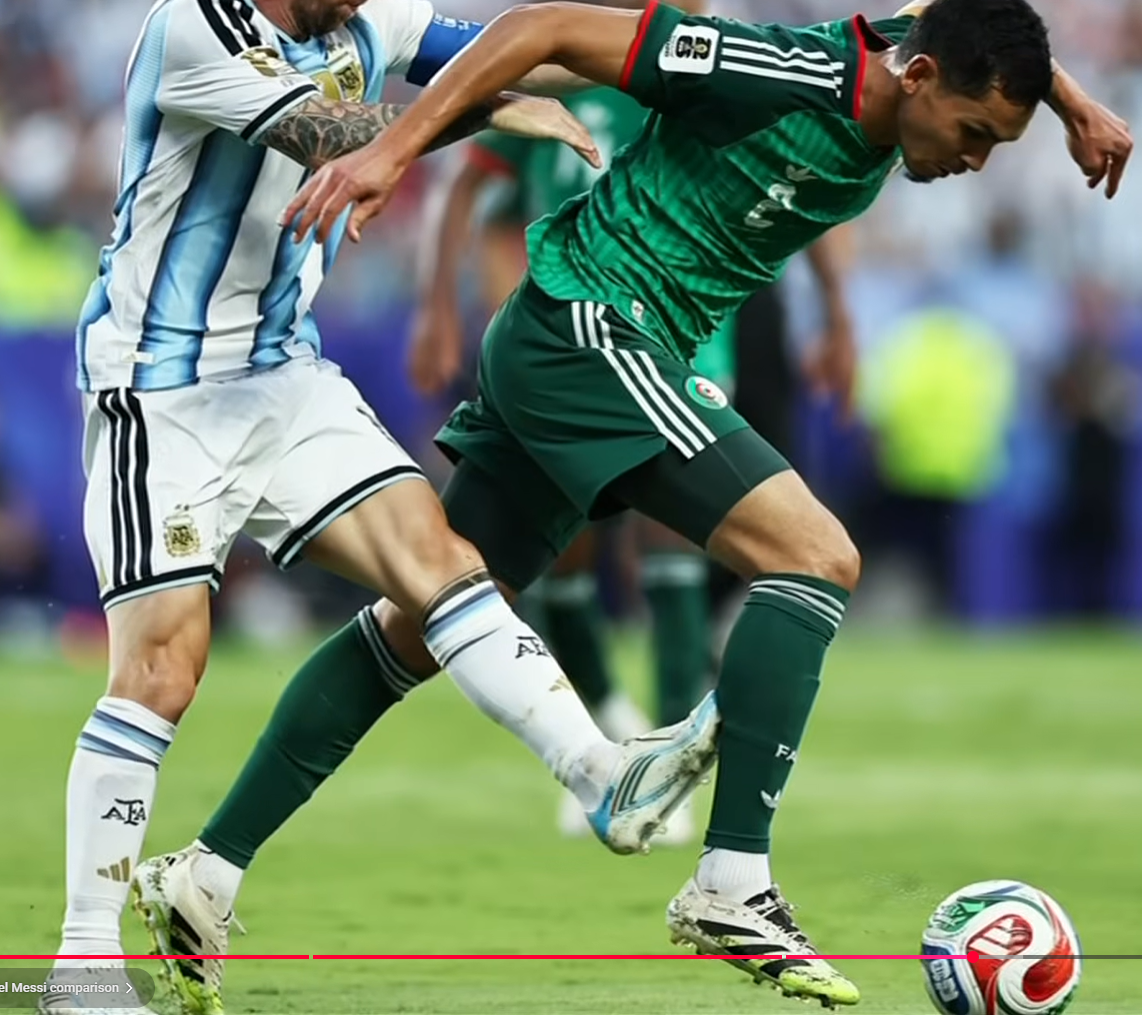
As I understand it, the reason Messi wasn’t charged with a foul at all was that the contact was unintentional and therefore could not be said to have reached the level of endangerment. The same logic would seem to apply to Balogun’s contact here.
Many commentators criticized Balogun’s red card on the grounds that the conduct was inadvertent, including former Premier League referee Mark Clattenburg here, and former Select Group referee Andy Davis here. This brings us to the next legal concern:
Standard of Review
The debate over Balogun’s red card flows naturally into another technical legal question: what standard governs on-field determinations? After all, the referee did not even whistle Balogun for a foul, let alone issue a yellow card, let alone a red card. Which standard applies when deciding whether to overturn the initial on-field decision?
The IFAB Rules of Soccer provide a clear answer. The FIFA World Cup’s Video Assistant Referee (VAR) Protocol states that a missed red-card decision can be reversed, but only if the error is “clear and obvious.” Here is the language of the Protocol:
The original decision given by the referee will not be changed unless the video review clearly shows that the decision was a “clear and obvious error.”
The principle behind this rule is to minimize disruption to the game’s flow. VAR remains controversial in part because of the delays it introduces. Therefore, this standard of review is far from a mere technicality; it is a key element in preserving the beauty of the game.
In World Cup play, the application of the “clear and obvious” standard is often straightforward—think of semi-automated offside tracing during a passing sequence. But for subjective judgments such as whether an action constitutes serious foul play, the calls become far more debatable.
Given that subjectivity, when neutral observers disagree with a call, it becomes hard to classify the decision as a “clear and obvious” error. If trusted, impartial observers (like Clattenburg and Davis) disagree with the call, it is unlikely that the error was truly “clear and obvious.”
Appeals Process
So Balogun’s red card appears incorrect, at least in my view, based on the analysis above. Is there any possibility to appeal—especially appealing the one-game suspension that followed the ejection?
Under FIFA World Cup rules, it seems the United States cannot appeal the suspension directly, but FIFA’s disciplinary committee could extend the punishment to additional games. I do not dispute that the no-appeal rule currently applies and should be followed in Balogun’s case. But from a legal standpoint, this one-way mechanism that allows only punishment to grow—and never to shrink—seems poorly conceived.
First, consider why a one-game suspension is tacked onto the red-card penalty in the first place. The answer is clear upon reflection. Without such a supplemental punishment, the end of a match could become a free-for-all for opposing players; a team that is already losing could simply target opponents with reckless tackles because the ejection from a game that is already decided won’t constitute a meaningful punishment.
So given that the deterrent effect is the rationale behind this added suspension, how does a rule that prevents appeals align with that purpose? My stance is that the appeals process should be broadened to permit an appeal by the suspended player. This change would not meaningfully undermine the deterrent value of the sanction. For instance, it is implausible to think Balogun’s calculations about his challenge on the Bosnian defender took the absence of an appeal into account.
Allowing appeals by a suspended player would also help the process’s accuracy. Accuracy is, of course, one of the fundamental justifications for appellate review in law—the notion that a detached, post-event review can correct on-the-spot errors. In this context, an appeal could occur after the game—when deadlines and time pressures are no longer a factor. Since a suspension for the next match will occur only after several days, there is an opportunity to conduct a measured review—particularly for marquee World Cup fixtures.
Another common-law function of appellate review is to promote consistency across different courts and jurisdictions. For example, appellate challenges to criminal sentences seek to prevent divergent rulings by different tribunals. The same aim applies to red-card suspensions in a tournament spanning three host nations and multiple referees, where uniform application of rules matters.
From the commentary I’ve encountered about Balogun’s suspension, the most vocal criticisms concern his treatment relative to other similarly situated players, with Lionel Messi’s case being the most cited comparison for leniency. American soccer pundit Alexi Lalas, for instance, has argued that “if his [Balogun’s] name was Messi, he would still have played.” Whether Lalas is right or not, the appeal process could serve to address perceptions of inconsistency by providing a centralized and uniform mechanism for review.
To be clear, the novel appeals framework I propose would apply only to undo a suspension rather than to impose one. VAR already encroaches on the game in enough ways, without granting it the power to analyze prior matches for possible red cards. Yet there is nothing novel about permitting appeals that lean toward mercy. In the United States, for example, criminal defendants routinely exercise appeals, while appeals by prosecutors are far more the exception than the rule.
For all of these reasons, my conclusion is that Balogun’s red card was wrongly issued, and there should be a pathway for suspensions to be revisited. That said, I am not claiming to be a professional interpreter of soccer’s rules. And, of course, it’s possible that my views have been shaped by a personal hope that the U.S. team advances deeper into the tournament. If you have thoughts, please feel free to share them in the comments below.
