
The debate about the extraordinary regularization of migrants in Spain has finally entered its decisive phase. After beginning in January the urgent processing of the royal decree, the Government approved on April 14 the rule that activates the process. The measure targets people in irregular administrative status and applicants for international protection who were already in Spain before January 1, 2026, and provides residence and work authorizations with an initial one-year validity. The Government cites around 500,000 people potentially benefiting, although other estimates place the figure closer to one million.
Therefore, we are entering the final phase of launching a public policy that has triggered considerable division. It is also a measure that carries preconceived ideas that deserve nuance. Last January, the Jesuit Community of Níjar wrote in Agenda Pública that “regularization does not create these lives or integrate them into society for the first time; it merely recognizes legally a presence that was already social, economic and relational.” In the face of political alarm, the focus shifts toward a core aspect of the measure: these are people who already work, care for others, rent, study, consume and sustain entire neighborhoods, but do so from a legal limbo that makes them more vulnerable to exploitation and abuse.
That is why Gemma Pinyol-Jiménez, director of migration policies at Instrategies, is right to present regularization as something more than an administrative adjustment. In her analysis, she defines it as an indicator of the democratic quality of a society and as a correction of a dysfunctional migration system.
“Keeping hundreds of thousands of people for years on the margins of the law does not strengthen the State, but the opposite”
A democracy is measured also by the distance between real life and the institutional recognition it grants to those who are already part of it. Keeping hundreds of thousands of people on the periphery of the law for years does not strengthen the State, but the opposite. It neither organizes the labor market nor improves convivencia (social cohesion).
The Economic Reason for Migrant Regularization
The economic dimension of the debate is one of the most analyzed, and perhaps a pillar of defense and critique depending on whether the measure is supported or not. CIDOB researcher Matthew McLaughlan, drawing on the Economic and Social Council (CES) report, notes that the Bank of Spain attributes 80% of GDP growth between 2019 and 2024 to immigration and that Spain faces employment needs of 2.4 million positions between 2025 and 2035.
To this is added another figure recently updated by the Ministry of Inclusion: Social Security already exceeds 3.21 million foreign affiliates and 42.9% of employment created since the labor reform corresponds to workers from other countries. Under this interpretation, immigration is one of the central pieces of the country’s economic expansion.
The economic journalist Belén Carreño summed it up well in another reading: regularization does not mean suddenly incorporating half a million irregular workers into our labor market, but rather formalizing their employment situation. That distinction matters greatly because formalization has concrete effects: more contributions, more income tax (IRPF), greater negotiating power for the worker, less room for wages below the collective agreement and abusive working hours. Pinyol also emphasizes this point and notes that “the persistence of irregular labor relations impoverishes the labor market.”
Nevertheless, while it is evident that immigration plays an essential role in Spain’s growth, many authorities express doubts about the sustainability of this growth model. Under this criterion, what is being questioned is the impact of immigration on areas such as infrastructure, services, or the housing market.
The director of Opina 360, Juan Francisco Caro, explains, following the report La España de los cincuenta millones de habitantes, that immigration requires “planning, not polarization.” And that planning goes far beyond the initial permit. It relates to housing, credential recognition, high-quality labor integration, public services, regional integration, and the prevention of pockets of exclusion. Caro recalls that housing prices in major cities already act as a barrier to entry and retention, while Carreño warned of the need to monitor social frictions, administrative bottlenecks, and processes of poor integration. While an economic model can function on the basis of immigration, it must find a way to grow sustainably and carry out the appropriate investments in sectors where pressure is increasing.
The Social Reading and the Pull Effect
Another common thread in immigrant regularizations—both past and present—is the “pull effect.” Researcher Yoan Molinero Gerbeau of the Institute for Studies on Migration focuses on the evidence. His review of the academic literature on the 2005 regularization and comparative experiences concludes that science does not support the idea of an automatic increase in new arrivals simply because regularization occurs.
“What emerges is a reduction in irregularity, less vulnerability, more labor formalization, and higher revenue.”
Spain does not appear as an anomalous case after 2005, nor do international studies show a generalizable “magnet.” What does appear, Molinero writes, is something else: a reduction in irregularity, less vulnerability, more labor formalization, and greater revenue. In other words, the most frequently cited debate is probably the least proven.
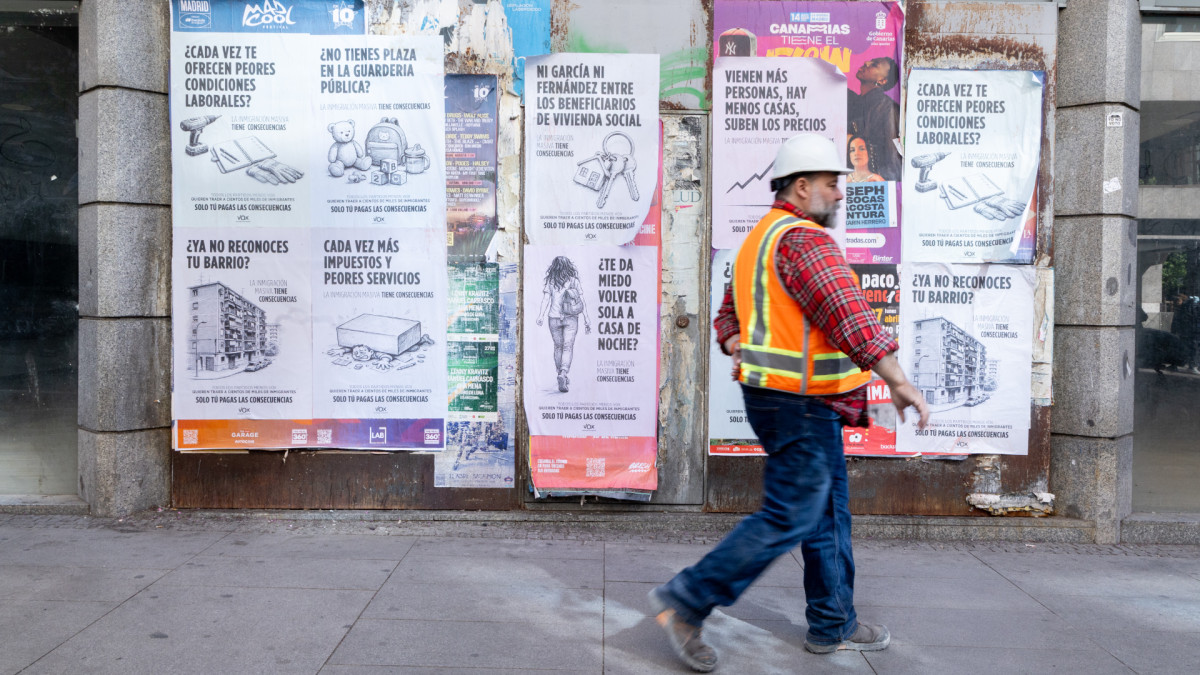
That said, the fact that this argument may be weak does not mean the social discussion is irrelevant. Lucila Rodríguez-Alarcón, director of the Fundación porCausa, speaks of an “anti-migrant narrative” built on the axis of “them” versus “us.” CES, in the reading by McLaughlan, reaches a similar conclusion: the negative view of immigration is fed less by direct coexistence than by misinformation contexts and political instrumentalization. Or, in other words, the discussion about regularization ceases to be solely migratory and becomes also a democratic issue.
“What order exists when more than half a million people are kept outside the system, without full registration, without effective obligations, and without sufficient protection?”
Faced with the caricature that regularization equals renouncing control, Rodríguez-Alarcón’s thesis is precisely the opposite. What order exists when more than half a million people are kept outside the system, without full registration, without effective obligations, and without sufficient protection? The role of public authorities cannot consist in multiplying the shadow, but, precisely, in reducing it. That a person can be identified, work legally, contribute, educate their children with stability, and go to the administration without fear is a more rational way of organizing life in common. That is why the Jesuits of Níjar also insist that prolonged irregularity “did not foster coexistence, but normalized precariousness and abuse.”
Regularization forces a choice between two languages. One reduces the problem to threat, overflow, and constant suspicion. The other rests on solid evidence: a legal name is being given to a part of the country that already exists. If Spanish policy wants to live up to the moment, it should begin by embracing precisely that.
