
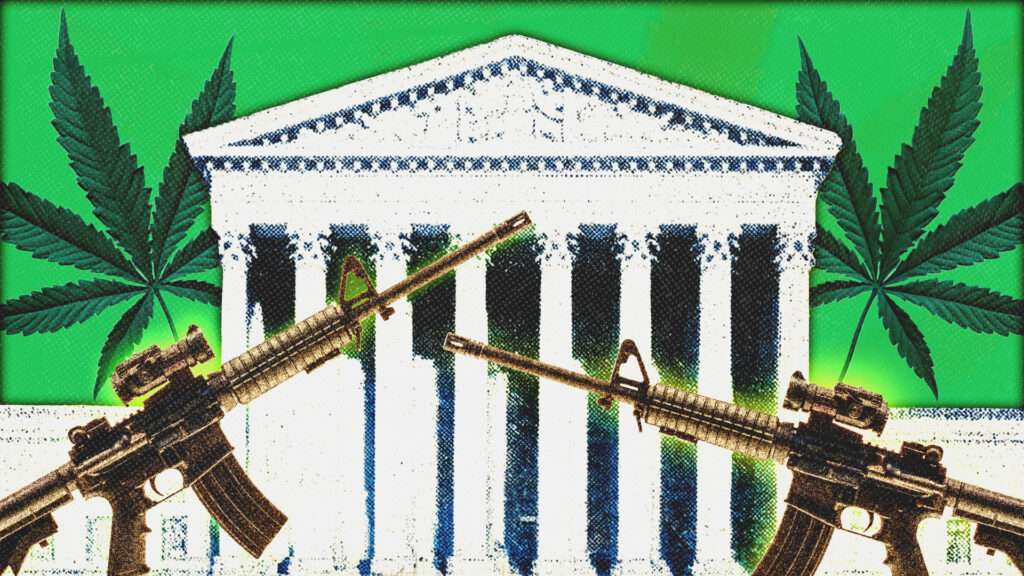
Having safeguarded the Second Amendment rights of individuals who use drugs and of those who hold carry permits, the Supreme Court is now positioned to scrutinize the legality of prohibitions on “assault weapons.”
During a 12‑day stretch last month, the Supreme Court affirmed the gun rights of cannabis users, rejected Hawaii’s default rule barring firearms on private property accessible to the public, and agreed to assess the constitutionality of bans on “assault weapons.” This flurry of Second Amendment activity highlights the idea that what are portrayed as sensible gun regulations do not always align with the right to keep and bear arms as it has historically been understood.
When Congress enacted the Gun Control Act in 1968, lawmakers assumed that an “unlawful user” of marijuana, depressants, stimulants, or narcotics should be barred from owning a handgun. They reaffirmed that stance in 1986, updating the language to include unlawful users of “any controlled substance.”
Although the latter statute bore the label Firearms Owners’ Protection Act, it evidently did not shield gun owners who favor politically unpopular intoxicants, or even those who used medications prescribed for others. It treated all such individuals as felons.
That policy, the Court unanimously ruled on June 18, is unconstitutional unless there is evidence that a particular drug user’s possession of a firearm would pose a danger to themselves or others. It rejected the Trump administration’s attempt to prosecute a Texas cannabis user who owned a pistol, holding that the government may not strip people of their Second Amendment rights simply because they use marijuana.
The justices reached that conclusion by appealing to “this Nation’s historical tradition of firearm regulation”—the lodestar of the Court’s Second Amendment jurisprudence. Applying the same test a week later, six justices concluded Hawaii had violated the Second Amendment by making it illegal for carry‑permit holders to bring guns into a private business without the owner’s explicit permission.
As Hawaii framed the matter, that presumptive gun ban appeared to merely safeguard existing property rights. Yet, as Justice Samuel Alito noted in the majority opinion, Hawaii’s law “departs sharply from the standard common‑law rule on access to private property held open to the public.”
Under that rule, everyone, including those lawfully carrying firearms, may enter unless expressly prohibited from doing so; by contrast, under Hawaii’s new law, no one carrying a firearm may enter without the property owner’s explicit authorization.
That shift, Alito observed, imposed “severe restrictions on the daily activities” of residents with carry permits. Nor was the effect incidental, since Hawaii was attempting an end run around the Supreme Court’s 2022 decision recognizing a constitutional right to carry handguns in public for self‑defense.
Five days after it overturned Hawaii’s law, the Court agreed to hear a pair of cases involving bans on widely owned rifles that politicians describe in a tendentious way as “assault weapons.” A dozen states, beginning with California in 1989, have enacted such laws, which hinge on arbitrarily prohibited features such as folding stocks, pistol grips, and barrel shrouds.
The rifles targeted by these laws are rarely used by criminals but are commonly used by law‑abiding Americans, who own more than 30 million of them. The latter point is constitutionally relevant because the Supreme Court has stated that the Second Amendment applies to “bearable arms” that are “in common use” for “lawful purposes like self‑defense.”
The long‑standing question posed by these cases is whether the Second Amendment guarantees “the right to possess AR‑15 platform and similar semiautomatic rifles.” If so, other restrictions on the firearms Americans may buy, such as magazine limits and California’s handgun specifications, might be vulnerable to constitutional challenges.
The decided cases also carry potentially broad implications. If drug use, by itself, does not justify disarming someone, what about a nonviolent felony conviction? And if Hawaii’s expansive ban on public gun possession was unconstitutional, the sweeping, location‑specific bans imposed by states such as California and New York likewise appear legally questionable.
Nearly two decades after recognizing a constitutional right to arms, the Supreme Court is beginning to address lingering questions about its contours. Politically zealous proponents of gun control may not relish the answers.
© Copyright 2026 by Creators Syndicate Inc.
