
“And when you arrived on our land, you offered your talents and energies to intensify the cultivation of the fields, to increase factory production, to brighten the clarity of the classrooms, to build and honor your homes and to, together with us, make the Mexican nation greater.”
Thus spoke the Mexican President Lázaro Cárdenas about the Spaniards who, fleeing the Civil War, arrived in a Mexico that welcomed the Republican government in exile.
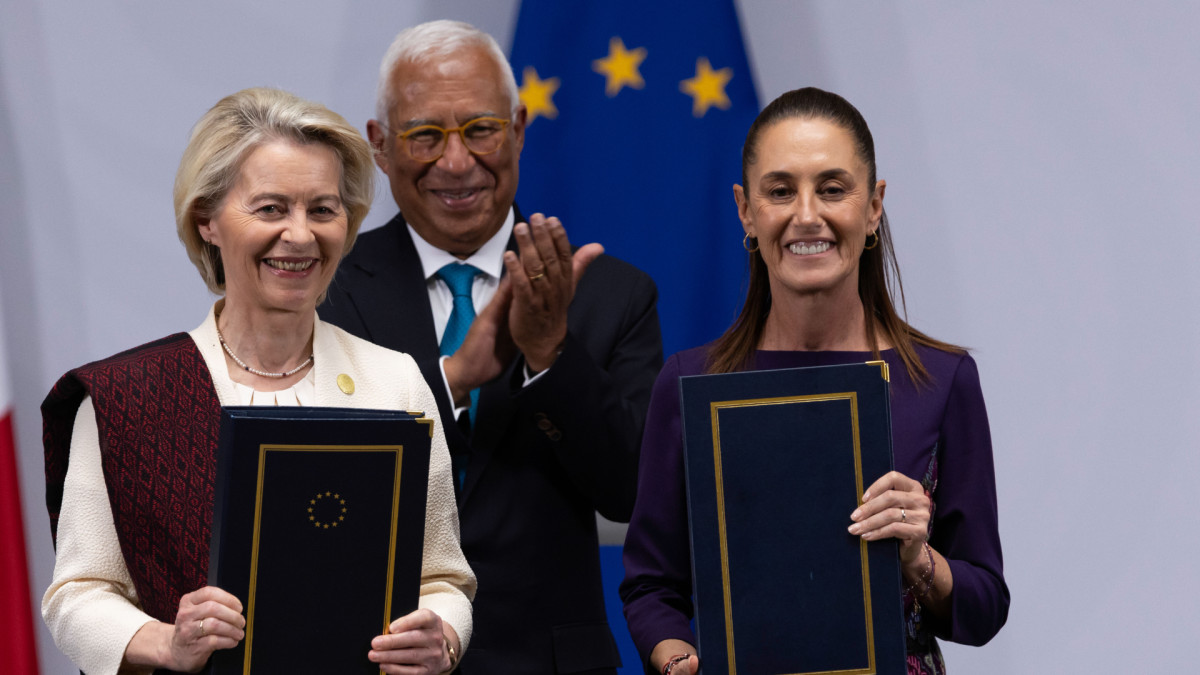
Almost a century later, the depth of our bond feels evident with greater force than ever, as the European Parliament gives the green light to the so-called Modernized Global Agreement between the European Union and Mexico. An instrument that redefines the encounter of two allies with deep political and economic ties that, seated on equal terms, seek to give a decisive boost to their relationship.
“The Modernized Global Agreement between the European Union and Mexico is an instrument that redefines the encounter between two allies with deep political and economic ties”
The approval of the agreement, negotiated over almost a decade, is no small event. After its signing during the bilateral summit held in Mexico City last May, what we are now sealing goes beyond the mere revision of a political and commercial accord: it is the recognition of the need to cooperate to the fullest with strategic allies who share our vision of the world.
The ambition to boost our commercial ties
From a global perspective, Mexico has consolidated itself as a central player in the value chains of a large number of productive sectors and as a key trading partner for the EU in the region, with European investment in Mexico exceeding €207 billion in 2024.
Thus, it is essential that the agreement eliminates barriers to trade in almost every area —90% of current tariffs disappear— and that it updates the investment protection mechanisms, bolstering certainty for both European and Mexican operators. Key elements that will facilitate the operations of the more than 45,000 European companies that export to Mexico, most of them SMEs that will benefit especially from the harmonization of regulatory standards.
Alongside this, the agreement opens public procurement in 14 of the 32 Mexican states, ensuring that for the first time in history European companies can access state funding in the country. The new framework also protects 568 European geographical indications, such as Rioja or Manchego cheese, reinforcing protection and giving solid guarantees to our producers.
The Spanish industry is one of the main beneficiaries of this agreement. Mexico is the first Latin American destination for Spanish goods and services exports and more than 5,600 Spanish companies have a base in the country, with a strong presence in the agri-food sector, where Spain accounts for 37% of all European exports to Mexico.
“Mexico is the first Latin American destination for Spanish exports of goods and services, and more than 5,600 Spanish companies have a base in the country”
The agreement arrives at a moment when Spain and Mexico seek to strengthen their bilateral relationship, especially after the visit of the Mexican president, Claudia Sheinbaum, to the leadership summit In Defense of Democracy, held last April in Barcelona at the invitation of the head of the Government, Pedro Sánchez. It was no casual trip, but the first visit by a Mexican president to Spain in eight years.
This gesture has been followed by the trip of King Felipe VI, as well as visits by various members of the Spanish government to Mexico. With these encounters, the Government has set a clear direction for the future of our bilateral economic relationship: Spain aims to double bilateral trade with Mexico by 2030.
But beyond the strictly technical aspects, the signing of the EU-Mexico agreement speaks to a foreign and commercial policy that must go beyond transactional. Perhaps the best example is the legally binding obligations included in environmental, labor, and social protection. Through these elements, in addition to upholding the Paris Agreement objectives, the agreement pushes Mexico to ratify key conventions of the International Labour Organization.
This means to shield greater protections for workers, but it also demonstrates the importance of —even when it is not easy— that the EU continues to push for turning trade negotiations into a tool to promote decent work, rejecting the race to the bottom that dominated decades-old free-trade agreements. The Brussels effect, at its best.
“It is important that the EU continue to bet on making trade negotiations a tool to promote decent work”
Because the adoption of an agreement is not only its legal framework, but the opportunities it brings. A good reflection of this is the launch of a joint investment package under the Global Gateway initiative —the EU’s external investment program— for projects in renewable energy, sustainable mobility, or biosanitary research. It amounts to €5 billion to drive the development of high value-added sectors, guided by sustainable development criteria.
The MEP Hana Jalloul in the European Parliament plenary session on political and economic cooperation with Mexico. Photo: European Parliament
A Europe that accelerates the diversification of its trade alliances
The scope of the agreement now ratified by the Parliament goes beyond the business opportunities that will arise for companies on both sides of the Atlantic. Its adoption comes at a time when the EU understands that its strategic autonomy depends on pressing ahead vigorously to seal new deals (or reinforce existing ones) with partners such as South Africa, Australia, or India.
Because Europe and Mexico share something fundamental in times of rising protectionism. In addition to having a firm commitment to international law, both actors have vigorously defended the need for a reform of the World Trade Organization, as a further necessary step in resisting unilateralism.
For Europe, the agreement is not an isolated tool to boost exports to a specific partner, but a reinforcement of our global ties with Latin America; a region where — despite exceptions — there remains broad support for a rule-based global trade system and where, together with Mexico, our trade relationship with Mercosur will also be essential.
The tariffs during the Trump administration or the rise of export controls give our bond with Mexico a significance far greater than a decade ago, when negotiations for the agreement began: what was once the modernization of a trade text is today a strategic imperative for our economic security.
“What used to be the modernization of a trade text is now a strategic imperative for our economic security”
In other words, the Europe–Mexico partnership is a key—indeed, a substantial—chapter in the essential path the EU must take to diversify our network of trade partners and reduce strategic dependencies. Access to strategic raw materials for the European industry, where Mexico is one of the main exporters of minerals such as fluorspar, copper, or zinc, is a central area in this discussion; and a cross-cutting topic in the debates on our economic security in which I have the honor of representing the European Socialists in the European Parliament’s International Trade Committee.
For small European companies exporting to Mexico, for Mexican workers whose labor protections are now tied to this agreement, for women and Indigenous communities, and for European energy companies, this agreement must be tangible and yield real consequences.
This has been my priority as a negotiator for the European Socialist group on trade relations with Mexico: to ensure that the European Parliament makes it clear to the Commission and to the Member States that this new framework cannot stay merely words.
“Europe must correct course as soon as possible to make clear that provisions related to respect for sustainable development are non-negotiable”
Now, after the Parliament’s approval, it will be essential to ensure that its implementation contributes to these objectives, a task that will require the voice of civil society. If not, Europe must correct course promptly to make clear that the provisions related to respect for sustainable development are non-negotiable. In that effort, the European Socialists (and particularly the Spaniards) will be a firm bulwark.
With the ratification of the Modernized Global Agreement, the Parliament sends a clear message, which goes beyond the economic and the bilateral relationship itself: strategic autonomy, but also the Union’s influence on the global stage, now depends more than ever on alliances with all those who understand that the multilateral system is not an option, but a necessity.
A reality that many, on the global and Spanish right, seem unable to grasp.
