
The ruling reprimands the DOJ for demanding “private and sensitive” details about Georgia election workers without a legitimate law-enforcement aim
On Tuesday, a federal judge in Georgia nullified a grand jury subpoena aimed at testing President Donald Trump’s counterfactual assertion that widespread fraud deprived him of a rightful win in the 2020 election. U.S. District Judge William M. Ray II, a Trump appointee, highlighted the scope of the subpoena as “staggering,” as it sought “private and sensitive” information about thousands of Fulton County employees and volunteers who helped with collecting, processing, counting, or recounting ballots that year. He found that such a demand could not be justified by any valid prosecutorial need because the statutory window for charging crimes tied to the 2020 election had already closed more than half a year earlier.
Ray’s ruling stands out for several reasons. First, its necessity stems from Trump’s continued embrace of a stolen-election narrative that the courts rejected nearly six years ago. Second, while the Department of Justice (DOJ) appears eager to pursue the president’s personal vendettas, it frequently demonstrates lapses, as shown by its failure to heed the statute of limitations in this case. Third, federal judges rarely overturn grand jury subpoenas, so this rebuke from a judge nominated by Trump signals a strong critique of the DOJ’s handling.
“The Court agrees with Fulton County that, in pursuing the Subpoena, the DOJ is engaged in an ‘arbitrary fishing expedition,’ such that the Subpoena is unreasonable and must be quashed,” Ray wrote. “The statute of limitations for any possible crime arising from the 2020 Election has long expired.” Although grand juries collaborate with federal prosecutors to “investigate alleged criminal actions,” he added, “that does not grant the DOJ the right to use the Grand Jury to do whatever the DOJ wishes.”
The subpoena, which Fulton County received on April 20, demanded the names, job titles, residential and email addresses, and personal phone numbers of individuals who directly or indirectly assisted Fulton County with the 2020 election. The list encompassed people “assigned to review Mail-In Ballots,” “assigned to the Voter Review Panel/Board,” “assigned to Mobile Voting Locations,” or “assigned to transfer results to or from media or to transport ballots, ballot stock, or media.” It also included personnel “employed or contracted by the Fulton County Board of Registration and Elections,” those who “worked or volunteered on Election Day” and were tasked with reviewing or tallying ballots, individuals who participated in the Risk Limiting Audit, contributors to the Recount, and individuals who served as precinct managers or assistant managers.
What was the DOJ aiming to achieve with that data? “It contends that it is pursuing legitimate law-enforcement purposes,” notes Ray, who rejects that claim. “A counterpoint is the long-standing view of the current President of the United States, both prior to and following his 2024 General Election win, that he lost in 2020 due to election fraud.”
In particular, Trump “has alleged fraud in states he won in 2016 but lost in 2020, including Georgia,” Ray writes. “There were allegations, both at the time and since, that the genesis of his defeat in Georgia stemmed from supposed fraud by election officials and others in Fulton County, which delivered the final margin of votes in Georgia that decided the 2020 Election. Therefore, it seems plausible to consider that the DOJ, now firmly under the present President’s control, is seeking to identify people who might possess information or views supporting his claim that the 2020 Election was not legitimate.”
Ray stops short of judging the truth of that claim. Yet he emphasizes that the DOJ faces a formidable barrier in trying to prosecute anyone allegedly involved in the scenario Trump imagines.
“The 2020 Election took place on November 3, 2020,” Ray notes. “Audits and recounts occurred in the following two to three weeks. The electors of each state cast their votes on December 14, 2020. And Congress met to tally the certified Electoral College votes on January 6, 2021.” He points out that the congressional count “was not completed until January 7, 2021,” a reference to the Capitol riot in which Trump’s supporters seized upon his grievance.
Why is this relevant? Because, Ray explains, “the five-year statute of limitations on any alleged crime tied to the 2020 Election expired, at the latest, on Wednesday, January 7, 2026.” In other words, “an investigation into potential criminal conduct by anyone who may have contributed to the certification of the 2020 Election in Georgia would not be a legitimate use of the Grand Jury and its subpoena authority, since no valid indictment could issue from that Grand Jury after the expiration of the applicable statutes of limitations.”
If the DOJ had “acted quickly to obtain this information after the current President resumed office on January 20, 2024, and within the relevant limitations period,” Ray adds in a footnote, “the Court’s analysis [could have been] different.” To explain its delay, the DOJ argued that the subpoena could help uncover evidence that anti-Trump conspirators sought to cover up their alleged 2020 scheme within the past five years, in which case obstruction charges might still be possible.
Ray rejected that argument. “In the DOJ’s view, the prospect of criminal obstruction creates a timely offense,” he notes. But that claim is foreclosed by the Supreme Court’s 1957 ruling in Grunewald v. United States, which held that “acts of concealment undertaken after the core goals of a conspiracy have already been achieved do not, by themselves, extend the duration of the conspiracy for statute-of-limitations purposes.”
The DOJ had argued for essentially an unlimited extension of the statute of limitations, such that a court would be unable to quash a subpoena even if Grunewald suggested otherwise, provided the DOJ could point to possible obstruction-related evidence. Ray described that stance as unreasonable and asserted that the DOJ cannot evade the statute of limitations merely by proposing a theory about someone somewhere doing something illegal. He concluded that the DOJ’s approach would amount to asking the court to ignore nonspecific allegations that have no path to a conviction.
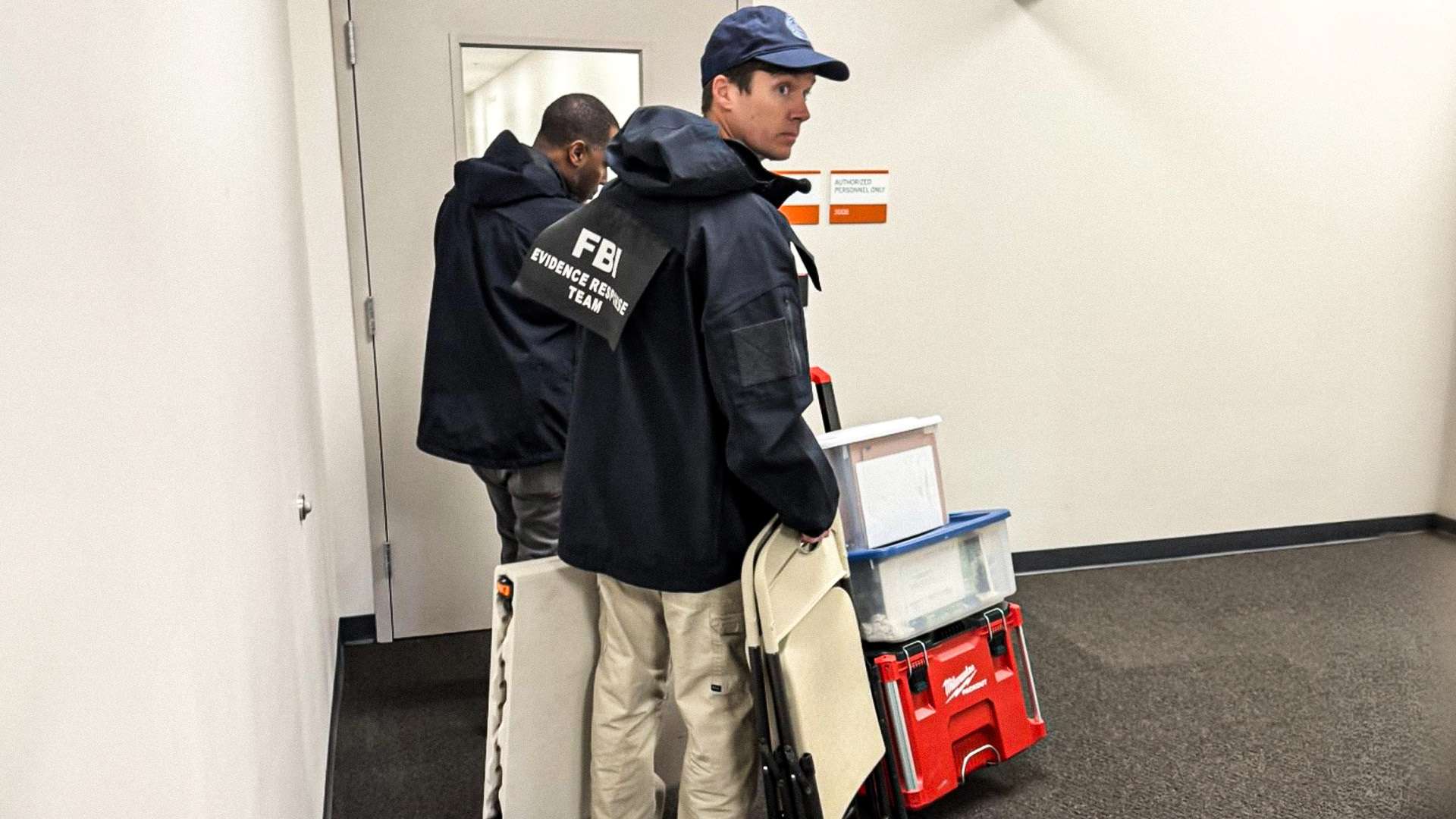
The DOJ also leaned on a January 28 warrant, approved by a federal magistrate, authorizing the FBI to seize more than 600 Fulton County election records. Fulton County had sought the return of those records, and U.S. District Judge J.P. Boulee had described the FBI raid as unprecedented, noting flaws in the warrant affidavit and troubling language, and identifying features of the case that were problematic. Boulee nevertheless ruled that Fulton County had not shown that the government had “callously disregarded” its rights, a finding the DOJ thought supported the subpoena. Ray disagrees, stating that nothing in Boulee’s order convinces this Court that the DOJ had a compelling need for the private information of election workers—distinct from the ballots seized by the FBI.
Ray acknowledges that his decision will likely frustrate supporters of the president. “In these highly partisan times we live in, there will surely be those who oppose this ruling because they accept the fraud allegations surrounding the 2020 Election and want those claims brought to light,” he remarks.
Ray notes that nothing prevents continued inquiry by those who endorse such claims—Congress, and perhaps the DOJ itself—from pursuing them further. But he adds that the Grand Jury’s authority, which exists to investigate potential crimes and to return indictments when warranted, cannot be weaponized to conduct such inquiries.
Otherwise, the judge warns, “anyone in power” could, in future administrations of a different party, use the Grand Jury process to subpoena the private information of ordinary citizens—potentially those who oppose them—without a legitimate law-enforcement objective. He stresses that the data sought in this case (names, addresses, phone numbers, emails) are highly private and sensitive; a private company that failed to shield such data from digital thieves could face a data-breach class-action lawsuit.
In short, even those who support the President—or who doubt the fairness of the 2020 election—should be concerned about whether the DOJ can wield the Grand Jury to seize private information without a solid prosecutorial purpose.
