
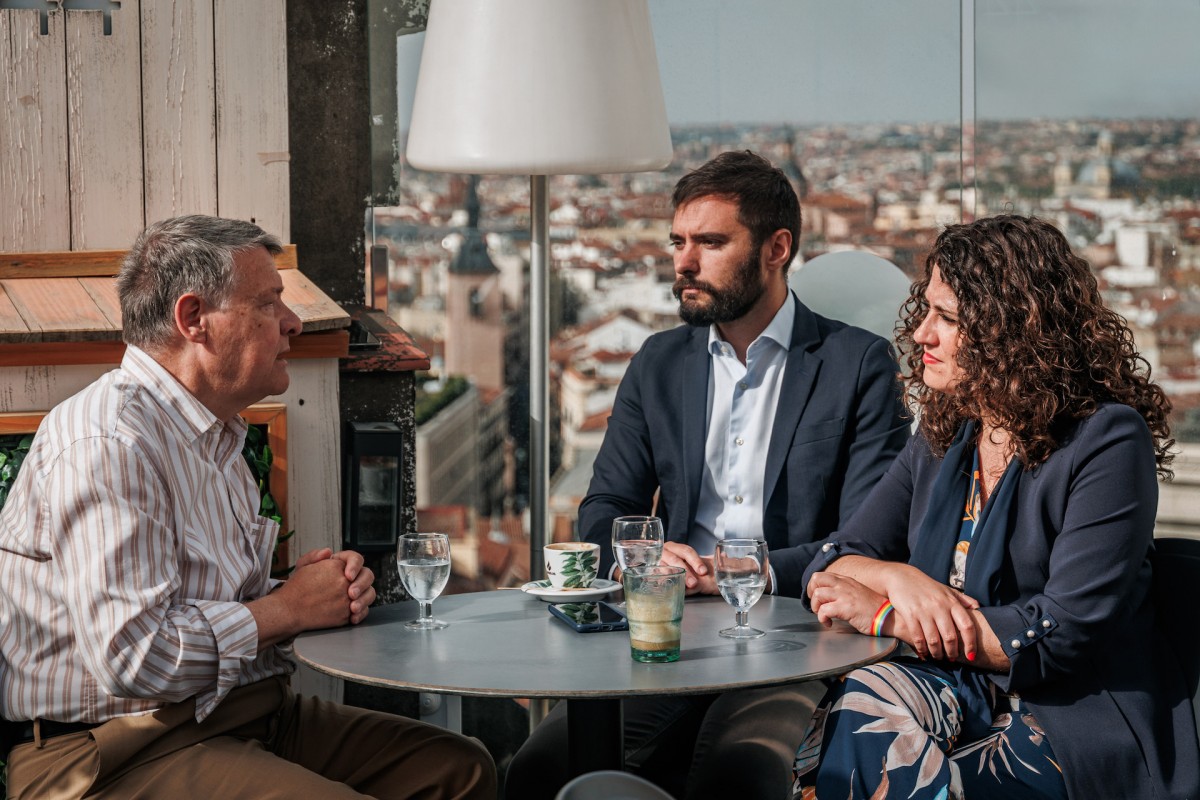
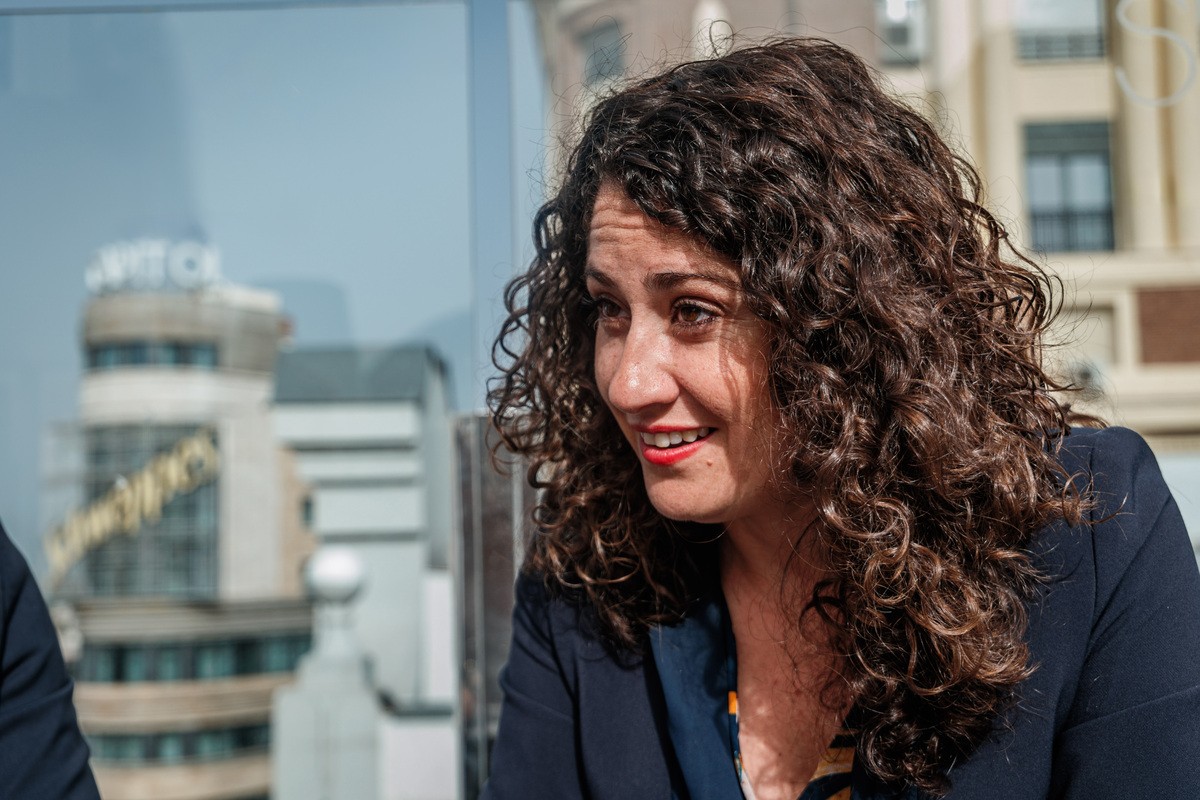
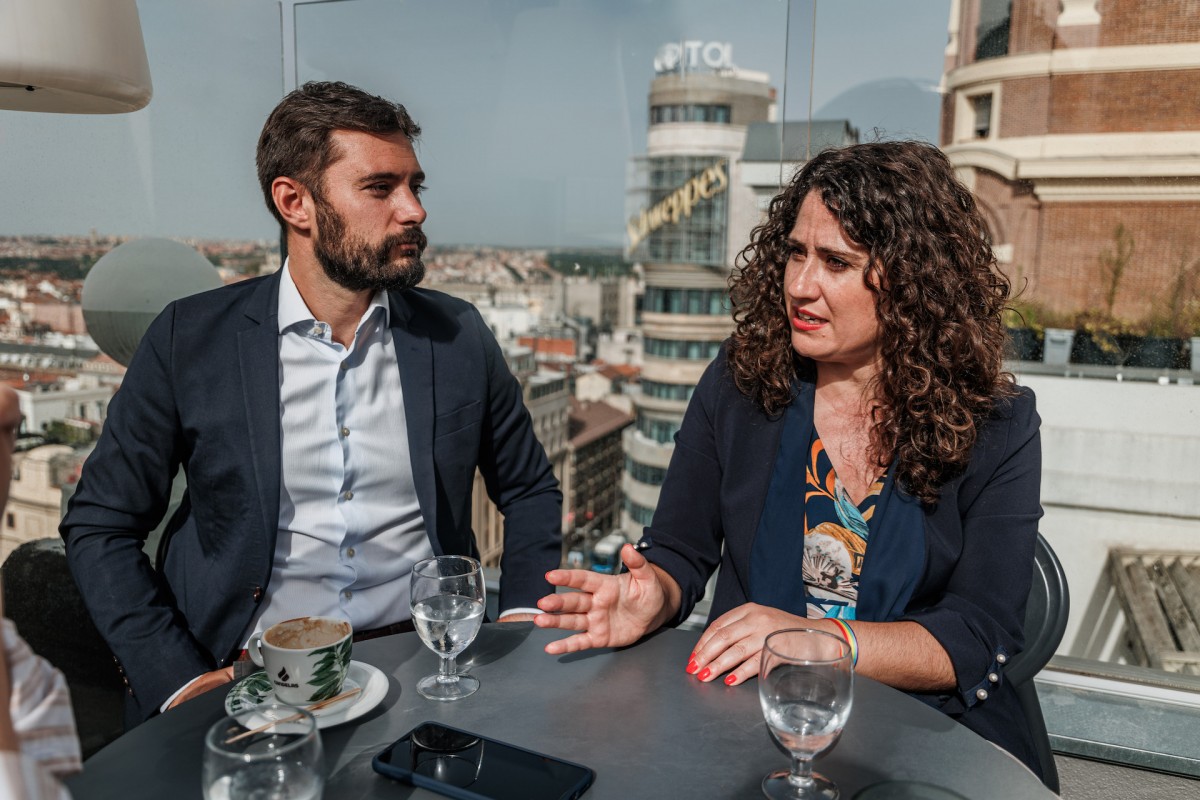
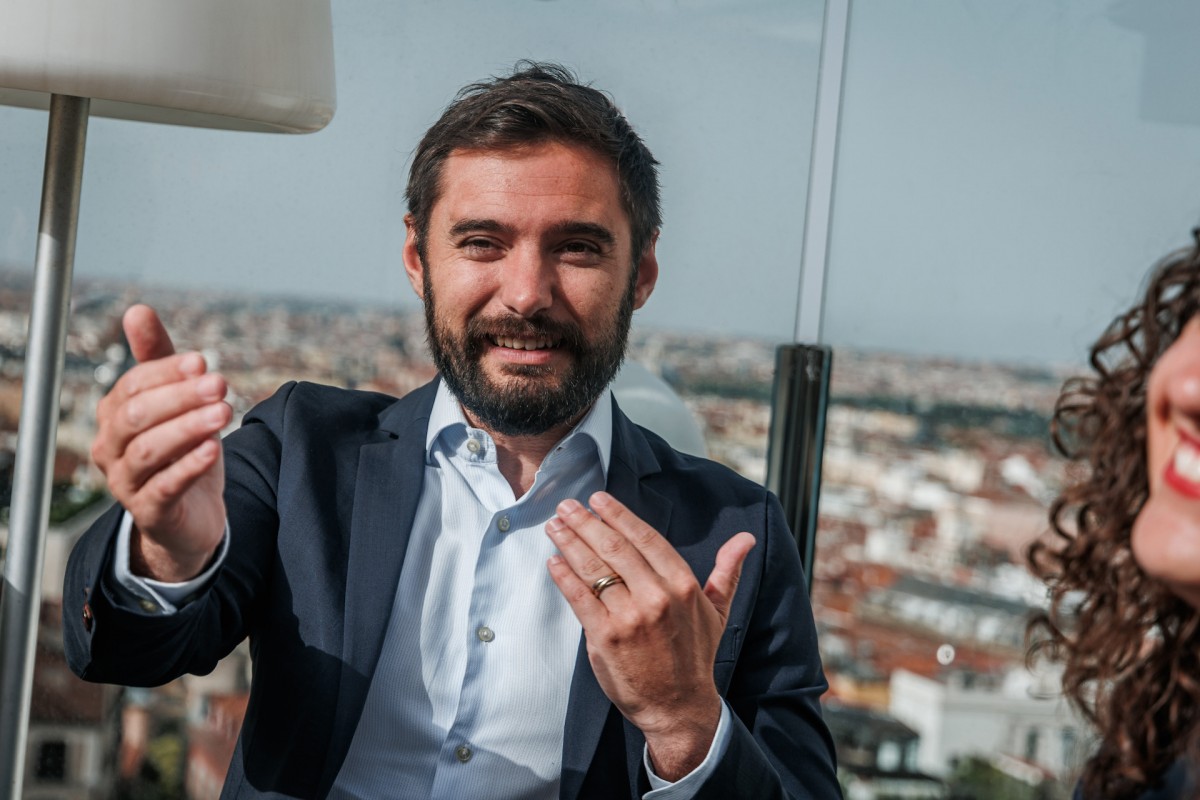
The two protagonists of our conversation today are state officials and are representatives, on one side, of the Spanish Socialist Workers’ Party (PSOE) and, on the other, of the People’s Party (PP). Enma López (Vigo, 1986) and Nacho Catalá (Madrid, 1988) meet with Agenda Pública and discuss with our adviser Jordi Sevilla, who as Minister of Public Administrations (2004-2007) championed some of the main rules and milestones in the field of public service, exploring the underlying dynamics of Spanish politics and administration from the perspective of two democratically-born politicians who participate with enthusiasm, and with respect for one another, in the two major parties. López and Catalá point to the need for Spanish politics to evolve in its dynamics: “I don’t want to sell more crap, I want to return to boring politics, I’m involved in boring politics”, she says. “Blessed bipartisanship! How well this country did for 43 years with bipartisanship”, he concludes.
López is currently a councillor in the opposition at the Madrid City Council, in addition to being a member of the Technical Treasury Corps and the State Insurance Inspectors Corps, after having served as an adviser in the cabinets of Presidents José Luis Rodríguez Zapatero and Pedro Sánchez. Catalá, who was an adviser at the Ministry of Public Administrations under Mariano Rajoy’s Government, is today a deputy from the majority that supports the Madrid Regional Government and a civil administrator of the State. Senior officials.They pursue politics because they want to, but, probably also, because they can. “In the end only civil servants can stay in politics. And the rich,” they note in an explicit critique of the political climate and the personal costs associated with the tasks of representation.
Agenda Pública wants to contribute with this conversation, once again, to make exception the norm by giving space for people who think differently to converse, share diagnoses, disagree respectfully on a common playing field, and make visible agreements and dissents with the public at large, assuming they are addressing citizens who deserve respect in the considerations they share with them. Far from the mud, without noise and with a vocation of public service that challenges both politicians or civil servants and also challenges us media outlets.
The two of you are officials and, aside from being elite bodies, you are currently holding elected public positions. Why did you leave your civil service careers and say: “I want to devote myself to politics”? Is there something you can do as a politician that you couldn’t do as a civil servant? Or did you view it as a shortcut to advance your career through politics?
Enma López (E. L.): They are tasks that share a common denominator — public service — and this service can be carried out from both the civil service and political spheres. For me, public service is the common foundation of everything. I entered politics before I joined the civil service. I joined the Socialist Youth at 16. But an essential factor for pursuing professional politics is having a place to return to, that freedom to say no at times because your life does not depend on politics.
“For those who want to improve reality a little, politics is the best path”
It’s true that in politics you can accomplish things. After all, laws are crafted by those who draft them and rules are decided by those who decide. Civil servants implement them. But for those of us who hold a modest ambition to nudge reality a bit and make things better, politics is the best route.
Nacho Catalá (N. C.): Politics is the space where things are transformed. Politics and being a civil servant are two sides of the same coin: public service. I want to dedicate myself to working for the community, and politics is the greatest commitment there is, even though it can sometimes be a thankless one.
In my particular case, I understood that they were two faces of the same coin and that perhaps from politics you can go a step further to change things. In the end, civil servants owe their allegiance to the legitimacy of a Government that has a concrete political program and has every right to implement it. Civil servants, senior civil servants, translate political programs into public policies. By contrast, if you are in politics, you can take the next step: “Hey, I also want to propose a concrete program so that it becomes concrete policies.”
It’s true that while your party governs—and you know this well—it is possible to reach positions like sub-secretary, but it’s also true—and this is less talked about and somewhat unfair—that you then have to return to the ministries. When your party is no longer in power, you have to rejoin. And I have known cases of people who have rejoined and were not well received. It isn’t always an easy landing.
Why does this happen? Is the role of a civil servant and a politician so intertwined that you cannot be a good civil servant, apolitical in partisan terms, if you have held a public post for one party or another?
E. L.: Civil servants must be independent and work according to the law. But I also understand, because it’s human, that someone who reaches a public post needs to have a team they trust. I fully understand changes because you need someone aligned with your political vision. To go from there to prejudging the work of fellow civil servants for having held a public post… That’s a mistake because we are wasting a capital that is tremendously important.
And I’m not only talking about civil servants. I was an adviser in Zapatero’s cabinet in the final stretch, and I remember fellow advisers who were not civil servants and who were very valuable people who found it very hard to get work. They would reach the final interview stages and hear: “You have a very good profile, but right now we cannot risk having someone like you.” That is very hard to understand, even in the United States, for example.
The politician must make decisions listening to the opinion of a technician who can tell him: “Hey, what you want to do cannot be done or cannot be done this way.” Can a technician who has a clear political-partisan position influence his analysis according to his own ideas?
N. C.: It is impossible to think about politics without public service. They are two completely different elements.
“I envy when I see government changes in Italy, France or England, while the high civil service remains intact”
Where does one end and the other begin?
N. C.: The big dividing line is that each must know their place. The politician has a concrete program, elected at the polls, and is legitimized to carry it out, but to implement it and see how it can be materialized from a legal or budgetary point of view, one must rely on the technicians. I envy Italy, for example, where government changes are constant, or France or England, where the high civil service remains. On the one hand, because politics has understood that I cannot work without the high civil service. And high officials must understand that the government’s legitimacy comes from the citizens.
But we encounter politicians who distrust civil servants. There have been some ministries—like Podemos has shown—that exploded from within due to a complete lack of trust between senior officials and high civil servants. And there are also high officials who do not understand their role and clashes occur.
In places where public positions and senior officials understand their roles, everything works much better. Even in places like Italy, where politics is chaotic, the administration nonetheless progresses forward.
That means you think it would be more reasonable to pursue something that has long been pursued but never fully achieved in Spain: drawing a clear line between posts intended for public servants — whose requirement is merit or ability, plus performance evaluation — and political posts which can, in addition, be held by civil servants, doctors or dancers.
E. L.: The line is very fuzzy. In the end, what is an under-secretary? An under-secretary is a political post, clearly a high public function post, but he or she remains someone who directly implements policies. And it also depends on the size of the ministry we are talking about. If it is a very large ministry with a big structure, many Secretaries of State and general secretaries, a deputy director is much further down. But in smaller ministries, like Public Administration or Equality, a deputy director sits close to the core of power. That makes drawing the line a bit harder.
N. C.: We’re talking about that difficult line that we’ve been discussing since 1984. It has a strong cultural and administrative component. I don’t think the answer is a law that strictly defines which positions are high posts and which are high officials.
E. L.: We should not fall into reglamentarism. I agree it’s more a matter of culture and philosophy — how we understand and how we respect the high official and, in turn, how the high official respects the political leadership.
N. C.: Ultimately, regulation will always have a loophole. Any rule can be justified to explain why it shouldn’t be this way. Every norm has its exception. Now, in the Government we have, there are conceptualizations of general directors like never seen before. If you’re not convinced that you are a manager, that you are a general director and you may get along very well or very poorly with your minister, but you are there to execute the State’s administrative policy…
Of course, but if that minister doesn’t understand it that way, they can dismiss you and appoint someone else. What we are facilitating, through facts, is an excessive partisan politicization of the civil service, which in principle is a public service as well. That is, it has different rules: to be a civil servant you can measure merit and ability, but not ideology.
N. C.: There you have, again, the element of political culture. If you’re appointed minister of whatever and you know you’ll have a top-tier technical team, regardless of what they think; you know they will carry out your political agenda and turn it into administrative actions.
There’s a need to change the image we have of civil servants outside. It’s very different when the minister is a civil servant and when he isn’t. Let’s not fool ourselves: there is distrust toward public servants. There’s a bit of corporatism and a portion of prejudice. But I understand that someone from outside arrives with that baggage of prejudices and, on first reaction, wants to trust people.
“The image of the civil servant painted by Forges doesn’t resemble reality”
There needs to be a pedagogical effort. The image we have of the civil servant portrayed by Forges doesn’t reflect reality. There are outstanding public servants, highly devoted people who have served many different governments for many years, doing fantastic work, and when they say no to a politician, they do so not to obstruct the implementation of the political program but because it truly isn’t a good idea, because the law doesn’t permit it, or it would cause problems, and they are trying to protect you as well.
Also in ministries I’ve found people saying: “The law doesn’t allow it.” And I would always add: “Well, if we need to change the law, then change the law. Tell me how to change the law.” But, in any case, do you think it is necessary to professionalize public leadership?
N. C.: More than a cataloguing of posts, what is needed is a statute for senior civil servants, for the managerial function.
So that the managerial function is chosen on criteria like civil servants (merit, capacity, effort, etc.) and not so much by whether they belong to this or that party.
N. C.: And that it be prestigious. Now you can appoint a deputy director or general director without truly having undergone top-management training. To be a manager at Telefónica or any major company in this country, you must have training, know-how, and the competencies to lead projects, manage risk, and lead teams. In the Administration, not so much.
E. L.: Well, the Council of Ministers does review résumés before appointments. I want to trust that they do. I want to trust that the decision-makers carry out those analyses.
“There have been outstanding ministers without a career and dreadful ministers with doctorates”
On the other hand, I don’t think it’s essential to require an MBA for everyone who seeks a post. As a technocrat, I worry about excessive technocracy because, at the end of the day, we can detach ourselves from society. Is it necessary to have a career to be a minister? There have been outstanding ministers without a career and dreadful minister- doctors.
N. C.: We have a great school for public formation, the National Institute of Public Administration (INAP), although it could still serve more of its potential. It houses excellent teachers and there is time to develop those programs. Rather than succumbing to technocracy, it’s about transmitting knowledge and ongoing competencies to those who will manage the most complex issues.
Therefore, we might agree on two things: first, it would be positive to professionalize public leadership in a more standardized way, and second, we should commit to requiring certain training for ascents within the Administration as one of the prerequisites to access these roles.
E. L.: Managerial training should be part of the training catalog that civil servants receive because, as far as I know, five years ago that didn’t exist. There were more Excel courses than training on how to work with teams.
But that, Emma, opens a gap. If that is done, and I am in favor of it, it reduces the possibilities for politicians to reshuffle certain positions.
E. L.: You’re giving a range of people with that qualification to choose from.
N. C.: Indeed, and in the end it would be a matter of rights and obligations. We are expanding the rights of the high public function in the pursuit of greater continuity and professionalism. That is the right we recognize for the high public function. The Government that arrives has a catalog of men and women with excellent training, knowledge and competencies, among whom it can choose and who also constrain him as a political decision-maker.
This has the drawback that the civil servant who aspires to an senior post knows that, in addition to completing the training and meeting the requirements, they need an extra: to be closer to one party or another. What I’m saying is that it is essential to have trusted positions and others where it is the politician’s turn to appoint people who are there, professionals who have worked with the previous minister, who will work with the next minister and who will work with you.
N. C.: The Secretary General of the Presidency of the French Republic has held his post for 16 years.
E. L.: In the Directorate General of Insurance, which is a place I know well, the deputy directors have held their positions for a long time, and they have just named as Director General of Insurance someone who was a deputy director. It’s a leadership team that existed since the Rajoy era and has remained through Pedro Sánchez’s tenure. Antonio García de Pinto, the current director general, is a strictly professional person, a highly capable individual, and without partisan affiliation.
“With such an unstable politics, public service must be stable”
Therefore, establishing clearer lines of where political decisions end and merit-based decisions begin could help clarify the landscape and bring some stability.
N. C.: The current political reality is very, very unstable. There are caretaker governments for long periods, frequent changes, motions of no confidence… Perhaps in a Spain with eight-year terms for governments we could tolerate a more unstable public service. If politics remains as unstable as it is now, and we want to deliver good service to citizens, the public service must be stable.
Otherwise, we’ll revert to the 19th century, to sinecures. Each time the minister changed, everyone changed. The entire development of the public service from the 19th century to today has been precisely to avoid that.
N. C.: Factual reality has shown that continuity of teams is beneficial.
We’ve discussed the value of training public employees and of senior management in a dual sense. First, they must pass an examination. Second, it’s advisable that they take ongoing training courses etc. Would it be reasonable to require political office-holders to also undergo some training? I don’t think so.
E. L.: Once you’re in office, training always helps, and above all receiving keys: management keys, contract law keys…
Or simply knowing how to manage a team. You need to know how to manage teams; you don’t need to memorize the law, but you do need to manage people.
But again, you’re named by a Prime Minister and it will have been considered because your management affects their governance. In that bond we are connected, and our fate is shared. You must try to select the best profiles.
Recapping. First, there must be training. Second, there must be ongoing training and specialization for executive teams. Third, although that cannot be extended to purely political posts, it would be desirable for those posts to have some kind of experience.
N. C.: That they are good people who do not shout at their teams, for instance. And that they understand their team has to work with a balance, including weekends.
Do you not think that political conduct could be regulated through codes? For example, could the wife of the Prime Minister contract or not with public companies? I think it’s legal, but maybe there should be a code of conduct. Perhaps there could be a code of conduct stating that a minister cannot shout, cannot insult, cannot mistreat… Do you think that’s reasonable?
N. C.: I don’t know if an ethical code would prevent mistreatment of your team..
E. L.: There is the Penal Code.

“And yes, but ethical codes are for what the Penal Code does not cover. I made the Government’s good-governance rule, for example, regarding gifts. I’ve been a civil servant and have received gifts that I later prohibited when I was minister. It was an internal code because the Penal Code said nothing. The key of those codes is that there is an independent body that truly monitors compliance. Would an independent body help ease tensions and reassure public opinion about how politicians manage affairs?
“I wish the public’s image of the civil servant who drew Forges’ cartoons matched reality.”
There needs to be a pedagogical effort. The image we have of the civil servant who drew Forges’ cartoons doesn’t reflect reality. There are outstanding public servants, people who are highly devoted and who have served many governments for many years, performing a fantastic job and who, when they say no to a politician, do so not to obstruct the implementation of their political program but because it truly isn’t a good idea, because the law does not permit it, or because it would cause problems and they are trying to protect you as well.
Also I have found that in many ministries you’re told: “The law does not permit it.” And I would always add: “Well, if we need to change the law, we change the law. Tell me how to change the law.” But, in any case, do you think it is necessary to professionalize public leadership?
N. C.: Rather than a catalog of posts, what is needed is a statute for high officials, the managerial function.
So that the managerial role is chosen on merit and capacity, not on party affiliation.
N. C.: And that it carries prestige. Now you can appoint a deputy director or a general director without truly having undergone high-management training. To be a manager at Telefónica or any major company in this country you need training, knowledge, competencies to lead projects, manage risk and lead teams. In the Administration, not so much.
E. L.: Well, the Council of Ministers does review the résumés before appointments. I want to trust that they do it. I want to trust that those who make those decisions perform those analyses.
“There have been outstanding ministers without a career and dreadful ministers with doctorates”
On the other hand, I also don’t think it’s essential to require an MBA for anyone who wants a political post. As a technocrat, I worry about excessive technocracy because, in the end, we can detach ourselves from society. Is it necessary to have a career to be a minister? There have been outstanding ministers without a career and dreadful ministers with doctorates.
N. C.: We have a great public training institution, the Instituto Nacional de Administración Pública (INAP), although it could be functioning more fully… Within it we can have excellent trainers and there is time to develop those programs. Rather than falling into technocracy, it is about conveying knowledge and ongoing competencies to those who will manage the more complex matters.
Therefore, we might agree on two things: first, it would be beneficial to professionalize public leadership in a more standardized manner, and second, we would have to commit to that ascending within the Administration requiring training courses as one of the prerequisites to access.
E. L.: Executive training should be part of the catalog of training that civil servants receive because, as far as I know, five years ago it did not exist. There were more Excel courses than courses on how to work with teams.
But that, Emma, opens a gap. If that is implemented, and I am in favor of it, it reduces the politician’s ability to reshuffle certain posts.
E. L.: You are offering a range of people with those credentials and you can choose from them.
N. C.: Yes, and in the end it would be a question of rights and obligations. We are expanding the rights of the high public function in search of greater continuity and professionalism. That is the right we recognize for the high public function. The Government that comes has a catalog of men and women with excellent training, knowledge, and competencies, among whom it can choose and who also constrain him as a political decision-maker.
Esto tiene el problema de que el funcionario que quiere ser nombrado alto cargo sabe que, además de hacer el curso de formación y de reunir los requisitos, necesita un plus: estar más próximo a un partido u otro. Lo que yo estoy diciendo es que es imprescindible que puedas tener puestos de confianza y otros en los que al político le toque asumir a las personas que estén allí, a profesionales que han trabajado con el ministro anterior, que trabajarán con el ministro posterior y que trabajarán contigo.
N. C.: El secretario general de la Presidencia de la República Francesa lleva 16 años en el cargo.
E. L.: En la Dirección General de Seguros, que es un lugar que conozco bien, los subdirectores llevan muchísimo tiempo y, de hecho, acaban de nombrar director general de Seguros a alguien que era subdirector. Es un equipo directivo que estaba en la etapa de Rajoy y que se ha mantenido en la etapa de Pedro Sánchez. Antonio García de Pinto, que es el actual director general, es una persona estrictamente profesional, un tipo muy válido, y sin afiliación política.
“Con una política tan inestable, la función pública tiene que ser estable”
Por tanto, establecer mejor esas líneas de “hasta aquí llega la decisión política y hasta aquí llega la decisión en función del mérito y la capacidad”, podría ayudar a clarificar un poco el panorama y tener estabilidad.
N. C.: The current political reality is extremely, extremely unstable. There are caretaker governments for long periods, changes, motions of censure… Perhaps in a Spain with eight-year governments we could allow a more unstable public service. If politics remains as unstable as it is now, and we want to deliver good service to citizens, the public service must be stable.
If not, we revert to our nineteenth century, to sinecures. Every time the minister changed, everyone changed. The entire development of the public service from the nineteenth century to today has been precisely to avoid that.
N. C.: Factual reality has shown that continuity of teams is good.
We’ve spoken about the value of training for civil servants and for senior leadership in a dual sense. First, they must pass an examination. Second, it’s advisable that they take training courses, refresher courses, etc. Would it be reasonable to require political office-holders to undergo some training as well? I think not.
E. L.: Once you’re in the post, training always helps and above all, receiving keys: management keys, contract-law keys…
You must know how to manage teams; you don’t need to know the entire law by heart, but you do need to know how to lead people.
But again, you are appointed by a Government and that will have considered it because your management influences their governance. In that bond we are linked and our fate is shared. You must try to select the best profiles.
Recap. First, there must be training. Second, there must be training and specialization for executive teams. Third, although that cannot be extended to political posts in particular, it would be advisable that they have some kind of experience.
N. C.: That they are good people who don’t yell at their teams, for example. And that they understand their team has to be able to reconcile, and that Saturdays and Sundays exist.
Do you not think that political conduct could be regulated via codes? For instance, should the wife of the Prime Minister be allowed to contract with public companies? I believe it’s legal, but perhaps there should be a code of conduct. Maybe there could be a conduct code stating that a minister cannot yell, cannot insult, cannot mistreat… Do you think that is reasonable?
N. C.: I don’t know if an ethical code would prevent mistreating your team..
E. L.: There is the Penal Code.
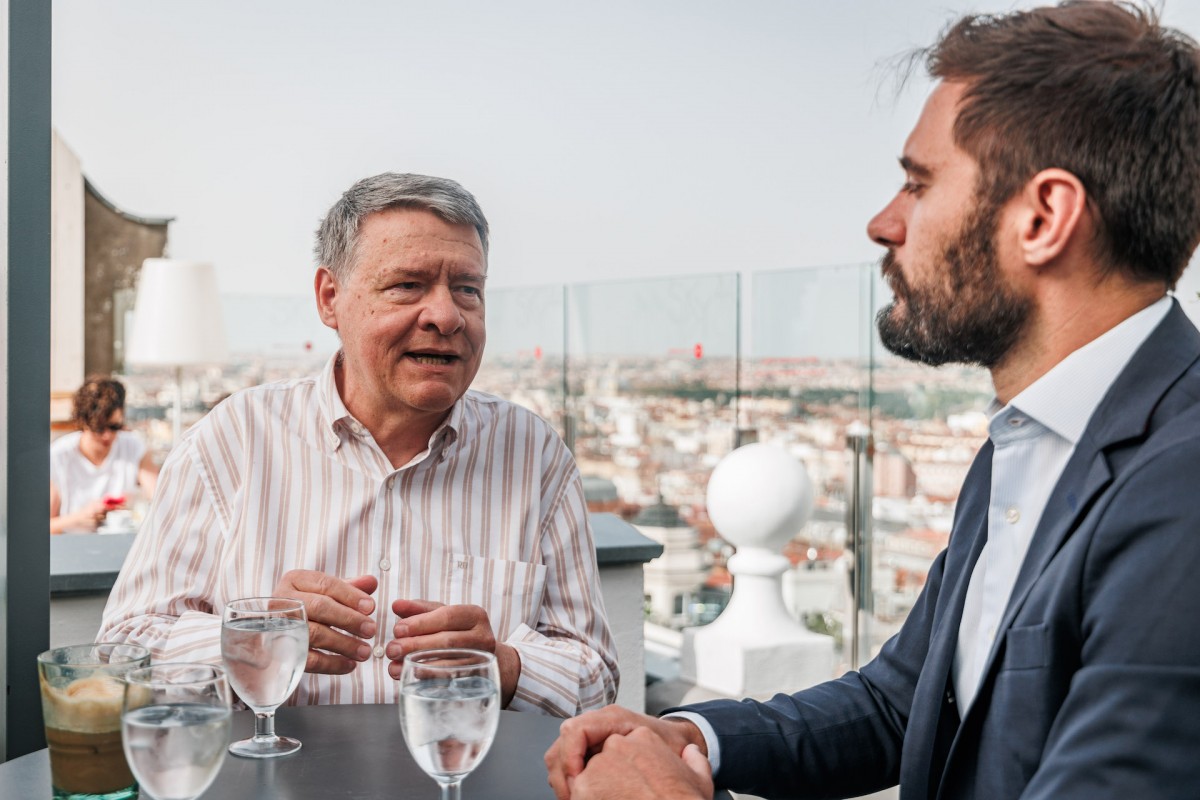
“But there are many good ideas that are blocked by the current uncertainty about how to regulate them.”
The text continues with an explicit discussion about the governance and the use of compliance frameworks. They touch on the role of ethical guidelines and the need for independent oversight to ensure that good governance is practiced, and they recognize the value of such bodies for the well-being of public servants who sustain the country’s political system. They emphasize that people who support and sustain public policy deserve proper support and recognition, and that their professional well-being benefits everyone.
N. C.: There should be an ethics committee for public life or good governance, always helpful.
E. L.: Compliance, just like in private companies.
Let’s talk, if you agree, about the so-called revolving doors. There has been a lot of demagoguery in recent years, though there have probably also been some too-lax interpretations of the rules. I’m someone who believes that if after six years you can be a lawyer, after six years as a senior official, as a deputy, you have learned something. Therefore, you have value beyond your connections and your calendar. How do you see the current regulation?
N. C.: Ultimately we can only be in politics the civil servants. And the rich.
E. L.: I couldn’t agree more.
N. C.: We have become overly fixated on eliminating conflicts. The result is that politics is losing outstanding profiles from the business sector in Spain, who do not want any of this. Not to mention people who have learned a great deal in politics, as you said earlier, and who then are not allowed to move into the sector they know: “You’ve spent six years as Secretary of State for Transport, but you can’t go to the transport sector.”
Enma López: “Focus on the pastries.”
N. C.: Exactly, but not in transport. “You may indeed run a bakery, but you cannot work in the transport sector.”
“How can we attract private-sector talent that offers a different perspective, which is essential, if there’s no day after?”
E. L.: There’s been a lot of demagoguery and a very unfair treatment. It feels as if everything we’ve done is for nothing, when that isn’t true, but it feeds the great discrediting of politics. How will we attract talent? How will we attract good people? How will we attract strong managers? How will we bring in private-sector professionals who offer a necessary new perspective, if there is no day after?
N. C.: What do you want to bring in? You pay them less. They will have a very tough life and then they won’t be able to return to their professional activity. And that, for love of the art. Of course. “Well, sir, I’ll keep my job at Telefónica and please don’t take it personally.”
N. C.: That leaves you with a situation where you can’t bring in talent from outside and you have to choose for political posts people who, being civil servants, have a guaranteed return.
N. C.: Or people from the parties. To hold a political post, you either build a career within a particular party and thus “one day I’m in, another day I’m out,” or you become a civil servant. And the rest, in the 90s, we lost.
Let’s move to another topic. I propose a formula. If there are great State-wide agreements that apply for eight years, I don’t mind if the Government changes. This would apply because we have agreed on it, regardless of who governs, and it would bring much more stability to the functioning and the involvement of public employees. But, of course, this seems impossible now. The deterioration of politics has reached personal insults and blocks agreements. And believe me, you used to be very tough with your opponent, but you never insulted them.
N. C.: I have lived both times: I’ve lived through the old and the new politics, and it’s an unsustainable change.
E. L.: It’s unsustainable, especially with the level of tension you’re under. We’ve faced a global pandemic, two wars at Europe’s doorstep, runaway inflation… The situation is already harsh enough without adding harassment, fake news, pseudo-media, stalking, and online hate. How much do all these tensions feed the polarization?
They feed off each other…
E. L.: And that is the public’s discredit of politics. It’s something that is clearly defined by a certain social class that has no interest in politics because power is one thing and government is another. Those who always hold the power often do not want us to have government. The more estranged people are from politics, the less interested they are in government. Probably that also reduces the caliber of people who run it. So, polarization is one of the faces of anti-politics.
N. C.: I disagree with Emma here, because I truly don’t think there is a power trying to suppress politics. The bitterness in politics mirrors the bitterness in society. They feed off one another. Do you remember the early celebrity shows that stopped being about love and started to mimic sensational journalism? It then moved to football shows…
Society itself is quite irritated, and that spills into politics. People are angry, far more agitated than fifteen years ago, and they want to see turmoil in politics. In politics, turmoil is generated because that is what people ask for. And the media know perfectly that the clickbait works with jokes, with insults, and that a lengthy editorial does not sell.
E. L.: To what extent are we not responsible? I don’t care if it sells. I don’t want to sell more crap. I want to return to boring politics. And indeed, I participate in boring politics, perhaps because I am the spokesperson for Economy and Finance. When at the City Council we reached the Villa Agreements in the midst of the pandemic, it was very well perceived. Then Almeida shelved them in a drawer, but that’s another part of the movie.
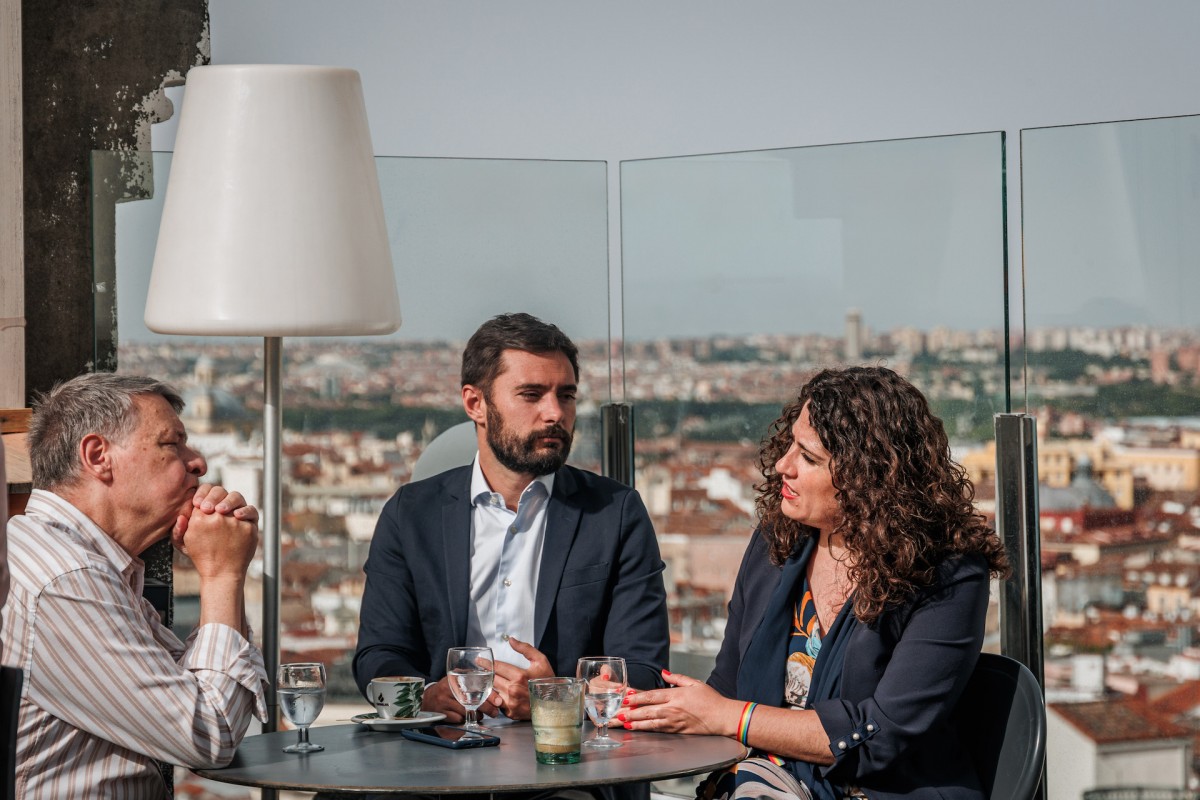
Or the unlocking of the General Council of the Judiciary. Most people say it was time now.
N. C.: To what extent is irritated the public a minority that shouts a lot? There are big extremes that have influenced both central parties. Populism is contagious. Vox and Podemos are two major culprits of the polarization.
Look, when you were minister, you held a fairly hard position from the PP. But it has nothing to do with what is happening now. There were bridges then. The key is bridges.
With Soraya Sáenz de Santamaría, who was the spokesperson, we dined together every month. And with Juanma Moreno we met in the Parliament.
N. C.: As long as there exist two extremist parties, I am very pessimistic. Also, when you drift slightly to the other side, the other party raises its tone and takes more ground.
The question is their mere existence. The PSOE is doing the best, I don’t know if you remember when Pedro Sánchez said he would not pact with either the conservatives or with populists. That was the moment now as the PP has allied with Vox.
Once that journey is complete, Pedro Sánchez can begin to move toward the center.
E. L.: Indeed. And the pact on the General Council of the Judiciary is the first step. We must return to genuine state-to-state pacts, and one key area would be education. Ángel Gabilondo tried and came very close, but…
“Blessed bipartisanship, how well this country did for 43 years with bipartisanship!”
I would be satisfied now with a pact for an emergency plan to clear the waiting lists, for example.
N. C.: The quarrel hasn’t yielded anything good. Do you remember when it was said that we had to end bipartisanship? Oh, blessed bipartisanship, what a good run this country had for 43 years with bipartisanship! The other path has brought caretaker governments, prorogued budgets, quarrels, clashes, and a breakdown of general consensus.
In Spain there are different levels where administration and political relations combine. To what extent do you think there is room to continue advancing to manage problems that are common to a multinational State through multi-level governance?
E. L.: Yes, governance has much more to grow.
N. C.: The foundational principle of generating the autonomous State did not foresee such vertical problems across levels. The autonomous, municipal and state levels are groundwater layers that sometimes run on water and oil, quite distinct and separate from one another.
But there are many problems that will only be solved if they agree.
N. C.: We have not generated the institutional and legal elements of vertical cooperation. This gives rise to these groundwater layers, to the point that Madrid’s City Council can live apart from the autonomous community in public policy. And apart from the state. It’s hard to understand, for example, the housing problem in central Madrid.
E. L.: Now I’m very concerned about the challenge of artificial intelligence within the Administration. It seems one of the major issues, because just as decentralization posed a challenge and some ministries got left behind and found their competencies during crises — think of the Health Ministry during the pandemic — now comes the AI revolution. To what extent is the Administration prepared to absorb the changes to come? Will we be able to maximize its benefits? Will we be able to face challenges in terms, for example, of inequality?
N. C.: In the 2000s we failed to truly ride the digitalisation wave, and now comes the great revolution.
Only looking at whether it replaces public employees isn’t the most relevant issue, though it must be considered. We should analyze how it revolutionizes procedures, controls, etc.
E. L.: As long as we keep having scanned forms.
N. C.: There are administrations not yet connected to a single registry.
E. L.: And suddenly, on top of all that, we’re going to add artificial intelligence.
The question is: should it be pushed by public employees and civil servants or by politicians?
E. L.: Everything done with the help of public officials is a guarantee it will work better. I would create working groups with civil servants, take them to the best places in the world to learn.
N. C.: And with the private sector, which is sensing much more what is coming, its opportunities and risks. The political level is not thinking about it, and the civil service is decades behind, because we’re still dealing with other issues.
“Artificial intelligence is such a big revolution that the legislator will not know how to regulate it”
There is a large private sector that does see it coming, that is starting to apply changes, and there, coordinated work is needed. A revolution is coming so big and so substantial that the legislator will not know how to regulate it nor will the Administration know how to implement it. The public sector must lead the push, drive innovation, and also guarantee rights. A tsunami is coming and it could overwhelm us.
Thank you both very much.

Natalie Foster
I’m a political writer focused on making complex issues clear, accessible, and worth engaging with. From local dynamics to national debates, I aim to connect facts with context so readers can form their own informed views. I believe strong journalism should challenge, question, and open space for thoughtful discussion rather than amplify noise.